Leather Manufacturing
Why Transparent Communication Is Essential in Leather Manufacturing
Poor communication with a factory costs time and money. Learn how clear, transparent processes prevent production errors, align expectations, and build lasting partnerships with your B2B leather goods supplier.
Why Transparent Communication Is Essential in Leather Manufacturing
Choosing a manufacturing partner is one of the most critical decisions a brand founder or sourcing manager will make. While quality, price, and capacity are paramount, they are all underpinned by a single, often-underestimated factor: communication. Without a clear, consistent, and transparent flow of information, even the most promising partnership can result in costly errors, missed deadlines, and damaged trust. Effective leather manufacturing communication isn't a 'nice-to-have'; it is the fundamental system that ensures the design you envision is the product that gets delivered.
From our 25 years on the factory floor, we have seen firsthand what happens when communication breaks down. A simple misunderstanding about a Pantone colour reference can lead to an entire batch of leather bags being produced in the wrong shade. A vague note on a tech pack about 'durable hardware' can result in zippers that fail after six months of use, leading to customer returns and brand damage. These are not hypothetical scenarios; they are the real-world consequences of ambiguous instructions and a lack of proactive dialogue between buyer and factory. For us, building a robust communication framework is as important as maintaining our cutting and stitching machinery.
What “Leather Manufacturing Communication” Actually Means in a Factory
When buyers think of communication, they often picture emails and video calls. While these are components, true leather manufacturing communication is a structured, documented process that integrates directly into the production workflow. It's about translating a creative vision into a set of precise, actionable instructions that can be executed consistently by dozens of hands on the factory floor, from the leather cutter to the quality control inspector.
For us, this means moving beyond simple back-and-forth messaging. It is a system built on several key pillars:
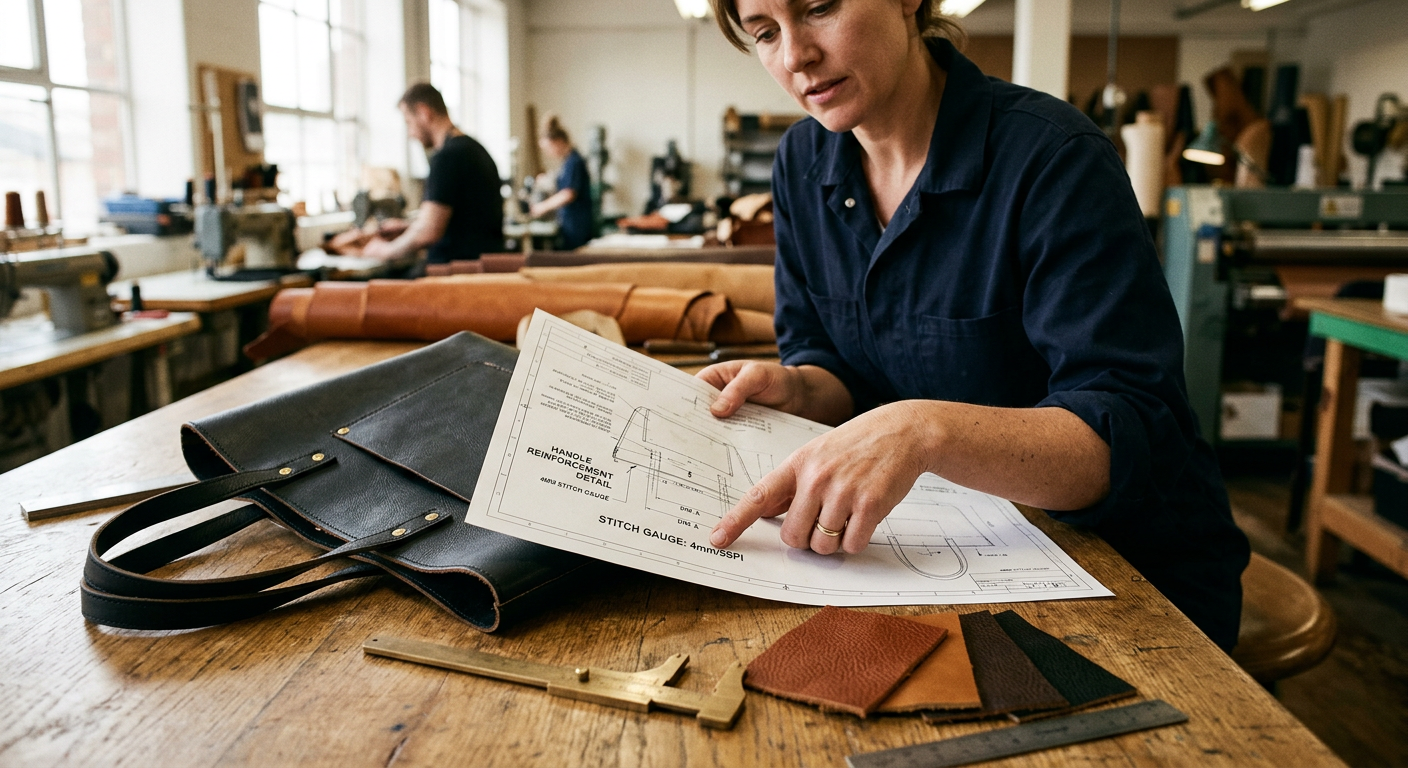
The Tech Pack as the Single Source of Truth: A comprehensive technical package is the bible for any production run. It must go beyond a simple sketch. We expect and work with tech packs that detail every component: leather type and thickness (e.g., 1.2-1.4mm full-grain cowhide), hardware material and finish (e.g., solid brass with PVD coating), thread type and colour (e.g., Gütermann Mara 30, colour matched), and construction details (e.g., turned edges, 10 stitches per inch). When a tech pack is incomplete, our first communication is to ask questions to fill in the blanks, preventing assumptions.
Pre-Production Meetings (PPM): Before a single piece of bulk leather is cut, our production manager, a pattern master, and your dedicated account manager meet to review the approved sample and the tech pack. We discuss potential production challenges, confirm material standards, and clarify any ambiguities. This is the moment to catch a potential issue, like a complex corner that may not wear well over time, and propose a more robust construction method.
The Counter-Sample Loop: A physical sample is the ultimate communication tool. The first sample translates the tech pack into a tangible object. Your feedback—whether it's a request to adjust strap length by 2cm or change the interior lining—is documented and used to create a revised counter-sample. This loop continues until you sign off on a final, approved pre-production sample (PPS) that becomes the gold standard against which every bulk unit is measured.
Work-in-Progress (WIP) Reporting: For larger orders, transparency during the 25-45 day production lead time is crucial. We provide photographic updates at key milestones: upon receipt and inspection of the leather, after the first cutting runs, and during initial assembly. This allows you to see progress and provides peace of mind that the project is on track and adhering to the approved standard.
On the factory floor, this changes everything. Instead of a pattern cutter guessing at a detail, they have a precise schematic. Instead of a stitcher making an aesthetic judgement, they have a stitch-per-inch (SPI) specification to follow. This systematic approach reduces variation, minimises rework, and transforms the manufacturing process from a guessing game into a precise engineering exercise.
Materials, Specs and Standards
Clear communication is most critical when defining technical specifications. Vague terms like 'good quality' or 'durable' are subjective and lead to disputes. We operate on a basis of objective, measurable standards. When we receive your tech pack, we cross-reference it with our internal standards and highlight any areas that require clarification or confirmation. This ensures we are quoting for, sourcing, and producing exactly what you expect.
Here is a sample of the kind of specifications we define with our clients before production begins. This level of detail is a core part of our leather manufacturing communication protocol.
| Specification | Our Standard / Tolerance | Why It Matters |
|---|---|---|
| Leather Thickness | +/- 0.2mm of specified thickness (e.g., 1.4mm +/- 0.2mm) | Ensures consistency in the product's structure, weight, and feel. |
| Stitch Count | +/- 1 stitch per inch (SPI) of specification | Affects both the aesthetic and the durability of the seams. |
| Colour Matching | Delta E < 2.0 against approved Pantone or leather swatch | Guarantees colour consistency across the entire production run. |
| Edge Paint Thickness | 3-5 coats, hand-sanded between coats, for a smooth, rounded finish | Prevents cracking and peeling, a common failure point in poor-quality goods. |
| Hardware Scratch Test | No flaking/peeling after 24hr salt spray test (ASTM B117) | Verifies the durability of plating on zippers, buckles, and studs. |
| Dimensional Tolerance | +/- 3mm on overall bag dimensions; +/- 1mm on wallets | Ensures the final product matches the intended size and proportions. |
| Reinforcement Points | Bar-tacking or back-stitching at all strap and handle joints | Critical for the product's load-bearing capacity and long-term use. |
| HTS Code Confirmation | Agreed upon Harmonized Tariff Schedule code prior to shipment | Prevents costly delays and unexpected duties at customs. For many leather wallets, this is 4202.31. |
Our Process, Step by Step
Our communication process is designed to give you clarity and control at every stage. We assign a dedicated English-speaking account manager to every client, providing a single point of contact from your first enquiry to final delivery.
Initial Enquiry & Quoting (1-2 business days): You send us your tech pack, reference images, or physical sample via our contact form. We review the details and will come back to you within 24 hours, often with clarifying questions about materials or construction, before providing a detailed FOB quote.
Sample Development (10-14 days): Once the quote is approved and the sample fee is paid, we begin creating your first prototype. This involves pattern making, sourcing the specified materials, and initial assembly. We treat sampling as a mini-production run to test the design's manufacturability.
Sample Review & Feedback: We ship the sample to you via express courier (DHL/FedEx). You review it and provide consolidated, documented feedback. Clear notes and photos are immensely helpful here (e.g., "Increase handle drop by 3cm," "Use a lighter-weight lining material").
Counter-Sample/PPS Approval: Based on your feedback, we create a revised sample. Once you are 100% satisfied, you approve this as the Pre-Production Sample (PPS). This PPS is signed, dated, and becomes the 'gold standard' for bulk production.
Deposit & Material Procurement: Upon receiving a deposit (typically 50%), we immediately place orders for the bulk leather, hardware, and lining materials. We inspect all incoming materials against the approved specifications before they are accepted into our inventory.
Bulk Production (25-45 days): Production commences. Our line supervisors use the PPS and the tech pack to manage the cutting, stitching, and assembly teams. We maintain strict quality control throughout the line, not just at the end.
Mid-Production & Final Inspection: We perform an in-line inspection when about 20-30% of the order is complete, and a final AQL (Accepted Quality Limit) 2.5 inspection before packing. We welcome clients or third-party inspectors to be present for this final inspection.
Balance Payment & Shipping Logistics: Upon successful final inspection, we issue the final invoice. Once the balance is settled, our logistics team manages the booking with your freight forwarder. We prepare all necessary export documentation (Commercial Invoice, Packing List, Bill of Lading, Certificate of Origin) for a smooth customs clearance process under FOB Chattogram Incoterms.
MOQs, Lead Times and Pricing Signals
Transparent communication directly impacts the core commercial aspects of your order. Ambiguity creates risk for the factory, and risk is often priced into the quote. By providing clear, complete information, you help us provide a more accurate and competitive price.
Our Minimum Order Quantity (MOQ) is 50 pieces per style, per colour. This is relatively low for the industry and is possible because our production lines are flexible. However, this MOQ is predicated on clear instructions. If a design requires extensive development or has unclear specifications, the time investment can make a 50-piece run unviable. A well-prepared tech pack is the best way to ensure you can benefit from our low MOQ.
Lead times are also a function of communication:
- Sampling: 10-14 days. This clock starts once we have all the necessary information and materials. Delays in clarifying a detail or sourcing an unusual component can extend this.
- Production: 25-45 days. This begins after PPS approval and deposit payment. The 25-day timeline is achievable for simpler items like leather belts or wallets using stock materials. More complex items like structured bags or leather jackets requiring custom-tanned leather will be closer to the 45-day mark. The key is that we provide a realistic timeline upfront based on your specific design.
Your communication also sends pricing signals. A buyer who presents a detailed tech pack, asks specific questions about material options, and provides clear feedback signals professionalism. This tells us you are a serious partner, and we can operate efficiently, allowing for more favourable pricing. Conversely, vague enquiries that require us to guess at specifications often result in higher initial quotes to cover the potential for multiple revisions and unforeseen costs.
We operate on an FOB Chattogram (Chittagong), Bangladesh basis. This means the quoted price includes manufacturing, packing, and delivery to the port of Chattogram. Clear communication ensures we prepare the correct export documents, including the crucial HTS code, to avoid any issues when your shipment is booked by your freight forwarder.
Common Mistakes Buyers Make (And How to Avoid Them)
Over the years, we've noticed recurring communication gaps. Addressing them from the start can save weeks of delays and thousands of dollars.
The Mistake: Providing an incomplete or vague tech pack. Relying on phrases like "high quality leather" or "standard lining."
- The Fix: Be specific. Specify leather type (full-grain, top-grain), thickness (in mm), tannage (chrome, veg-tan), and finish. Specify lining by material (e.g., cotton twill) and weight (in gsm). If you are unsure, ask us for options and we can provide guidance.
The Mistake: Delaying feedback on samples. Receiving a sample and taking two weeks to provide comments stalls the entire project timeline.
- The Fix: Treat sample review as a priority. Allocate time to review it thoroughly as soon as it arrives. Consolidate all feedback from your team into a single, clear document. The faster we get clear feedback, the faster we can move to the next stage.
The Mistake: Making changes mid-way through bulk production. Asking to change a zipper type or thread colour after the materials have been procured and cutting has begun.
- The Fix: Lock down all specifications at the PPS approval stage. The purpose of the sample process is to finalise the design. Mid-production changes cause significant disruption, waste materials, and will incur additional costs and delays. Our custom development programme is built around finalising these details early.
The Mistake: Communicating verbally without written confirmation. Discussing a change on a video call but not following up with an email.
- The Fix: Always follow up any verbal discussion with a written summary. This creates a documented record that both parties can refer to, preventing 'he said, she said' disputes. We will always confirm significant changes in writing.
The Mistake: Not understanding the materials. Specifying a material that is unsuitable for the product's construction (e.g., a very soft lambskin for a large, structured tote).
- The Fix: Lean on our expertise. As manufacturers with deep knowledge of materials, we can provide advice on what works. If you have a specific aesthetic in mind, we can suggest materials and construction techniques to achieve it durably. We see this as a key part of our service.
How to Evaluate a Supplier's Communication
When you are comparing potential factories, you should actively test their communication capabilities. Here is a checklist of what to look for during the initial enquiry and sampling phase:
- Response Time & Quality: Do they respond to your initial enquiry within 24-48 hours? Is the response a generic template, or do they ask intelligent, specific questions about your design? Asking questions is a good sign; it shows they are thinking about manufacturability.
- Clarity of Questions: A good manufacturer will spot ambiguities in your tech pack. Do they ask for clarification on stitch counts, hardware finishes, or material thickness? This demonstrates attention to detail.
- Willingness to Provide Detail: Ask them for their standard tolerances (like the table above). Ask for details about their QC process. A transparent partner will share this information freely. See our own buyer FAQ for examples of the detail we provide.
- Sample Process: Do they have a clear, documented process for sampling and feedback? Do they explain the difference between a prototype, a sales sample, and a pre-production sample?
- Proactive Suggestions: A true partner will offer suggestions for improvement. Do they recommend a more durable construction for a handle attachment or a more cost-effective material that doesn't compromise quality? This shows they are invested in your product's success, not just blindly following orders.
- Single Point of Contact: Do you have a dedicated account manager who speaks your language fluently and understands the technical aspects of production? Being passed between departments is a red flag for disorganised communication.
Ready to move from research to samples? Send us your tech-pack or reference image and we'll come back within 24 hours with materials, MOQ and an FOB quote. Request a quote →
Case Snapshot: Solving a Hardware Crisis for a UK Brand
Last year, a growing UK-based online retailer approached us to produce a run of 750 units of a complex, multi-pocket leather backpack. Their tech pack was excellent, specifying a custom-designed 'gunmetal' finish for all zippers and buckles. During our PPM, we reviewed the hardware supplier's samples and noted a slight inconsistency in the finish compared to the client's approved master sample. Instead of proceeding and hoping the client wouldn't notice, our account manager immediately paused the hardware order and sent a detailed email to the buyer. This included high-resolution photos showing the variation under different lighting conditions and a short video explaining the potential for inconsistency across the batch.
We proposed two solutions: 1) Stick with the current supplier but accept a slightly wider tolerance on the finish, with a 5% cost reduction, or 2) Switch to a premium hardware supplier from Japan, which would add $1.20 per unit to the cost but guarantee a perfect match. The client, appreciating the transparency, chose the second option. This proactive communication added only four days to the material procurement timeline but prevented a potentially disastrous quality issue that could have led to the rejection of the entire order. The shipment was delivered on time, and the client praised our honest approach, citing it as the reason they placed a larger re-order for the following season.
Frequently Asked Questions
How does clear communication affect my price?
Clear, detailed communication reduces our risk and uncertainty. When we receive a comprehensive tech pack, we can quote more accurately and competitively because we don't have to build in a buffer for potential rework or multiple sample rounds. A well-prepared brief allows us to operate more efficiently, and we pass those savings on to you. Ambiguity, on the other hand, forces us to price in the risk of the unknown.
What if I don't have a professional tech pack?
That is not a barrier to working with us. Many successful brands, especially newer ones, start with a detailed sketch, reference photos, or a physical product they want to adapt. Our role then becomes collaborative. We will work with you to build out the technical specifications, asking the right questions to fill in the gaps and formalise your idea into a production-ready tech pack. This is a core part of our custom / OEM service.
How are samples handled and priced?
Samples are typically charged at 2x-3x the bulk production price per unit, plus shipping. This covers the higher cost of pattern making, individual material sourcing, and the focused time of our most skilled craftspeople. The sample fee is often credited back against your bulk order deposit if you proceed with an order above a certain quantity (e.g., 250 units). The entire process is managed by your dedicated account manager to ensure your feedback is perfectly implemented.
What does FOB Chattogram mean for me as a buyer?
FOB (Free On Board) Chattogram means our price includes the cost of the product, its export packaging, and transport to the port of Chattogram, Bangladesh, including clearing the goods for export. Your responsibility is to hire a freight forwarder to manage the ocean or air freight from Chattogram to your destination port, as well as handling customs clearance and any duties/taxes in your country. We provide all the necessary documentation to your forwarder for a smooth process.
How do you ensure quality during production if I cannot visit the factory?
This is where our communication protocol is vital. We provide work-in-progress (WIP) photos at key stages. Most importantly, we conduct a rigorous final inspection based on the AQL 2.5 standard, checking against the approved PPS. We create a detailed inspection report with photos and share it with you before the shipment is packed. We also fully welcome third-party inspection services like SGS, Intertek, or Bureau Veritas, and will facilitate their visit to our factory on your behalf.
Next Step
Effective leather manufacturing communication is the bedrock of a successful and profitable partnership. It transforms the buyer-supplier relationship from a simple transaction into a collaborative effort to create exceptional products. We have built our factory's reputation on this principle for over two decades.
If you are looking for a manufacturing partner who prioritises clarity, transparency, and precision, we invite you to put our process to the test. Send us your project details to begin the conversation. We're ready to show you how great communication leads to great leather goods, whether you're developing a new line of leather bags or perfecting your existing collection. Please request a quote to get started.
Ready to manufacture
Request a quote from TAT Manufacture
Full-grain leather, low MOQ from 50 pcs, OEM & private label. Get a detailed itemised quote within 24 hours.
25 years of leather manufacturing craftsmanship.
Services →OEM, private label, and custom leather production.