Buying Guide
Why Prototype Testing Matters Before Launching a New Leather Collection
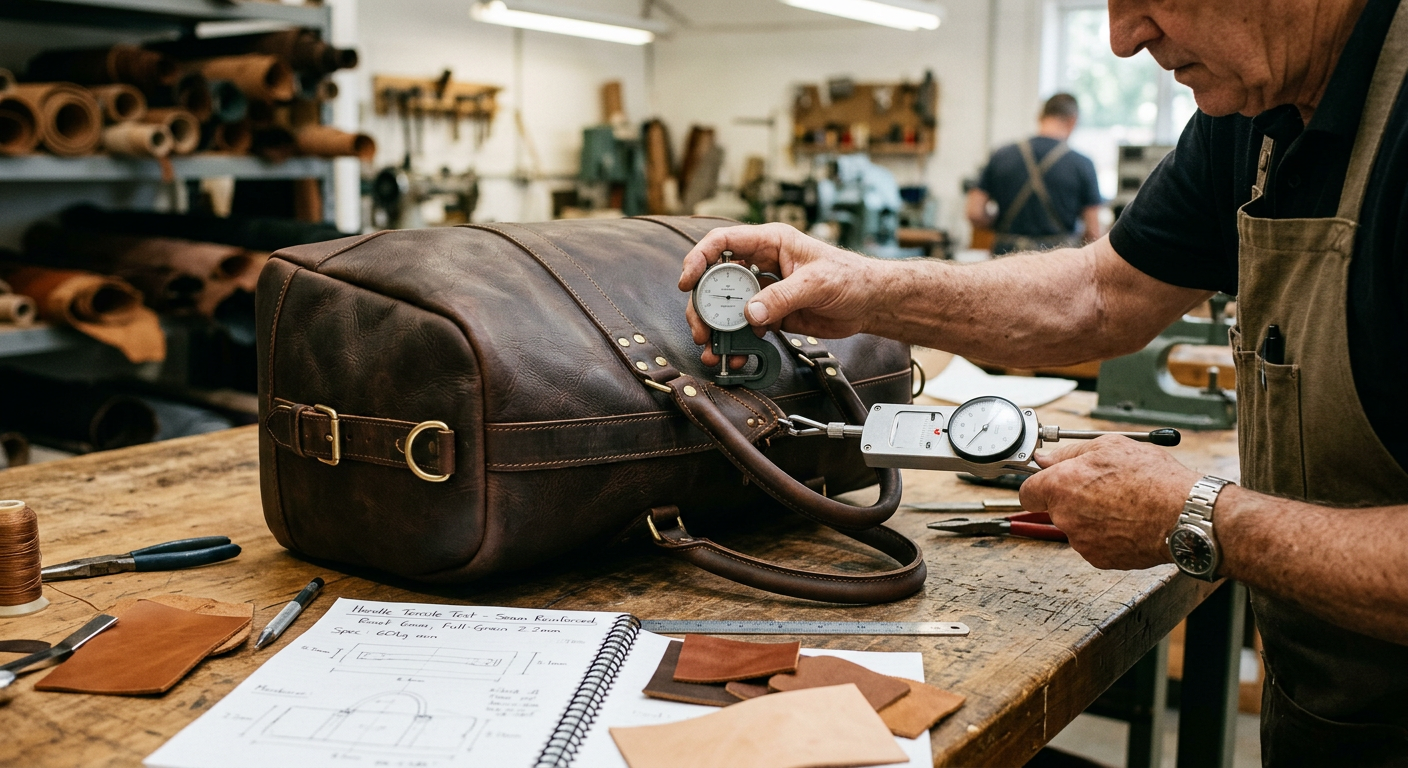
Discover how testing prototypes helps brands avoid expensive product failures after launch. Explore factory stress tests, load tolerances, and technical validation.
The buyer's problem
When a fashion label or commercial distributor commits capital to a production run, the greatest liability sits inside the gap between a design render and a manufactured unit under real load. Many brand founders and procurement heads review an aesthetic counter-sample, assess the hand-feel, verify the hue under showroom lights, and immediately approve bulk production. Three months later, after freight arrives in European or North American distribution hubs, end-customers report edge-paint delamination, handles ripping out of gussets under standard commuter weight, or pullers shearing off zips under mild torque.
Resolving post-delivery manufacturing failures erodes gross margins overnight. Returns handling, reverse logistics, freight write-downs, and customer churn can collapse an emerging line before it attains commercial velocity. Rigorous leather prototype testing during the pre-production phase separates viable commercial collections from costly product recalls. When vetting production facilities, experienced sourcing directors scrutinise how an OEM partner validates physical mechanics, chemical limits, and hardware resilience before a clicker press cuts a single production hide.
What "leather prototype testing" actually means in a factory
On a production floor, prototyping is not an exercise in visual styling. It is an engineering validation phase designed to isolate points of failure under mechanical stress, environmental friction, and repetitive handling. When we build samples in our custom manufacturing programme, an aesthetic prototype serves only as Step One. Once the aesthetic profile and silhouette align with tech-pack geometry, the sample must clear rigorous functional testing.
Factory-level testing changes how our sample makers and cutting masters approach their work:
- Tensile and Seam Shear Testing: Technicians mount joined leather panels into mechanical pull gauges. This measures stitch-tear resistance along needle perforations, ensuring selected thread weights (such as bonded nylon or braided polyester size 40 versus size 20) do not slice the grain layer under tension.
- Cycle Testing for Moveable Parts: Hardware assemblies, zipper tapes, snaps, and magnetic closures undergo repetitive cycling. A zipper slider must travel along teeth hundreds of cycles without misalignment; dog-hooks on removable shoulder straps must operate under spring tension without pin failure.
- Edge Finish Adhesion and Flexibility: Edge paint formulas must flex alongside the temper of the leather. Our workshop flexes painted edge margins across varied temperatures to confirm the polyurethane edge coat does not crack, bubble, or detach from dense vegetable-tanned hides or oily pull-up leathers.
- Dynamic Load and Drop Testing: Finished prototypes, such as structured leather backpacks or work totes, are packed with target weight plus a 50% safety margin and hoisted by their top handles on dynamic drop jigs to confirm rivet anchors, internal webbing reinforcements, and box-X stitching hold firm.
- Rub Fastness and Colour Migration: Using standard crockmeter pads in both dry and wet conditions, sample makers scrub dyed hides across hundreds of rotations against light fabrics to ensure topical aniline or semi-aniline finishes do not transfer onto a customer's wool coat or raw denim.
Materials, specs and standards
Commercial-grade leather goods demand distinct mechanical thresholds depending on their functional class. A structured cardholder needs stiff board reinforcement and tight stitch tolerances, whereas heavy duffles require high tensile ratings and corrosion-resistant metalwork. During leather prototype testing, we measure raw materials and assembled panels against precise quantitative standards before signing off on full bill-of-materials procurement.
Below are standard mechanical specifications, test references, and factory pass/fail tolerances applied during our sampling rounds:
| Component / Property | Industry Test Method | Target Standard / Tolerance | Typical Failure Mode Identified in Testing |
|---|---|---|---|
| Leather Tensile Strength | ISO 3376 / ASTM D2209 | ≥ 15 N/mm² (Upper Leathers) | Grain tearing along dense stitch lines |
| Seam Burst Strength | ISO 13935-2 / ASTM D1683 | ≥ 180 N per 25mm seam | Thread rupture; needle hole elongation |
| Dry / Wet Crockfastness | ISO 11640 (Veslic) | Dry: 4-5 Grey Scale (500 cycles); Wet: 3-4 (100 cycles) | Pigment transfer to white canvas test cloth |
| Hardware Salt Spray | ASTM B117 / ISO 9227 | 24 to 48 hrs exposure (No white/red rust) | Zinc alloy pitting; electrolytic plating peel |
| Zip Chain Lateral Strength | BS 3084 / ASTM D2061 | ≥ 600 N (Size #5 Metal / Coil) | Teeth pulling out of polyester tape under load |
| Handle Jolt / Dynamic Drop | In-House / QB/T 2155 | 5,000 cycles with 8 kg load (Zero tear) | Rivet pull-through; d-ring pin deformation |
| Flex Resistance (Finish) | ISO 5402-1 (Bally Flex) | 50,000 flexes dry (Zero cracking) | Micro-cracks on micro-pigmented grain coating |
Verifying these values on raw hides and prototype sections prevents systemic field failures across large shipments of leather bags or small leather goods. We document these tolerances across every technical sign-off stage.
Our process, step by step
Systematic engineering reduces commercial risk. At our production facility, where we draw upon 25 years of leather goods manufacturing expertise detailed in our factory overview, we guide overseas buyers through a 9-step pathway from concept validation to container loading.
- Tech-Pack and Spec Review: You submit production blueprints, vector files, reference dimensions, leather weight specifications (in millimetres or ounces), lining choices, and hardware finishes. We assess design feasibility, internal reinforcement schemes, and cut-yield ratios within 24 hours.
- Raw Material Sourcing and Tanning Allotment: We match your target feel, temper, and oil content with audited tanneries. Hides are inspected for substance uniformity, thickness tolerances (±0.1 mm), and base surface cleanliness.
- Pattern Engineering and Tooling: Pattern makers produce cardboard or digital CAD profiles. If custom zinc-die cast hardware or embossed logo brass dies are required, we commission the tooling during this stage.
- First Prototype Assembly (Proto 1): Master artisans cut and assemble a baseline unit by hand. This prototype checks proportion, opening ergonomics, weight distribution, and internal pocket clearances.
- Technical Stress and Prototype Validation: The initial sample undergoes functional leather prototype testing. Handles endure dynamic drops, zips run through cycle jigs, and leather swatches enter Veslic rub and Bally flex testing. Weak points are documented with high-resolution photography.
- Engineering Counter-Sample (Proto 2 / Red Seal): We adjust patterns based on failure points—adding internal non-stretch microfibre tapes, heavier gauge thread, or thicker backing boards. The refined counter-sample is shipped via express courier to your team for formal sign-off.
- Pilot Pre-Production Batch: Once you approve the Red Seal counter-sample, our clicker presses and skiving departments prepare pilot components. We cut dies, confirm split balances, and produce a small control run to train line operators.
- Full Bulk Production: After pilot approval, bulk assembly proceeds across dedicated lines for skiving, edge staining, assembling, gluing, stitching, and hardware setting, supervised by quality managers.
- End-of-Line Quality Assurance and Packaging: Finished goods are checked against approved golden samples, packed with moisture-absorbing silica pouches, boxed in heavy corrugated cartons, palletised, and transferred to the port for customs clearance.
MOQs, lead times and pricing signals
We structure our operations to support independent labels, mid-market retailers, and corporate buyers seeking manageable balance sheet exposure without sacrificing factory-direct pricing.
- Minimum Order Quantity (MOQ): Our production baseline starts at 50 pcs per style/colourway. This allows emerging and established collections to test varied SKUs—such as complementary leather wallets and larger travel items—without over-committing raw materials.
- Sampling Lead Times: Proto 1 and counter-sample development typically runs 10 to 14 days from tech-pack confirmation and raw hide arrival. Custom hardware development (mould opening) adds roughly 7 to 10 days.
- Production Lead Times: Bulk runs require 25 to 45 days, depending on total piece volume, complexity of internal organisers, and tanning cycles for custom-dyed hides.
- Shipping Terms & Port: Quotations are provided on an FOB Chattogram (Bangladesh) basis. Chattogram provides direct container shipping routes to major international distribution terminals across Europe, the UK, the Middle East, and North America. Air-freight options via Dhaka (DAC) are readily available for rapid sample dispatches or expedited pilot runs.
When evaluating quotes, watch out for abnormally low prices from suppliers who gloss over technical sample validation. If an offshore supplier offers a price per unit that undercuts the baseline cost of certified hides and high-tensile hardware, they are usually trimming costs inside hidden components: substituting real reinforcement boards with scrap cardboard, using brittle cast zinc hardware prone to snapping, skipping edge priming layers, or using unbonded thread that rots under humidity.
Common mistakes buyers make
Over decades of manufacturing leather goods, we have observed overseas buying departments repeat structural errors that undermine production outcomes. The following issues can be avoided with disciplined sampling:
- Signing off on looks alone: Approving a pre-production sample because it looks pristine on an office mannequin, without loading it with its intended working weight. The fix: Pack every sample with real-world contents—laptops, chargers, documents, water bottles—and carry it daily for a week. Inspect stress points, handle comfort, and corner wear.
- Ignoring backing reinforcements: Focusing solely on outer leather grades while neglecting the internal interlinings (salpa, texon board, microfibre sheets, or EVA foam). The fix: Request cross-section cutaways or build-sheet specifications from your factory that detail how handle bases, flap anchors, and zipper margins are internally reinforced.
- Over-skiving critical attachment margins: Demanding paper-thin edges across external seams to reduce silhouette bulk, which strips the grain layer of its structural strength. The fix: Require your factory to maintain at least 0.8 mm to 1.0 mm substance on load-bearing structural seams, reinforcing skived margins with high-tensile non-stretch tapes.
- Overlooking hardware metallurgy: Specifying cheap, lightweight pot-metal alloys that crack under sudden side loads rather than solid brass or high-grade zinc alloy. The fix: Insist on verified pull-force ratings on D-rings, swivel clips, and buckles, and audit hardware with salt-spray testing if your target market covers coastal or humid zones.
- Changing materials between sampling and bulk: Testing a prototype built with vegetable-tanned hides, then switching the bulk order to chrome-tanned or pull-up hides to cut costs without re-sampling. The fix: Any change in raw tannage requires fresh leather prototype testing, as tensile strength, elongation, temper, and adhesive bonding properties vary dramatically between tannages.
- Failing to define clear pass/fail tolerances: Relying on vague terms like "clean stitching" in supply agreements instead of quantifiable numbers. The fix: Specify exact tolerances: stitches per inch (SPI, typically 6–8 for workbags), edge-paint thickness, and stitch-edge margins (e.g., 2.0 mm ±0.2 mm).
How to evaluate a supplier for this
Not every facility that claims OEM capability possesses the technical discipline to conduct structured mechanical validation. When vetting a potential leather manufacturer, look beyond showroom displays and inspect their engineering practices. Use this checklist during factory inspections or video audits:
- Do they run an independent sampling workshop? Verify whether samples are assembled by standard line operators or dedicated pattern engineers who understand how leather temper changes across distinct hide sections (bends, shoulders, bellies).
- Can they show internal physical testing equipment? Ask to see their tensile strength gauges, Bally flex testers, crockmeters, or drop-test rigs. If they outsource all testing, check their documentation trail for third-party lab reports.
- How do they track component revisions? Ask to inspect their counter-sample tagging protocol. Professional factories use physical Red Seal tags, numbered spec-sheets, and pattern revision logs to prevent out-of-date patterns from reaching the production floor.
- Do they audit inbound materials? A quality factory tests raw material lots as they arrive from the tannery, checking thickness tolerances with dial gauges and rub fastness on random cuts before cutting panels.
- What is their non-conformance policy? Clarify how the factory handles a component that fails load tests during sampling. A reliable supplier identifies the issue, suggests construction alternatives, and produces an updated counter-sample rather than shipping questionable assemblies.
Ready to move from research to samples? Send us your tech-pack or reference image and we'll come back within 24 hours with materials, MOQ and an FOB quote. Request a quote →
Case snapshot
An independent luxury travel accessories brand based in Melbourne, Australia, approached us to manufacture an oversized weekender duffle bag and a matching line of leather belts. Their initial production attempt with an offshore supplier had resulted in a 14% return rate across their domestic market; customer duffles were failing at the strap anchor points, where rivets tore through 1.2 mm chrome-tanned leather under 12 kg loads.
We re-engineered the bag's foundational geometry. Our sampling shop introduced a multi-layered load distribution system inside the gusset: a 0.6 mm non-stretch synthetic microfibre layer sandwiched between the outer hide and cotton twill lining, supported by an internal cross-box stitch pattern using 3-ply bonded nylon thread.
During prototype testing, the re-engineered anchor held without deformation up to 32 kg on our dynamic drop rig across 3,000 continuous cycles. The buyer approved the revised Red Seal sample within 12 days. We delivered a bulk initial order of 300 duffles alongside 400 belts on FOB terms within 38 days. Over the subsequent 18 months of retail distribution across Australasia, their field return rate dropped to zero, protecting brand equity and operational margin.
Frequently asked questions
How much does prototype development cost, and is it credited toward bulk production?
We charge an initial sample development fee that covers pattern engineering, single-unit cutting, edge finishing, and material setup. This fee typically ranges between 1.5x to 2.5x the estimated bulk unit cost, depending on the need for custom hardware moulds or brass embossing dies. When you proceed with a production order that meets our 50 pcs MOQ per style, this sample fee is credited back against your final bulk invoice balance.
How long does sample development take from tech-pack submission?
For standard designs using hides available in our current tannery stock, proto turnaround runs 10 to 14 days. If your product requires custom Pantone-matched leather tanning, specific drum-dyed colour lots, or custom hardware casting, the timeline extends by approximately 7 to 10 days to allow for tooling and lab-dip colour confirmations.
What specific equipment does your factory use to stress-test leather goods?
Our internal quality assurance process relies on calibrated mechanical gauges. We use Veslic and crockmeter friction testers for rub and pigment migration, Bally flexometers to evaluate finish longevity on folds, standard tensile pull benches for seam and rivet shear ratings, and dynamic cycle drop rigs. We run hardware parts through salt-spray cabinets when buyers require export compliance for marine or tropical markets.
Can we supply our own hardware and custom leathers for prototype testing?
Yes. While we maintain reliable partnerships with established tanneries and metal suppliers across our domestic base and international hubs, we regularly accommodate client-supplied materials (CMT). We can receive your custom Italian hides, specialised Swiss zips, or proprietary alloy hardware at our workshop, document receiving inspections, integrate them into prototypes, and subject them to the same mechanical testing standards.
How do you handle quality control between the approved prototype and bulk assembly?
We rely on a strict "Golden Sample" (or Red Seal) protocol. When you approve the final prototype, two identical units are signed off: one remains in your design office for inbound delivery auditing, and the other is tagged and held on our shop floor. Line supervisors and roaming inline QC auditors inspect cut hides, sub-assemblies, and final stitch lines against this master sample at five distinct production stages.
What shipping terms do you operate under for bulk production?
Our standard commercial pricing operates on an FOB Chattogram basis under Incoterms 2020. This covers inland transit, handling, and export customs clearance at the Port of Chattogram. We also coordinate with your nominated freight forwarders to manage ocean shipping (LCL or FCL) or arrange expedited air-freight out of Hazrat Shahjalal International Airport in Dhaka (DAC) if your marketing launch dates require urgent delivery.
Next step
Avoid launching a collection on guesswork and cosmetic samples alone. Review our commercial build capabilities across our structured leather bags catalogue, and consult directly with our technical team to schedule your initial sample run. Submit your tech-pack or structural references directly through our team via our inquiry and quote portal to receive a detailed cost breakdown and testing plan within 24 hours.
Ready to manufacture
Request a quote from TAT Manufacture
Full-grain leather, low MOQ from 50 pcs, OEM & private label. Get a detailed itemised quote within 24 hours.
25 years of leather manufacturing craftsmanship.
Services →OEM, private label, and custom leather production.