Leather Manufacturing
Why Production Capacity Matters More Than Factory Size
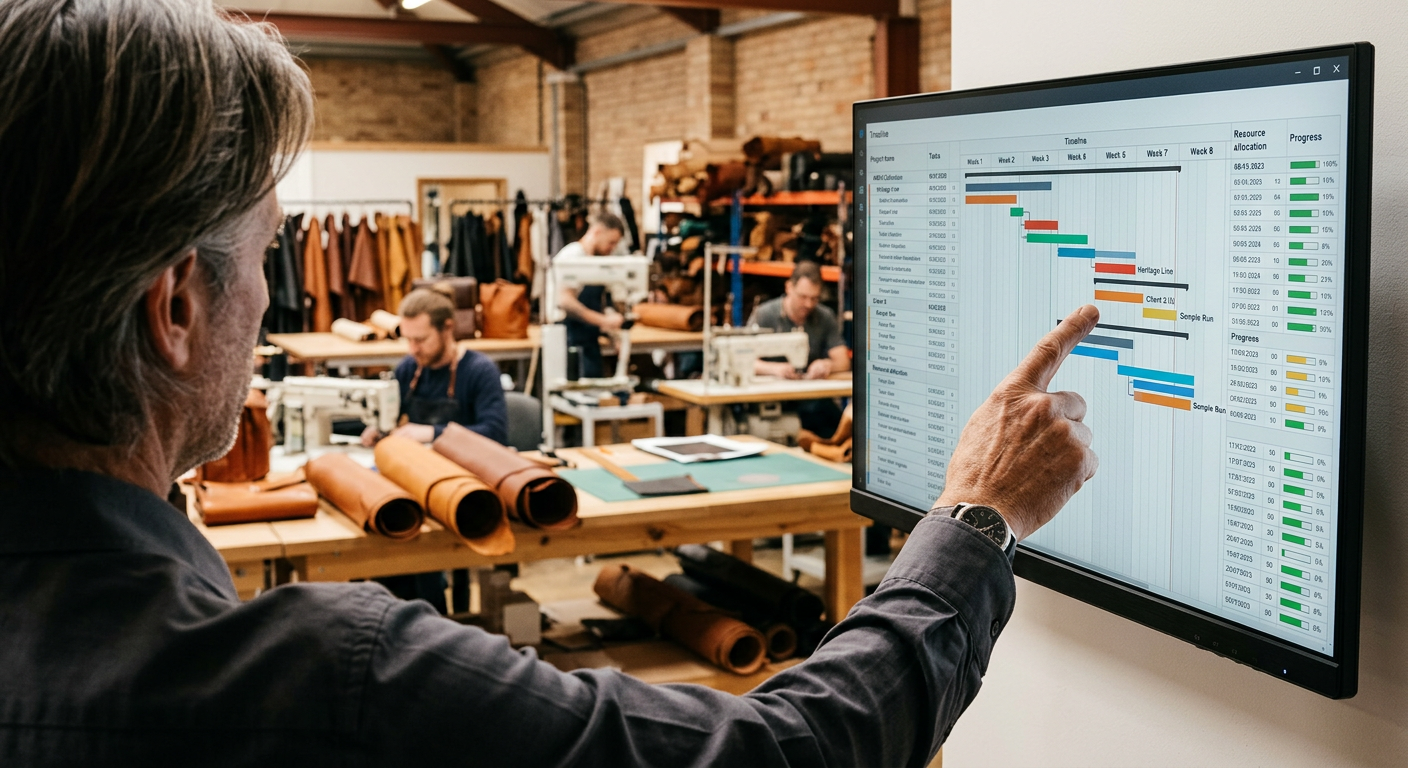
Don't be misled by a factory's square footage. True reliability comes from well-managed production planning. Learn how genuine leather factory capacity impacts your order's quality and timeline.
The buyer's problem
As a buyer, brand founder, or sourcing manager, you are constantly evaluating risk. One of the most common mistakes we see is equating a factory's physical size with its ability to deliver your order on time and to specification. A prospective client might tour a sprawling facility, be impressed by the sheer scale, and sign a contract, only to find their 500-piece order is constantly delayed. Why? Because the factory is optimised for 50,000-piece runs for global mega-brands, and smaller orders are perpetually pushed to the back of the queue.
Conversely, a smaller, more organised factory might be overlooked, yet it could be the perfect partner. The real measure of a supplier's reliability is not its square footage, but its leather factory capacity—a metric of how efficiently it can plan, execute, and deliver a specific volume of goods to a consistent quality standard within a promised timeframe. Misjudging this can lead to missed seasonal deadlines, cash flow problems, and damage to your brand's reputation with its end customers.
What “leather factory capacity” actually means in a factory
When we talk about leather factory capacity, we are not discussing the maximum number of bags we could theoretically produce if every machine ran 24/7. That is a vanity metric. True, usable capacity is a dynamic figure determined by several interconnected factors on the production floor.
First is production line configuration. At TAT Manufacture, we operate dedicated and semi-dedicated lines. A line set up for producing structured leather wallets has different machinery, jigs, and worker skills than one configured for assembling large, unlined tote bags or complex leather jackets. Our capacity for wallets is therefore independent of our capacity for jackets. A factory that uses the same general-purpose lines for all products will struggle with efficiency and quality control when switching between vastly different items.
Second is labour skill and allocation. Capacity is directly tied to the number of skilled artisans and machine operators available. More importantly, it depends on how they are managed. We use a production planning system that maps out every order, allocating teams based on their specific expertise—be it in precision cutting, complex stitching, or edge finishing. This prevents bottlenecks. If our edge-painting station is a known constraint, we schedule work to ensure it is fed at a steady pace, never overwhelmed or left idle.
Third is workflow efficiency. This is the most critical element. Our production floor is designed for a logical flow of materials, from the leather store, through cutting, skiving, preparation, assembly, finishing, quality control, and finally to packing. We measure our output not just in total units per month, but in lead time from material-in to product-out. By minimising wasted movement and downtime, we maximise our actual throughput. A larger factory with a chaotic layout and poor workflow can easily have a lower effective leather factory capacity than a smaller, more organised facility like ours.
Finally, it includes supply chain integration. Our capacity is also a function of how quickly we can receive, inspect, and prepare raw materials. We maintain strong relationships with tanneries and hardware suppliers, giving us predictable delivery schedules that feed directly into our production planning. This holistic view—from raw material to finished goods—is the essence of managing capacity effectively.
Materials, specs and standards
High production capacity is meaningless if it results in a high defect rate. The two must be linked by rigorous quality standards, which are defined in the tech pack and pre-production sample (PPS) and then enforced on the factory floor. Our ability to promise a 25-45 day lead time is predicated on the fact that we have established tolerances for every step. This prevents time-consuming rework and rejections.
For example, when we receive an order for a leather tote bag, our planning accounts for the specific type of leather. A soft, full-grain aniline leather requires more careful handling and has different cutting yields than a stiff, pigmented split leather. These material properties directly impact the time required per unit and, therefore, our daily capacity for that specific product line.
We adhere to client-specified standards and, where none are provided, our own internal benchmarks which are based on 25 years of manufacturing experience. These standards are not just goals; they are integrated into our workflow with inline quality checks at critical stages. A batch cannot move from stitching to finishing, for instance, until the Stitch Per Inch (SPI) and seam integrity have been verified against the approved sample.
Here are some of the typical specifications we work with:
| Specification | TAT Manufacture Standard / Tolerance |
|---|---|
| Stitch Per Inch (SPI) | 8-10 SPI for bags; 10-12 for wallets (or as per spec) |
| Leather Thickness | ±0.2mm of specified thickness (e.g., 1.2-1.4mm) |
| Edge Paint Application | 3-5 layers, hand-sanded between layers, no cracking |
| Colour Fastness (Crocking) | Grade 4-5 on dry rub, Grade 4 on wet rub (ISO 105-X12) |
| Hardware Plating | 48-hour neutral salt spray test for anti-corrosion |
| Seam Allowance | ±1mm of tech pack specification |
| Final AQL Standard | Level II, 2.5/4.0 unless otherwise specified by buyer |
| HTS Code Compliance | We ensure products are correctly described for codes (e.g., 4202.21) |
Our process, step by step
Our production process is designed for clarity, transparency, and predictability. This systematic approach is how we manage our leather factory capacity and give you confidence in our delivery schedules. From your first enquiry to final shipment, this is how we work together:
Enquiry and Quoting: You send us your tech pack, reference images, or physical samples. Within 24-48 hours, our team reviews the specifications, assesses material and construction complexity, and provides an initial FOB quote and estimated lead time. We may ask clarifying questions to ensure our quote is as accurate as possible.
Material Sourcing and Confirmation: Upon your initial approval, we source the exact leather, lining, and hardware required. We send you swatches or component samples for your physical approval before any production begins.
Pre-Production Sampling (PPS): Once materials are confirmed, we create a complete pre-production sample. This is an exact replica of what will be mass-produced. This stage typically takes 10-14 days. This sample is your opportunity to test the product and make final adjustments.
Sample Approval and Order Confirmation: You receive the PPS. You either approve it for production or provide consolidated feedback for a final revision. Once the PPS is approved, you issue a Purchase Order (PO) and we finalise the production schedule.
Production Planning and Allocation: With the approved PPS and PO in hand, your order is formally entered into our production schedule. We allocate a specific production line, team, and timeframe. This is the crucial step where your order secures its slot within our factory's capacity.
Cutting, Skiving and Preparation: Our cutting department uses your approved patterns to cut the leather panels—either by hand for intricate designs or with hydraulic presses for standard components. Edges are skived to the correct thickness for clean seams and folds.
Assembly and Stitching: The prepared components move to the assembly line. Our artisans stitch the product according to the approved sample, with inline quality supervisors checking work at key stages to catch any deviations early.
Finishing and Final QC: After assembly, products go to the finishing department for edge painting, hardware attachment, cleaning, and final touches. Every single unit then undergoes a final, rigorous quality control inspection against the approved PPS and your AQL standards.
Packing and Labelling: Approved items are packed according to your specifications, including individual polybags, hangtags, carton labels, and master carton markings. This ensures they arrive at your warehouse protected and ready for distribution.
Logistics and Documentation: We transport the packed consignment to the port and handle all export documentation for shipment on FOB Chattogram Port (IATA: CGP) terms. We provide you with a copy of the Bill of Lading and other necessary shipping documents so your freight forwarder can manage the import process on your end.
MOQs, lead times and pricing signals
Our operational structure is intentionally designed to serve small-to-medium-sized brands, importers, and retailers who require high-quality products without committing to enormous volumes. Our numbers reflect this philosophy.
Minimum Order Quantity (MOQ): Our standard MOQ is 50 pieces per style, per colour. This is the minimum quantity required to achieve production efficiency. It allows us to buy materials without excessive surcharges, set up a dedicated production team for your specific product, and minimise waste. For an order smaller than this, the setup time becomes disproportionately high, driving up the per-unit cost significantly.
Lead Times: We operate on a clear, two-phase timeline:
- Sampling: 10-14 days from confirmation of materials.
- Bulk Production: 25-45 days from approval of the pre-production sample (PPS) and receipt of your Purchase Order. The exact duration within this range depends on the order quantity and complexity of the item.
These are realistic lead times. We would rather give you an achievable date than an optimistic one we cannot meet. This 25-45 day window allows for sourcing, production, and our multi-stage QC process without rushing any step, which is how we maintain quality.
Pricing Signals: As a buyer, you should view a prospective supplier's price as a signal of their operational reality. An unusually low price can be a red flag. It may indicate a factory that is desperate for work and will over-promise on its capacity, is cutting corners on materials or compliance, or is using unsustainable labour practices. Our pricing is calculated based on real costs: A-grade leather, quality hardware, skilled labour wages, and a methodical production process. We provide a fair price for a reliable service, ensuring we are a sustainable partner for your brand's growth.
Shipping Terms: We ship on FOB Chattogram Port, Bangladesh terms. This means the quoted price includes the cost of the goods and all expenses to get them loaded onto the vessel at the port. You are responsible for arranging and paying for the main sea/air freight, insurance, and all import-related costs in your country.
Common mistakes buyers make
Evaluating a factory on its production capacity is nuanced. We often see new buyers make the same handful of preventable mistakes. Here is what to watch out for:
Mistake: Focusing only on the quoted price.
- The Fix: Treat pricing as one part of the puzzle. A slightly higher price from a factory with a proven record of on-time delivery and low defect rates offers far better value than a low price that results in delayed shipments and lost sales.
Mistake: Equating factory size with suitability.
- The Fix: Ask targeted questions about their production planning for orders of your size. A large factory might be impressive, but are they organised to handle a 200-piece order with the same care as a 20,000-piece one?
Mistake: Providing a vague or incomplete tech pack.
- The Fix: A detailed tech pack with clear drawings, measurements, material specs, and hardware details is the single best tool you have. It allows us to quote accurately and, more importantly, to plan production capacity precisely. Vague specs lead to guesswork, delays, and sample revisions.
Mistake: Rushing the sample approval process.
- The Fix: The pre-production sample is your golden sample. Scrutinise it. Test it. Do not give approval until it is perfect. Requesting changes after production has started is the number one cause of major delays and will invalidate any initial lead time estimate.
Mistake: Not clarifying communication channels and frequency.
- The Fix: Before placing a PO, agree on a communication plan. Who is your single point of contact? How often will you receive updates? A factory that proactively manages its capacity will be able to give you regular, honest updates.
Mistake: Ignoring the factory's specialisation.
- The Fix: Ask a factory for examples of products they have made that are similar to yours. A factory that specialises in heavy-duty leather backpacks may not be the best choice for delicate, fine-edged clutches, and vice-versa. Their true capacity lies within their area of expertise.
Ready to move from research to samples? Send us your tech-pack or reference image and we'll come back within 24 hours with materials, MOQ and an FOB quote. Request a quote →
How to evaluate a supplier for this
When you are comparing potential manufacturing partners, move beyond the surface-level questions. To truly understand a supplier's leather factory capacity and its suitability for your brand, use this checklist:
Ask About Their Production Planning System: Don't just ask for their total capacity. Ask how they plan. Do they use software? A Gantt chart? A simple spreadsheet? Ask them to walk you through how a new order of your size would be integrated into their current schedule. A confident answer indicates a well-managed system.
Request a Virtual Tour Focused on Workflow: During a video call or a visit to our factory gallery, ask to see the flow of work. Does the layout look logical? Is it clean and organised? Look for signs of efficiency, like neatly arranged components at workstations, rather than chaotic piles. Organisation is a direct indicator of managed capacity.
Inquire About Current and Future Loading: Ask them, "What percentage of your capacity is currently booked for the next three months?" and "How much capacity do you keep in reserve for urgent orders or potential delays?" A factory that is running at 110% capacity is a factory that cannot handle any unexpected problems. We aim to run at 80-85% to ensure we have a buffer.
Discuss Their Specialisation and Experience: Show them your product. Ask, "What is your experience making items like this? Do you have dedicated machinery or teams for this type of construction?" A factory’s true capacity is highest for the products it knows best, like our dedicated lines for leather bags and small leather goods.
Pose a Hypothetical Scenario: Give them a real-world test. "If we approve a sample for 500 leather totes on March 1st, what is your guaranteed ex-factory date?" Cross-reference their answer with their stated 25-45 day lead time. A specific, confident answer is a good sign.
Assess Their Communication During Quoting: The initial inquiry phase is a test. How quickly, clearly, and professionally do they respond? Are their questions intelligent and aimed at clarifying ambiguity? This early communication is a strong predictor of how they will communicate when your order is in production.
Case snapshot
A start-up brand from Munich, Germany, approached us after a difficult first year with another supplier. Their product line consisted of minimalist, high-quality leather backpacks and matching wallets, targeting the premium urban commuter market. Their previous factory was a massive operation in Asia, and while they were capable of excellent quality, the brand’s orders of 200-300 units were considered insignificant. They faced constant communication blackouts and their delivery dates were pushed back three times, causing them to miss the critical Christmas sales season. Their small order was simply not a priority for a factory built for mega-runs.
Frustrated, they contacted us. We started with a trial order for 50 backpacks and 50 wallets. Our merchandising team provided daily updates during the 12-day sampling process. The pre-production samples were approved on the first submission. We then scheduled their full 250-piece backpack order, which was completed and shipped FOB Chattogram 35 days later, well ahead of their deadline for the spring collection launch. The key difference was not size, but focus. Our managed leather factory capacity was perfectly aligned with their needs as a growing brand. They now have a predictable supply chain, allowing them to focus on marketing and design, and have since expanded their collection with us to include a range of leather accessories.
Frequently asked questions
What is your pricing for a typical leather bag?
Pricing is entirely dependent on the specific design, leather type, hardware, and order quantity. As a rough indication, a standard full-grain leather tote bag might fall in the range of £30-£50 FOB, whereas a more complex backpack with multiple compartments and custom hardware could be £50-£80 FOB. The only way to get an accurate price is to send us your detailed tech pack or a reference sample. We can then provide a firm quote.
Is the 50-piece MOQ per order or per style?
Our 50-piece MOQ is per style and per colour. For example, if you want to produce a tote bag in both black and brown leather, the minimum order would be 50 pieces of the black version and 50 pieces of the brown version. This is because each colour requires a separate leather batch and often different coloured thread and edge paint, effectively making it a distinct production run.
How much do samples cost?
Our standard policy for pre-production samples is to charge 2x the per-piece bulk production price, plus any shipping costs. For example, if a bag's bulk price is £40, the sample cost would be £80. This fee covers the artisan's time and material cost for a single unit, which is significantly higher than in bulk. We typically credit 50% of the sample cost back to you against your first bulk production order for that style.
Can you handle shipping to the UK/USA/EU?
We ship on FOB (Free On Board) Chattogram Port terms. This means we are responsible for producing the goods, packing them, and delivering them to the port in Bangladesh, as well as handling all Bangladeshi export customs clearance. From that point on, your designated freight forwarder takes over responsibility for the sea or air freight, insurance, import customs in your country, and final delivery. We have extensive experience with this process and can provide all necessary documentation for a smooth handover.
How do you ensure quality control?
Quality control is a continuous process, not a single step. It begins with the inspection of all incoming raw materials (leather, lining, hardware). During production, we have 'inline' QC supervisors who check work at critical assembly stages. Finally, every single finished item goes through a 100% final inspection where it is checked against the approved pre-production sample and your AQL criteria before being packed. This multi-stage approach minimises defects and ensures consistency.
Can you work with our custom hardware or leathers?
Yes, absolutely. Our custom / OEM / private-label programme is built for this. You can nominate specific tanneries for us to source from, or provide your own custom-branded hardware. We will need the supplier's details and specifications to coordinate delivery and ensure compatibility with your design. Please note that using nominated suppliers may impact the overall lead time, which we will clarify during the quoting stage.
Next step
Understanding a supplier's real production capacity is the key to building a resilient and predictable supply chain for your brand. If our approach of managed, quality-focused manufacturing aligns with your needs, the next step is to discuss your project in detail. Contact us with your specifications for a complimentary quote, or browse our range of leather bags for inspiration.
Ready to manufacture
Request a quote from TAT Manufacture
Full-grain leather, low MOQ from 50 pcs, OEM & private label. Get a detailed itemised quote within 24 hours.
25 years of leather manufacturing craftsmanship.
Services →OEM, private label, and custom leather production.