Leather Manufacturing
Why Precision Stitching Matters More Than Expensive Leather
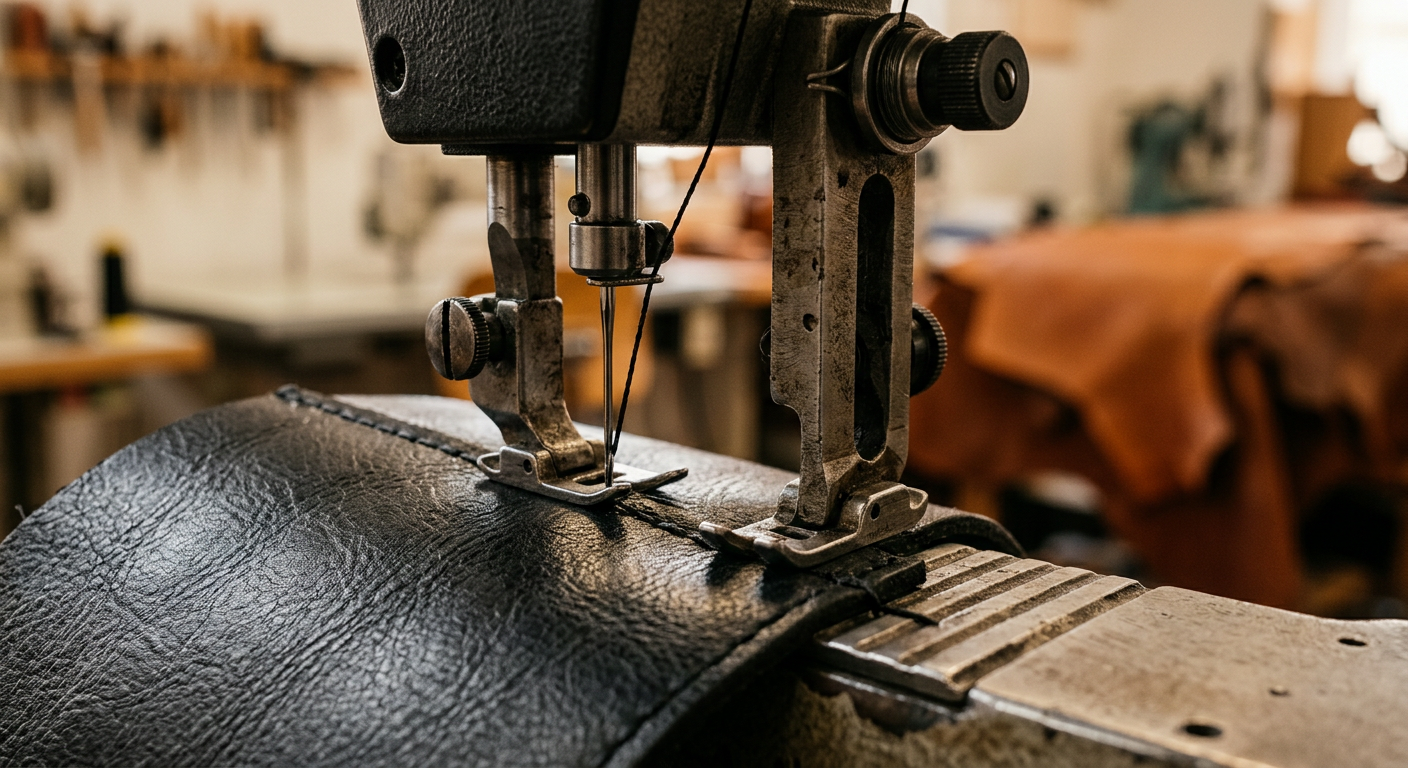
The difference between a luxury leather good and a discount item isn't just the hide—it's the stitching. Learn how SPI, thread, and factory skill impact your product's durability and brand value.
The buyer's problem
Many brand founders and sourcing managers invest heavily in sourcing premium leather, believing the material itself is the hallmark of quality. They secure beautiful full-grain hides, perfect the colour, and approve the hand-feel, only to face customer returns months later due to a split seam on a bag strap or a frayed wallet corner. The weak point wasn't the leather; it was the construction. This is a costly mistake, not just in terms of returns and replacements, but in the erosion of brand trust. Your customers don't differentiate between the material and the make—to them, it is simply a faulty product.
Choosing a manufacturing partner often comes down to comparing quotes, but a lower price can signal cut corners in labour-intensive areas like finishing and stitching. Poor leather stitching quality is a red flag that a factory prioritises speed over durability. As a buyer, your challenge is to look beyond the cost of the hide and evaluate a potential partner's technical skill and commitment to construction integrity. A product that lasts builds a brand that lasts, and that foundation is built one stitch at a time.
What “leather stitching quality” actually means in a factory
In our 25 years of manufacturing, we have seen first-hand that leather stitching quality is not a single attribute but a combination of machine, material, and operator skill. When you send us a tech pack, we are not just looking at the design; we are deconstructing it into a series of precise manufacturing steps where the stitching is paramount.
Here is what we focus on:
Stitches Per Inch (SPI): This is the most fundamental metric. A luxury handbag might require 8-10 SPI for its main seams, creating a strong and visually refined line. In contrast, a decorative stitch on a leather wallet might be a looser 6 SPI. A higher SPI generally means a stronger, more durable seam, but it also takes more time and requires a more skilled operator, directly impacting the labour cost of the item. We calibrate our machines for the specified SPI before a production run and our line supervisors check it constantly.
Thread Tension: This is the unseen hero of a good seam. If the top thread tension is too high, it will pull the bottom (bobbin) thread up through the leather, making it visible on the surface and weakening the seam. If it's too loose, the stitch will be sloppy and prone to snagging. Perfect tension means the lock—where the top and bottom threads meet—is buried exactly in the middle of the leather layers. Our operators are trained to identify and adjust this by feel and sight on every machine.
Seam Allowance & Consistency: A straight stitch line is only as good as its placement. A seam allowance of 1cm that wavers to 0.8cm or 1.2cm looks unprofessional and can compromise the product's structure, especially around curves and corners. We use specialised presser feet with edge guides and train operators to maintain unwavering consistency, which is a hallmark of high-end production.
Backstitching (or Bartacking): At stress points—where a bag strap joins the body, at the corners of a zip, or the top of a pocket—a simple stitch line is not enough. We apply a backstitch of 3-4 stitches or a dense bartack to lock the seam and prevent it from unravelling under daily use. Failing to specify this is a common reason for product failure.
Machine & Needle Selection: We do not use a one-size-fits-all approach. Stitching the gusset of a leather backpack requires a cylinder-arm machine for access, while assembling the main body panels is best on a flatbed. Stitching a fine glove requires a completely different machine setup from a rugged leather jacket. The needle is just as critical. A leather needle (type LR or S) has a special point designed to cut, not tear, the hide, creating a clean hole and preventing damage. Using the wrong needle is a classic sign of an amateur factory.
Materials, specs and standards
Beyond the operator's skill, the physical components of the stitch determine its longevity. The choice of thread and needle is a technical decision we guide our clients on. For most leather goods, we recommend bonded nylon or bonded polyester thread. The bonding agent prevents the thread from fraying or 'un-plying' as it passes through the tough hide at high speed, ensuring a clean, strong stitch. We typically use thread from reputable suppliers like Coats or Gütermann in sizes ranging from Tex 40 for fine accessories to Tex 90 for structural seams on bags.
The needle's size must be matched to the thread. A needle that is too small will fray the thread, and one that is too large will leave unsightly holes in the leather. These are the small details that accumulate to define a product's overall quality. Our internal standards, based on decades of experience, provide a baseline for any project, which can then be adjusted based on your specific tech-pack requirements. We view these specs not as constraints, but as a shared language for achieving excellence.
Here are some of our typical in-house standards for leather stitching quality:
| Specification | Standard / Tolerance |
|---|---|
| Stitches Per Inch (SPI) | Wallets & SLGs: 8-10 SPI; Bags: 7-9 SPI |
| Thread Type | Bonded Nylon / Polyester (default) |
| Thread Size (Tex) | T-45 for small goods, T-70 for bags, T-90 for straps |
| Seam Allowance Tolerance | +/- 0.5mm from specified allowance |
| Backstitch Count | Minimum 3 stitches at all start/end points and stress points |
| Needle Type | Schmetz or Groz-Beckert, leather point (LR/S) |
| Corner Stitching | Pivot with needle down for sharp, non-rounded corners |
| In-line Check Frequency | Every 10th unit checked for SPI & tension by supervisor |
Our process, step by step
Transparency is crucial for building a successful partnership. We want you to understand exactly how your product moves from a design file to a shipping container. Here is our end-to-end process for a new custom OEM project:
Enquiry & Tech Pack Review: You send us your technical drawings, material specifications, and target quantity via our contact form. Our team reviews it within 24 hours to ensure we have all necessary details for an accurate quote. We will ask questions about end-use to recommend the best construction methods.
Quotation & Material Sourcing: We provide a detailed FOB quote breaking down the cost of materials, labour, and hardware. Upon your approval, we begin sourcing the exact leather, thread, lining, and hardware for your sample.
Pattern Making & Prototyping: Our master pattern-maker creates physical patterns from your tech pack. These are used to cut the leather for your first prototype or sales sample. This is a critical stage where we translate your 2D design into a 3D object.
Sample Production (10-14 days): Our most skilled artisans stitch the first sample. We pay meticulous attention to your specified SPI, seam allowances, and construction notes. This sample is a physical representation of our factory's capabilities.
Pre-Production Sample (PPS) Approval: We ship the sample to you for approval. You can check the feel, function, and, most importantly, the stitching details. We welcome feedback and will make any necessary adjustments before bulk production.
Bulk Cutting & Preparation: Once the PPS is approved, we use the master patterns to cut the leather for the full order quantity. All pieces are sorted, skived (thinned at the edges for clean seams), and prepared for the assembly line.
Stitching & Assembly Line Production (25-45 days): The cut pieces move to our stitching lines. Each operator is assigned a specific task to ensure efficiency and consistency. Line supervisors perform constant in-line quality checks against the approved PPS, focusing on stitch integrity, tension, and alignment.
Finishing & Final Quality Control: Assembled products move to the finishing department for edge painting, hardware attachment, and final cleaning. Our dedicated QC team then conducts a final inspection based on AQL (Accepted Quality Limit) standards, checking every detail from stitching to zippers.
Packing & Boxing: Each item is individually packed according to your specifications (e.g., in a polybag with a dust bag). They are then placed into export-grade cartons, correctly labelled with shipping marks for easy identification.
Documentation & Shipment: We prepare all necessary shipping documents: Commercial Invoice, Packing List, Bill of Lading (B/L), and Certificate of Origin. The goods are then delivered to the port for shipment, typically on an FOB Chattogram basis.
MOQs, lead times and pricing signals
Understanding the commercial realities of production is as important as understanding the technical ones. Here are our standard terms, designed to be accessible for both emerging brands and established retailers.
Minimum Order Quantity (MOQ): Our MOQ is 50 pieces per style and per colour. This allows us to offer our premium manufacturing services to brands that are testing new designs or require smaller, more frequent inventory drops.
Lead Times: We operate on a clear timeline. Sample development takes approximately 10-14 days from the confirmation of materials. Bulk production takes between 25 and 45 days after you have approved the pre-production sample. The complexity of the product influences the final timeline; a simple cardholder will be closer to 25 days, while a complex, multi-panel leather bag may require the full 45 days.
Pricing Signals: The price of a leather good is a function of three things: materials, hardware, and labour. While the leather is a significant component, labour is what distinguishes a premium product. A higher SPI, intricate decorative stitching, or complex construction that requires specialised machines will increase the labour time per unit, and therefore the cost. A buyer who only looks at the leather grade and not the specified leather stitching quality is missing half of the value equation. Our quotes are comprehensive because we believe you should know what you are paying for, which includes the skill and time invested in perfect stitching.
Shipping Terms: Our standard pricing is based on FOB (Free On Board) Chattogram Port, Bangladesh. This means we are responsible for the goods and all associated costs until they are loaded onto the shipping vessel. You are then responsible for the sea freight, insurance, and import duties in your country. For further details on logistics, please see our Buyer FAQ.
Common mistakes buyers make
We have seen buyers, both new and experienced, make recurring mistakes that compromise the quality of their final product. Avoiding them can save you significant time and money.
Mistake: Providing an incomplete tech pack that specifies the leather but not the thread size, SPI, or backstitching requirements.
- Fix: Your tech pack should be a complete blueprint. Specify everything. If you are unsure, ask us for our recommendation for your specific product type.
Mistake: Choosing a supplier based on the lowest quote without scrutinising a sample.
- Fix: Always invest in a pre-production sample. It is the single most important tool for verifying a factory's claims about quality. The cost of a sample is a tiny fraction of the cost of a failed production run.
Mistake: Forgetting to check thread tension on the sample.
- Fix: When your sample arrives, don't just look at the stitch line. Try to gently pull the seam apart and look closely at the top and bottom surfaces. You should not see knots or loops of the opposing thread. The stitch should be flat and embedded.
Mistake: Not considering the factory's machinery.
- Fix: Ask your potential supplier what machines they will use for your product. If you're making cylindrical bags, do they have cylinder-arm machines? This demonstrates their experience with your product category.
Mistake: Approving a sample with minor stitching flaws, assuming they will be fixed in bulk.
- Fix: The sample represents the best work a factory can do. Any flaw you see in the sample will likely be magnified in bulk production. Insist on perfection in the PPS.
Mistake: Specifying stitch details that are not suitable for the material.
- Fix: An extremely high SPI (e.g., 12+) can perforate and weaken certain soft leathers. Trust your manufacturer's advice. We might suggest a lower SPI with a thicker thread for better structural integrity.
How to evaluate a supplier for this
When you are comparing potential factories, you need a checklist to assess their capability in delivering superior leather stitching quality. This goes beyond their sales pitch and gets to the core of their operational competence.
Request a Stitching Sample Pack: Before committing to a full product sample, ask for a small swatch of stitched leather. Ask for two versions: one showing their standard for a wallet (high SPI) and one for a bag (medium SPI). This is a quick, low-cost way to see their work.
Scrutinise Their Product Gallery: Look at the close-up photos in their gallery. Zoom in on the stitches. Are they straight? Are the corners sharp? Is the spacing perfectly even? Photos are curated, but they can still reveal a lot about a factory's standards.
Ask Specific Technical Questions: Don't just ask if they do 'good stitching'. Ask: "What thread Tex and SPI do you recommend for the strap on my tote bag design?" or "What type of needle point do you use for Nappa leather?" Their answers will reveal the depth of their technical knowledge.
Review Their QC Process: Ask them to describe their quality control process for stitching. Who checks it? At what stages? Do they use an AQL standard for final inspection? A professional factory will have a clear, documented process.
Provide a Deliberately Tricky Detail: In your sample request, include a feature that is difficult to stitch well—a tight curve, a junction of multiple thick panels, or a very fine decorative line. This is a stress test of their best operator's skill.
Enquire About Their Team: Ask about the experience of their sewing machine operators and their master pattern maker. Skill is a human factor. We are proud of the decades of experience our team holds, which you can learn more about on our /about page.
Ready to move from research to samples? Send us your tech-pack or reference image and we'll come back within 24 hours with materials, MOQ and an FOB quote. Request a quote →
Case snapshot
A German direct-to-consumer brand, known for its minimalist aesthetic, approached us after experiencing high failure rates with their existing supplier in another country. Their core product, a slim bifold leather wallet, was failing at the card slot corners where stitches were unravelling. Their return rate for this defect was nearly 7%. After reviewing their product and tech pack, we identified the issue: the previous factory used an unbonded thread with too few backstitches at the stress points. For their initial order of 750 wallets, we proposed a solution. We switched to a bonded nylon thread (Tex 45), increased the SPI from 7 to 9 for a more refined look, and programmed a 4-stitch locking backstitch at every card slot opening. We produced a PPS in 11 days. The client was impressed with the visible improvement in durability and finish. The full order was produced in 38 days and shipped FOB Chattogram. Six months post-launch, the brand reported their manufacturing defect return rate had fallen to below 0.4%, dramatically increasing their profit margin and improving customer satisfaction scores.
Frequently asked questions
What is your MOQ for custom designs?
Our minimum order quantity is 50 pieces per style and per colour. This flexible MOQ is designed to support both established brands needing to fill inventory gaps and new brands launching their first collection.
How does stitching complexity affect pricing?
Stitching is a labour-intensive process. The cost is directly influenced by the time it takes to complete a unit. Factors that increase labour and price include a higher Stitches Per Inch (SPI), complex curves that require the operator to slow down, decorative stitching patterns, and construction that requires multiple steps or specialised machinery. A simple tote bag is faster to produce, and thus more economical, than a gusseted satchel with multiple compartments, even if they use the same amount of leather.
Can I specify the exact thread brand and colour?
Absolutely. While we have standard house threads (high-quality bonded nylon and polyester) in a wide range of colours, we can source specific brands like Gütermann or Coats upon request. We can also custom-dye thread to match a specific Pantone colour for larger orders, ensuring perfect brand consistency.
How do you ensure leather stitching quality is consistent across a 1,000-piece order?
We use a multi-stage quality control system. First, all machines are calibrated for the correct tension and SPI before the run begins. Second, we have dedicated line supervisors who perform in-line checks on a systematic basis (e.g., every 10th or 20th unit) against the approved pre-production sample. Finally, every single finished item undergoes a final QC check where we examine all seams, stress points, and overall finish before it is packed.
What information do you need for an accurate quote?
A detailed tech pack is best. This should include technical drawings or sketches with dimensions, material specifications (leather type, lining, etc.), hardware details, and crucially, your requirements for stitching (like SPI, if you have one). If you don't have a full tech pack, a clear reference photo and a list of specifications will work. Please also include your desired order quantity.
Do you ship internationally and what are the terms?
Yes, we ship worldwide. Our standard pricing is FOB (Free On Board) Chattogram Port, Bangladesh. This is a common and efficient Incoterm where we handle all costs and logistics to get your order onto the ship. You then manage the ocean freight, insurance, and import into your home country. We can, however, work with you to arrange other terms like Ex-Works (EXW) or CIF if required.
Next step
Focusing on leather stitching quality is the single most effective way to improve the durability, perceived value, and customer loyalty of your products. It transforms a good material into a great product that stands the test of time. When you are ready to partner with a factory that understands this distinction, we are ready to build with you.
To begin the process, send us your project details for a comprehensive quote. If you'd like to see the range of products we apply these principles to, explore our collection of leather bags. We look forward to reviewing your designs. Please contact us today to get started.
Ready to manufacture
Request a quote from TAT Manufacture
Full-grain leather, low MOQ from 50 pcs, OEM & private label. Get a detailed itemised quote within 24 hours.
25 years of leather manufacturing craftsmanship.
Services →OEM, private label, and custom leather production.