Why Clear Product Specifications Save Time and Money
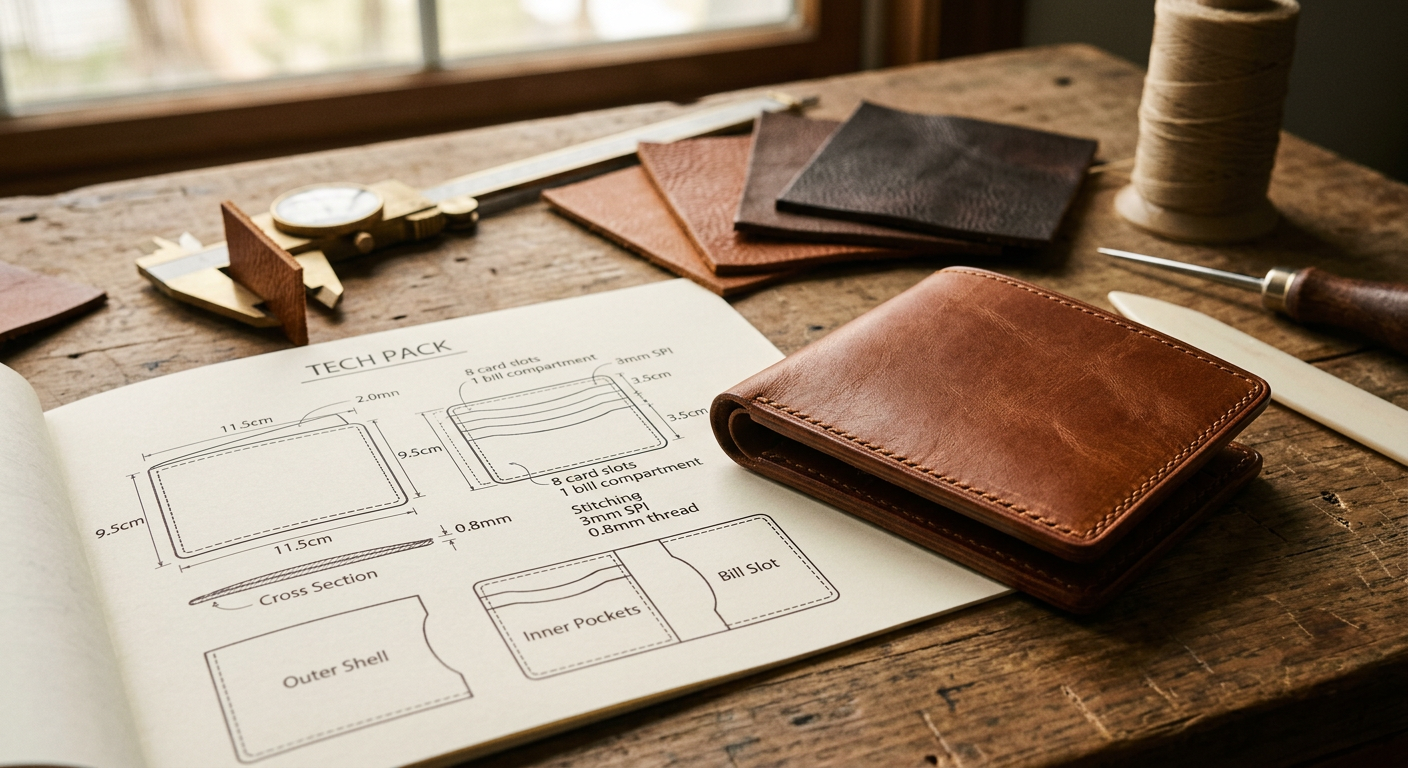
Discover how detailed leather product specifications streamline production, reduce costly errors, and ensure your final order meets brand standards. A practical guide for B2B buyers from the factory floor.
The buyer's problem
In our 25 years of manufacturing, we have seen one issue cause more delays, budget overruns, and frustration than any other: ambiguous specifications. A brand founder or sourcing manager invests months finalising a design, only to receive a shipment of goods that deviates from their vision in small but critical ways. The stitching is the wrong density, the leather feels thinner than the approved sample, or the colour of the metal hardware is slightly off. These are not just aesthetic issues; they are commercial disasters that can lead to rejected stock, missed seasonal windows, and damage to a brand's reputation for quality.
This is where the discipline of creating detailed leather product specifications becomes the most valuable, cost-saving activity a buyer can undertake. It is the single most important document in the relationship between a brand and a manufacturer. It serves as the contract for quality, the blueprint for production, and the ultimate reference point for quality control. Without it, both parties are operating on assumptions, and in manufacturing, assumptions are the direct cause of expensive mistakes. A clear specification sheet is your insurance policy against misunderstanding and your roadmap to a successful production run.
What "leather product specifications" actually means in a factory
For a buyer, a specification sheet might start as a collection of design ideas, sketches, and reference images. For us on the factory floor, leather product specifications—commonly known as a 'tech pack'—are the technical translation of that creative vision into a precise set of manufacturing instructions. This document leaves no room for interpretation. It is the absolute source of truth that dictates every action, from the sourcing of raw materials to the final packing of the finished goods.
When a tech pack is detailed, our production line operates with efficiency. The pattern master digitises the exact dimensions to create cutting dies, ensuring minimal wastage of the hide. The cutting team knows the precise leather thickness required, for example, 1.2mm for a bag's body and 0.8mm for its lining panels. The stitching department sets their machines to the specified stitches per inch (SPI)—perhaps 9 SPI for a durable leather backpack—using the exact thread colour and gauge listed. The assembly team knows which hardware (e.g., YKK #5 antique brass zipper) goes where. The finishing team knows they must apply three coats of a specific Fenice edge paint, sanded between each application.
Conversely, when a tech pack is vague, production grinds to a halt. A note that says “use high-quality brown leather” forces our sourcing manager to guess the type, grade, and finish you want. A missing SPI value means the sewing supervisor has to make a judgement call that might not align with your brand's aesthetic. Every question creates a delay, as we must pause to send an email and wait for clarification. These small delays accumulate, pushing back your delivery date. In the worst-case scenario, an assumption is made to keep the line moving, resulting in a product that doesn't meet your expectations.
Materials, specs and standards
The heart of any good tech pack is its Bill of Materials (BOM) and its construction details. This section breaks down every single component of the product. It’s not enough to say “leather”; you must specify the hide (cow, buffalo, sheep), the tanning process (chrome-tanned, vegetable-tanned), the finish (aniline, semi-aniline, pigmented), and the thickness. The same rigour applies to hardware, thread, lining, reinforcements, and even packaging.
At TAT Manufacture, we work with a wide range of materials and can source according to your exact needs. We follow globally recognised standards and operate within defined tolerances to ensure consistency across every single piece in your order, from the first to the five-hundredth. Tolerances are a critical part of a professional specification; they acknowledge that manufacturing involves micro-variations and set the acceptable limits for them. Below is a table illustrating some typical specifications and tolerances we work with for our range of leather bags and accessories.
| Specification Component | Example Standard | Typical Tolerance |
|---|---|---|
| Leather Thickness | 1.2-1.4mm (for bag body panels) | +/- 0.1mm |
| Stitching Density (SPI) | 8-10 SPI on primary seams | +/- 0.5 SPI per inch |
| Panel Cutting Dimensions | As per digital CAD pattern | +/- 1.0mm |
| Hardware Finish | PVD Antique Brass | Match to approved swatch |
| Edge Paint Application | 3 coats, hand-sanded between coats | No bleeding, uniform finish |
| Zipper Type & Size | YKK #5 Metal, as per BOM | As specified |
| Thread Gauge & Type | T-70 Bonded Nylon | Match to Gutermann code |
| Logo Debossing Depth | 0.6mm | +/- 0.1mm |
Understanding these details allows you to build a robust tech pack that translates directly to the product you envision. For example, the specifications for a rugged leather jacket will differ significantly from those for a delicate glove, involving different leather thicknesses, thread types, and hardware choices. The more detail you provide, the more accurately we can execute your design.
Our process, step by step
Transparency is key to a successful partnership. We want you to understand exactly how we take your leather product specifications and turn them into a finished order. Our process is structured to ensure clarity and quality at every stage.
Enquiry and Specification Review: You send us your tech pack, sketches, or reference images via our contact form. Our technical team reviews the documents for clarity and feasibility, noting any immediate questions.
Quotation and Material Proposal: Within 24-48 hours, we provide a detailed FOB quote per unit based on the proposed quantity. We will also suggest specific leather and hardware options from our network of trusted tanneries and suppliers that match your quality and price targets.
Counter-Sample Development: Once the quote is agreed upon, we move to sampling. Our master craftsmen create a physical sample based on your exact specifications. This crucial step takes approximately 10-14 days.
Sample Approval and Revisions: We ship the sample to you for evaluation. You can feel the leather, test the zippers, and check the workmanship. If any adjustments are needed, you provide feedback, and we can create a revised sample.
Order Confirmation and Deposit: Upon final sample approval, you issue a Purchase Order (PO). We require a standard deposit (typically 50%) to secure the raw materials and schedule production.
Pre-Production Meeting (PPM): Before mass production begins, our production manager, QC lead, and department supervisors meet to review the final approved sample and tech pack. This ensures everyone on the line understands the exact standards required for your order.
Mass Production and In-Line QC: Production commences. This includes cutting, skiving, stitching, assembly, and finishing. Our QC team performs in-line inspections at critical checkpoints to catch any deviations early, rather than waiting until the end.
Final Quality Control: Once all units are complete, they undergo a final inspection based on a pre-agreed AQL (Acceptable Quality Limit) standard, typically AQL 2.5/4.0. We check for cosmetic defects, functional issues, and measurement accuracy.
Packing and Labelling: Each item is packed according to your specifications, including polybags, hangtags, barcodes, and master carton markings.
Final Payment and Shipment: We share the final QC report with you. Upon receipt of the remaining balance, we transport the goods to the port and manage all export documentation for shipment FOB Chattogram.
MOQs, lead times and pricing signals
Understanding the commercial aspects of production is just as important as the technical ones. Here’s how your specifications interact with our business terms.
Minimum Order Quantity (MOQ): Our MOQ is 50 pieces per style, per colour. This relatively low MOQ is designed to support both emerging brands testing the market and established companies launching new, specialised products without a huge upfront investment. For example, you could launch a new wallet design in two colours with a total order of just 100 units. Ordering below 50 pieces is possible but often becomes cost-prohibitive due to fixed setup costs for patterns and cutting dies.
Lead Times: Our lead times are broken into two phases:
- Sampling: 10-14 days from confirmation of specs and payment of sample fees.
- Mass Production: 25-45 days from receipt of PO, deposit, and final sample approval. The exact time within this range depends on the order quantity, product complexity (a simple leather belt is faster than a multi-pocket bag), and material availability.
Pricing Signals and Incoterms: We quote pricing in USD on an FOB Chattogram (the seaport of Chittagong, Bangladesh) basis. FOB, or 'Free On Board', means our price includes the cost of the product and all expenses to get it loaded onto the shipping vessel at our port. You are responsible for arranging and paying for the ocean freight, insurance, and any import duties or taxes in your home country.
A crucial point on pricing: the quality of your leather product specifications directly impacts the accuracy and competitiveness of our quote. A detailed tech pack allows us to calculate material consumption and labour time precisely, resulting in a sharp, accurate price. A vague request forces us to add a contingency buffer to the price to cover the risks of unforeseen complexities or material costs. Clear specs save you money.
Common mistakes buyers make
Over the years, we've seen recurring mistakes that can be easily avoided. Here are the most common ones and how to fix them:
Mistake: Providing only a reference photo. A picture tells us the style, but not the size, materials, or construction.
- Fix: At a minimum, accompany the photo with key dimensions (Height x Width x Depth), strap length, and basic material ideas. Even a simple annotated sketch is a huge improvement.
Mistake: Vague material requests like “good quality black leather.” This could mean dozens of different leather types, each with a different feel, durability, and cost.
- Fix: Be as specific as possible. For example: “Full-grain cowhide, drum-dyed black, semi-aniline finish, 1.3mm thickness.” If you're unsure, ask us to suggest options based on your target retail price and desired aesthetic.
Mistake: Forgetting about the 'invisible' components. Many tech packs miss details on lining, internal reinforcements (to give a bag structure), thread type, or zipper brand.
- Fix: Create a checklist for your tech pack. Include: main material, lining material, thread (colour, type), hardware (base metal, plating, brand), reinforcements, and edge treatment. Our custom / OEM programme guide can help.
Mistake: Not specifying packaging and labelling. This can cause problems with your logistics provider or retail partners if barcodes are wrong or cartons are oversized.
- Fix: Include a page in your tech pack for packaging. Specify hangtag placement, polybag type, barcode label requirements, and master carton dimensions and markings.
Mistake: Changing specifications after production has started. This is the most costly mistake. It can force us to discard cut materials or halt the entire production line, leading to significant delays and extra charges.
- Fix: Treat the counter-sample approval as the final lockdown. Scrutinise your sample thoroughly and finalise all details before issuing the Purchase Order.
Mistake: Failing to define quality standards. Without a defined standard, what you consider a 'defect' we might see as an acceptable variance.
- Fix: Discuss and agree on an AQL standard with us before production. This provides an objective framework for the final inspection.
Ready to move from research to samples? Send us your tech-pack or reference image and we'll come back within 24 hours with materials, MOQ and an FOB quote. Request a quote →
How to evaluate a supplier for this
When you are comparing manufacturers, you are not just assessing their ability to sew leather; you are assessing their ability to interpret and execute your technical requirements. Use this checklist to evaluate a potential factory's competency with specifications:
Do they ask intelligent, clarifying questions? A good manufacturer will review your tech pack and come back with questions about missing details. A factory that accepts a vague spec without question is a red flag—they are likely planning to make assumptions.
Can they provide a sample of their own internal production documents? Ask to see a redacted version of a tech pack they have successfully produced from. This shows you their level of organisation and attention to detail.
Is their communication clear and timely during the sampling process? If they find a material is unavailable or a construction method is not ideal, do they proactively inform you and suggest alternatives?
Do they explain their Quality Control process? They should be able to tell you at what stages they perform inspections and what AQL standards they typically work to. Check our FAQ page for more on our QC process.
Are they transparent about their capabilities? An honest supplier will tell you if a design is outside their area of expertise. We, for instance, have deep experience in structured totes and complex leather wallets, and we would be upfront if a highly specialised technical product required machinery we don't possess.
How do they handle revisions? A professional factory will have a clear process for documenting feedback on a sample and creating a revised version, ensuring any changes are tracked and officially approved.
Case snapshot
A direct-to-consumer brand from Germany approached us after a disastrous experience with another supplier. Their first production run of minimalist wallets had a 30% rejection rate due to inconsistent stitch lines and sloppy, uneven edge paint. Their core brand promise was 'perfect simplicity', and their previous partner had failed to deliver. They came to us with an urgent need for a manufacturer who could execute with precision.
The client provided an excellent tech pack, but we knew the critical points were the stitching and edges. We scheduled a pre-sampling video call to go over their specifications, showing them our thread options and different edge finishing techniques live from our sample room. We agreed on a 9 SPI density with a specific Gutermann Mara 30 thread and a four-stage process for the edges using a matte finish paint. We produced a counter-sample in 12 days that perfectly matched their standard. Impressed with the execution, they placed an initial order for 300 units (6 SKUs x 50 pieces). The production was completed in 35 days, with a final AQL 2.5 inspection report showing a 99.5% pass rate. The goods shipped FOB Chattogram on schedule, allowing them to launch their collection successfully. They are now a repeat client, and we are developing a new line of leather accessories with them.
Frequently asked questions
How do my specifications affect the price?
Your specifications are the single biggest factor in determining the price. Detailed specs allow us to calculate costs accurately for materials and labour, resulting in a fair and competitive quote. Vague specifications force us to build a 'risk buffer' into the price to account for potential unknowns. The more detail you provide, the sharper your pricing will be.
What if I don't have a professional tech pack?
Not a problem. While a professional tech pack is ideal, we regularly work with founders and designers who are just starting out. We can begin with your sketches, reference photos, and a detailed list of requirements. Our team can help you build out a formal specification sheet as part of our custom product development programme. The key is providing as much detail as you can.
Can I see a sample before placing a full order?
Absolutely. Developing a counter-sample for your approval is a mandatory step in our process. We want you to be 100% confident in the product before we proceed to mass production. Sample fees are charged upfront and are typically deducted from the total cost of your bulk order.
What are your shipping terms?
Our standard terms are FOB Chattogram, Bangladesh (Port ID: BDCGP). This means our price covers all costs associated with producing the goods and transporting them to the port and loading them onto the vessel. The buyer is responsible for arranging and paying for the ocean freight, marine insurance, and all destination charges, including customs clearance and duties. We provide all necessary export documentation (e.g., Commercial Invoice, Packing List, Bill of Lading, Certificate of Origin).
How is quality controlled during production?
We employ a multi-stage QC process. It begins with checking all incoming raw materials. During production, we have 'in-line' supervisors who monitor each stage—cutting, stitching, assembly—to catch any issues as they happen. Finally, once an order is complete, our dedicated QC team conducts a final statistical inspection based on pre-agreed AQL standards (e.g., AQL 2.5) before anything is packed for shipment.
Can you source specific branded hardware or leather?
Yes. If your design requires specific components, such as YKK zippers, Riri zippers, or leather from a specific Italian tannery, we can source them through our extensive supply network. This must be clearly stated in your leather product specifications. Please note that sourcing unique, non-stock components may impact the cost and lead time, which we will clarify in our quotation.
Next step
Ultimately, clear and comprehensive product specifications form the bedrock of a successful and stress-free manufacturing partnership. They align expectations, prevent costly errors, and ensure the final product that lands on your doorstep is the exact product you designed. Taking the time to perfect your tech pack is the best investment you can make in your brand's quality.
If you are ready to turn your designs into reality, please send us your specifications and we will provide a detailed quote. To see the range of products we are capable of making, please browse our full product catalogue.
Ready to manufacture
Request a quote from TAT Manufacture
Full-grain leather, low MOQ from 50 pcs, OEM & private label. Get a detailed itemised quote within 24 hours.
25 years of leather manufacturing craftsmanship.
Services →OEM, private label, and custom leather production.