Buying Guide
What Determines the Minimum Order Quantity for Leather Products?
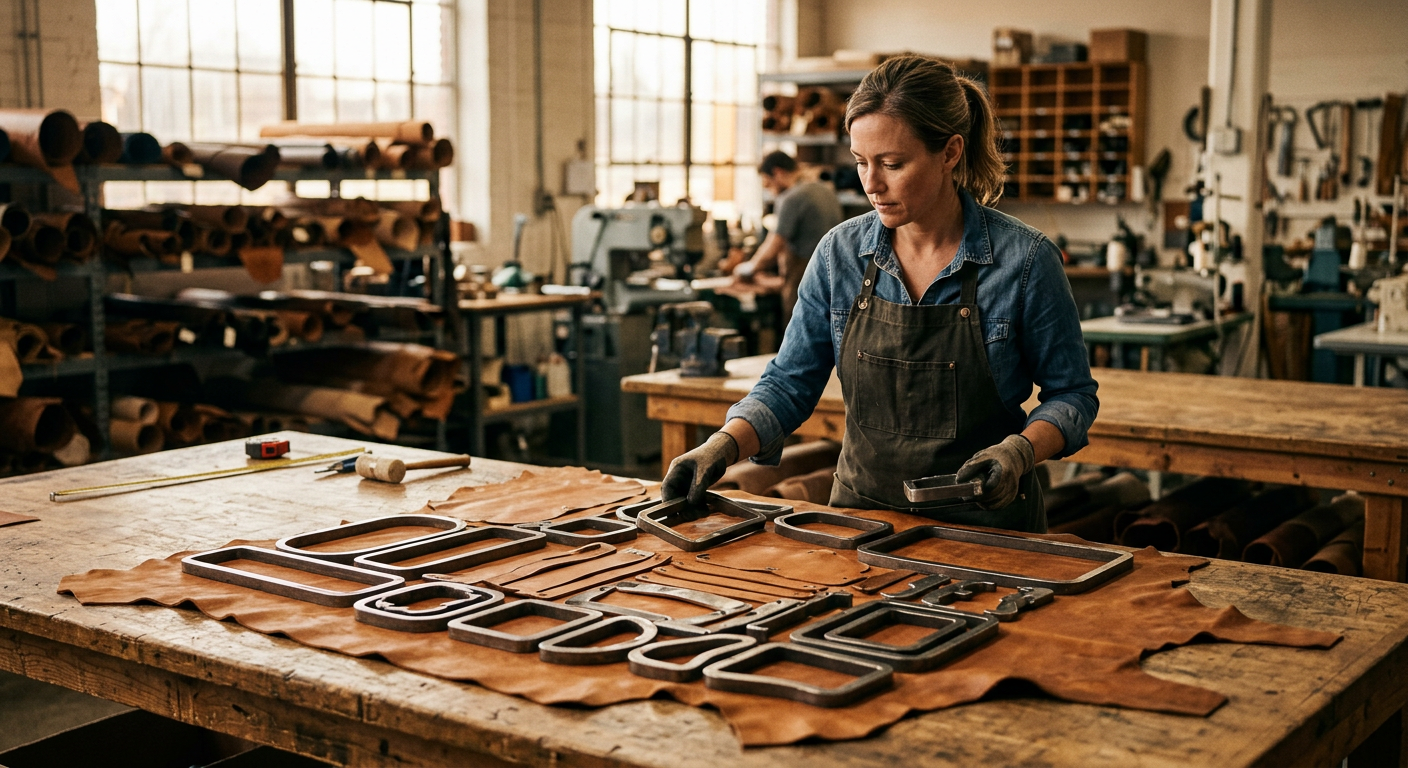
MOQ isn't just a number. Discover the factory-floor realities that drive it, from hide yields to cutting die costs, and learn how to negotiate smarter terms for your brand.
The buyer's problem
For any brand founder or sourcing manager, the term 'Minimum Order Quantity' or MOQ is one of the first, and often most challenging, hurdles in manufacturing. You have a brilliant design for a new leather bag, a solid business plan, and a target market ready to buy. You approach a factory, excited to get a quote, only to be told you must order 500, 1000, or even more units. This can be a project-killer for startups and a major financial risk even for established brands testing a new line.
This single number can feel arbitrary and frustrating, creating a barrier between your design and your customer. Why can’t a factory just make 10 or 20 pieces? The answer isn't about unwillingness; it's about the fundamental economics of production. Understanding the factors behind the MOQ is the first step to navigating the manufacturing landscape effectively, finding the right partner, and turning your vision into a commercially viable product. This guide provides a factory-floor perspective on leather MOQ explained by the people who set them.
What "leather MOQ explained" actually means in a factory
When we state an MOQ, we are not trying to be difficult. We are communicating the minimum threshold at which a production run becomes viable for both of us. Below this number, the process is inefficient, costly, and prone to inconsistencies. Our MOQ of 50 pieces per style and colour is the result of balancing accessibility for our clients with the unchangeable realities of the factory floor.
First, consider the materials. Tanneries, our primary suppliers, have their own MOQs. To produce a custom colour of leather exclusively for your brand, a tannery might require a minimum order of 500 to 1,000 square feet. This is enough leather for far more than 10 or 20 bags. If your order is too small to use this amount, we are left with a custom material we cannot sell to anyone else. The same logic applies to hardware. A custom-branded buckle or zip pull requires a mould to be made. The hardware factory will require a minimum order, often 1,000 pieces or more, to justify the cost of creating that mould and setting up their machinery.
Second is the cost of setup. For every new product, our team must prepare. This involves:
- Pattern & Die Cutting: Creating precise patterns and, for larger runs, expensive steel cutting dies. A single set of dies for a complex leather backpack can cost hundreds of pounds. This cost must be amortised over the production run. Spreading it over 10 bags makes the per-unit cost prohibitive; spreading it over 50 makes it manageable.
- Machine Calibration: Each machine in the production line, from the leather skiving machine (which thins leather edges for a clean fold) to the sewing machines, must be calibrated for the specific leather thickness, thread type, and stitch length your product requires. This setup takes time and skilled labour.
- Labour Efficiency: A skilled artisan becomes more efficient with repetition. The first one to five units of a new design are always the slowest to produce as the team internalises the construction sequence. A production run of 50 units allows the team to achieve a rhythm, a state of 'flow,' which reduces the time taken per unit and ensures consistency from the first piece to the last. A tiny run never reaches this peak efficiency, making each piece disproportionately expensive to make.
In essence, the MOQ is the point where the fixed costs of setup are sufficiently diluted across enough units to result in a fair price for you and a sustainable business practice for us.
Materials, specs and standards
The choice of materials is directly tied to the MOQ. Our ability to offer a relatively low leather MOQ explained as 50 pieces hinges on using materials we can source efficiently. We maintain a library of 'stock' leathers – high-quality full-grain and top-grain hides in classic colours like black, brown, and tan – that we buy in bulk. Because we have this on hand, we can accommodate smaller runs for clients using these materials. For more on our philosophy, you can read about TAT Manufacture.
However, if your design requires a specific Pantone-matched sage green nubuck or a particular embossed texture, we must source it specifically for your project. In this case, the MOQ is dictated not by us, but by the tannery. We will be transparent about this; we will present you with the tannery's MOQ and the total material cost. You then have a choice: either commit to the larger order to get your unique material, or adapt your design to use one of our excellent in-stock options. The same principle applies to custom linings, threads, and hardware.
Adhering to strict technical specifications is how we ensure quality, regardless of order size. Every tech pack should specify standards, and every good manufacturer should be able to meet or discuss them. Below is a table of common specifications we work with on every project:
| Specification | Our Standard / Tolerance | Why It Matters |
|---|---|---|
| Leather Thickness | +/- 0.2mm of specification | Consistency in weight, feel, and structural integrity. |
| Stitch Per Inch (SPI) | 8-10 SPI for bags, 10-12 for wallets | A higher SPI denotes a stronger, more refined seam. |
| Seam Allowance | As per pattern, +/- 1mm | Crucial for correct product assembly and final dimensions. |
| Edge Paint Application | Minimum 3 coats, hand-sanded between | Creates a smooth, durable, and professional-looking edge. |
| Hardware Plating | Varies by type (e.g., 3-5 microns) | Determines durability, corrosion resistance, and finish life. |
| Dimensional Tolerance | +/- 5mm on final product dimensions | Ensures every unit in the run is consistent. |
| Colour Matching (Lab Dips) | Within 95% of Pantone/Master Sample | Accounts for natural variations in leather absorption. |
| Reinforcement Placement | Critical stress points (straps, corners) | Prevents stretching and tearing, ensuring product longevity. |
Our process, step by step
Understanding our workflow helps clarify where and why the MOQ becomes a critical checkpoint. From your first email to final delivery, we follow a structured process designed for clarity and efficiency.
- Enquiry & Tech Pack Review: You send us your enquiry, ideally with a detailed technical package (tech pack) or at least clear drawings and reference images. We review the design for manufacturability.
- Initial Quote & MOQ Confirmation: Within 24-48 hours, we provide an initial quote. This will state the per-unit price based on our standard MOQ of 50 pieces per style/colour. If your design requires materials with a higher MOQ, we will identify that here.
- Material Sourcing & Confirmation: We discuss materials. If you choose our stock leather, we move forward. If you need a custom colour, we contact our partner tanneries, get their MOQ and pricing, and present you with the options.
- Sample Production: Once the details are agreed upon and the sample fee is paid, we produce a physical sample. This typically takes 10-14 days. This is your opportunity to see, touch, and test your product before committing to a full production run. For more detail on our capabilities, see our custom / OEM programme.
- Sample Approval & Feedback: We ship the sample to you. You review it and provide feedback. We can make minor adjustments. If significant changes are needed, a second revised sample may be required.
- Production Deposit & Order Confirmation: Upon your final approval of the sample, you formally place your bulk order and transfer a 50% deposit. This allows us to procure all the necessary raw materials for the full run.
- Full Production Run: Production begins. Our teams handle cutting, skiving, stitching, and assembly. This stage typically takes between 25 and 45 days, depending on the complexity of the product and the total order quantity.
- Quality Control (QC): Our QC team performs inspections at multiple stages: an in-line check during production and a final, rigorous 100% inspection of all finished goods against the approved sample and your spec sheet.
- Final Payment & Packing: Once production is complete and has passed final QC, we will send you a detailed packing list and our final QC report. You then transfer the remaining 50% balance. Your goods are then carefully packed for export.
- Shipment & Documentation: Your order is delivered to the port. We handle all export documentation and load the goods. Our standard term is FOB Chattogram (Free on Board). This means you take ownership once the goods are on the vessel, and you are responsible for sea freight, insurance, and import duties in your country. We provide all necessary documents (Bill of Lading, Commercial Invoice, Packing List) for a smooth customs clearance.
MOQs, lead times and pricing signals
Let's be direct about the numbers, as this is what matters when you are planning your business. Our standard leather MOQ explained simply is 50 pieces per style, per colour.
- MOQ: 50 pieces per style/colour.
- Sampling Lead Time: 10-14 days from confirmation of details.
- Production Lead Time: 25-45 days from sample approval and deposit payment.
- Shipping Terms: FOB Chattogram, Bangladesh.
Why 50 pieces? This is the minimum quantity that allows us to efficiently utilise a full team on a mini-production line, amortise the setup costs for cutting dies and machine adjustments, and consume a reasonable amount of leather without excessive waste. For a product like a standard tote bag, 50 pieces might consume approximately 750 sq ft of leather, which is a viable order quantity for us to place with a tannery if using a non-stock colour.
It is crucial to understand that MOQ and price are inversely related. The price we quote you for 50 pieces is not the price you will pay for 500 pieces. A larger order quantity provides significant economies of scale. The fixed setup costs are spread over more units, and we can negotiate better prices on raw materials. Labour becomes more efficient. For example, the per-unit price for 500 leather belts might be 20-30% lower than the price for just 50. When you request a quote, we can provide tiered pricing to illustrate this. This helps you make strategic decisions about your order volume and inventory investment.
For shipping, quoting FOB Chattogram gives you control and transparency. You can work with your own preferred freight forwarder to find the best rates for shipping and insurance. We handle all the local logistics and paperwork to get your goods onto the ship. Once shipped, you will use the provided HTS codes (e.g., 4202.21 for leather handbags, 4203.30 for leather belts) to manage customs and duties in your home country.
Common mistakes buyers make
Over our 25 years in business, we've seen buyers make the same handful of preventable mistakes when it comes to MOQs. Avoiding them will make your sourcing journey much smoother.
Mistake: Requesting a quote for 5-10 pieces.
- The Fix: Understand that factories are set up for bulk production. If you are just starting and need very small quantities, you are better served by a local artisan or a 'no-minimum' print-on-demand service, which is a different business model. For factory production, think in dozens, not single units. Start with our MOQ of 50 as your baseline.
Mistake: Designing with hyper-specific, custom materials for a first order.
- The Fix: Be flexible. For your initial run, design around our high-quality stock materials. This allows you to take advantage of our 50-piece MOQ. Once your product is proven in the market and you are ready to scale, we can then explore developing custom-dyed leathers and bespoke hardware for your larger follow-up orders.
Mistake: Sending an incomplete tech pack or just a photo.
- The Fix: The more detail you provide upfront, the more accurate our quote and MOQ assessment will be. A good tech pack includes dimensions, material types, hardware specifics, stitch details, and branding placement. A vague request leads to a vague (and likely higher) quote to cover unknown variables. See our buyer FAQ for what to include.
Mistake: Believing the MOQ is a negotiation tactic.
- The Fix: View the MOQ as a technical constraint, not a starting price. While there can be some flexibility (for example, if an order is for 5 different styles all using the exact same black leather), the underlying principles of setup costs and material minimums do not change. A better negotiation tactic is to discuss tiered pricing for higher volumes.
Mistake: Focusing solely on the per-unit price without considering the MOQ.
- The Fix: Calculate your total investment. A factory offering a 1,000-piece MOQ may have a lower per-unit price, but a total outlay of £10,000. Our 50-piece MOQ at a slightly higher per-unit price might represent a total outlay of only £1,500. This is a far more manageable entry point for testing the market.
Mistake: Ignoring the cost and logistics of shipping.
- The Fix: Get a quote from a freight forwarder early in the process. Our FOB Chattogram price is only part of your total landed cost. You must account for ocean freight, insurance, import duties, and local transport to get a true picture of your per-unit cost.
How to evaluate a supplier for this
When you're comparing potential manufacturing partners, the MOQ is a key data point. But how you discuss it reveals a lot about the factory's character. Use this checklist to evaluate suppliers on their approach to MOQ.
- Transparency: Do they simply state the MOQ as a hard rule, or do they explain why it is what it is? A good partner will be able to articulate the role of material sourcing, die costs, and labour setup. They should make the number feel logical, not arbitrary.
- Solution-Oriented: When you discuss your budget and volume constraints, does the supplier shut down the conversation, or do they offer solutions? Look for a factory that suggests alternatives, such as using stock materials to meet a lower MOQ or adjusting a design for more efficient production.
- Material Knowledge: Can they clearly explain the difference in MOQ between using their stock leather and ordering a custom-dyed hide? They should be able to give you specific numbers (e.g., "The tannery requires a 500 sq ft minimum for that colour") and explain the implications for your total cost and lead time.
- Flexibility within Reason: A good factory has firm policies rooted in production realities, but can also be creative. Ask them: "We want to order three different leather wallet styles. If they all use the exact same leather and thread, can we treat the MOQ more flexibly?" Their answer will tell you if they are a rigid operator or a true partner.
- Tiered Pricing: Do they readily offer tiered pricing for higher quantities? This demonstrates that they understand economies of scale and are equipped to grow with your brand. It shows they are thinking long-term, not just about one small order.
- Clear Communication: Is their communication professional and clear? The discussion around MOQ involves technical and financial details. You need a partner who can communicate these complex ideas simply and effectively in English.
Ready to move from research to samples? Send us your tech-pack or reference image and we'll come back within 24 hours with materials, MOQ and an FOB quote. Request a quote →
Case snapshot
A start-up fashion brand from the United Kingdom approached us to produce their inaugural collection of three minimalist tote bags. Their initial plan was to produce 25 units of each style—a total of 75 bags—each in a unique pastel colour. During our initial consultation, we explained that while the total quantity was above our MOQ, the per-colour quantity of 25 was problematic. To get their three specific pastel shades custom-dyed would require ordering the tannery's minimum of 500 square feet for each colour, a massive and costly over-purchase of leather for just 25 bags each. We presented a solution. We colour-matched their desired pastels to high-quality leathers available from a premium stockist we work with, who could sell us smaller quantities. This meant a slightly different leather finish, but it kept the colours they wanted. We then proposed an MOQ of 50 pieces for their two strongest designs and deferred the third style for a later season. The client agreed. The final order was for 100 bags (2 styles x 50 pcs). We produced samples in 12 days and the full production order was ready for FOB shipment from Chattogram 40 days after sample approval. This pragmatic approach allowed the brand to launch successfully with a manageable investment, validating their designs before committing to larger, custom-dyed orders.
Frequently asked questions
How does my choice of leather affect the MOQ?
Your choice is the single biggest factor. If you use one of our in-stock leathers (we have a wide range of full-grain and top-grain options in classic colours), you can take full advantage of our 50-piece MOQ per style. If you require a custom-dyed leather, a unique embossed finish, or a specific type of hide we don't stock, we are then bound by the MOQ of the tannery, which is typically 500-1,000 square feet. We will facilitate this, but the cost and quantity will be higher.
Is the 50-piece MOQ per order or per style?
Our MOQ is 50 pieces per style and per colour. For example, an order for a black tote bag and a brown version of the same tote bag would be considered two separate runs, each requiring a 50-piece minimum. This is because switching colours involves changing thread, edge paint, and sometimes even needles and machine settings, which is effectively a new production setup. This is a key part of our leather MOQ explained policy.
Can I get a sample before committing to the full MOQ?
Absolutely. We insist on it. We will produce a full, finished pre-production sample for your approval before we begin any bulk manufacturing. Sampling takes approximately 10-14 days. There is a fee for the sample to cover the cost of materials and our pattern maker's time, which is typically credited back to you when you place your bulk order.
What are your payment terms for an MOQ order?
Our terms are standard for the industry and designed to create a secure transaction for both parties. We require a 50% deposit upon confirmation of your order, after you have approved the pre-production sample. This deposit allows us to purchase all the raw materials for your run. The final 50% balance is due upon completion of the order, prior to shipment. We will provide you with a final QC report and packing list before you make the final payment.
Do you handle shipping and duties?
We ship on FOB (Free on Board) Chattogram terms. This means we are responsible for all costs and logistics of getting your goods packaged, cleared for export, and loaded onto the shipping vessel at the port of Chattogram, Bangladesh. From that point, you (or your designated freight forwarder) are responsible for the cost of ocean freight, insurance, and any import duties or taxes in your destination country. We provide all the necessary export documentation (Bill of Lading, Commercial Invoice, Packing List) to ensure a smooth customs process on your end.
Can I customise hardware for a 50-piece order?
For a 50-piece order, custom-moulded hardware (e.g., a buckle with your logo) is generally not feasible. The factories that produce hardware have very high MOQs, often 1,000 pieces or more, to justify the cost of creating a new mould. However, we offer a wide range of high-quality stock hardware in various finishes (antique brass, nickel, gunmetal, etc.) that you can choose from. For larger orders (typically 500+ units), we can certainly manage the development of fully custom hardware for your brand.
Next step
Understanding the MOQ is about understanding the mechanics of manufacturing. We believe a transparent and collaborative approach is the best foundation for a long-term partnership. Our goal is to help you grow, and that starts with finding a viable path to production for your first order.
If you are ready to discuss your project, we are ready to listen. Send us your design specifications to get a detailed quote and begin the sampling process. Let's build something great together. Please contact us or browse our full range of leather bags for inspiration.
Ready to manufacture
Request a quote from TAT Manufacture
Full-grain leather, low MOQ from 50 pcs, OEM & private label. Get a detailed itemised quote within 24 hours.
25 years of leather manufacturing craftsmanship.
Services →OEM, private label, and custom leather production.