Leather Manufacturing
The Hidden Reasons Leather Products Fail Final Quality Inspection
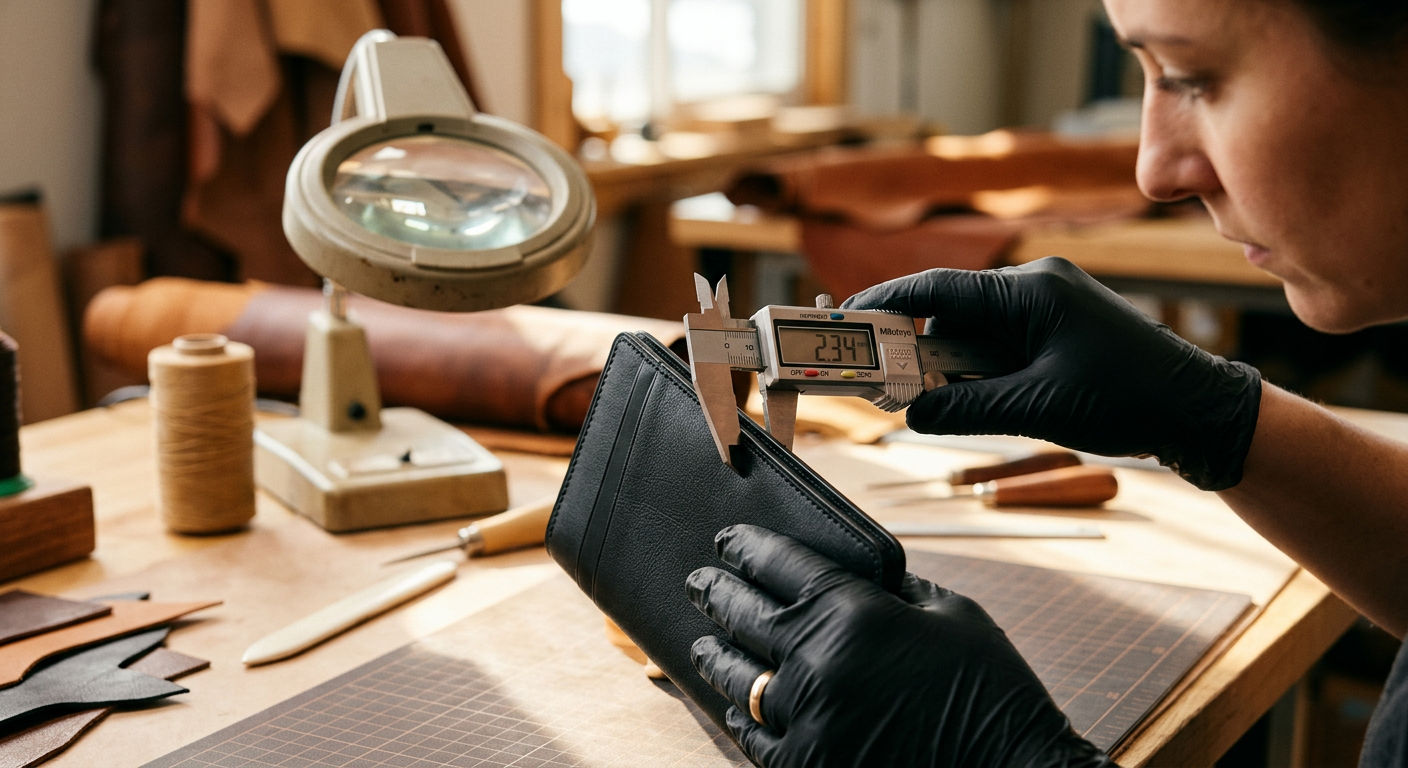
A failed inspection can derail your collection launch. We detail the common defects in leather goods and show how a professional factory prevents them from happening in the first place.
The buyer's problem
Nothing is more costly to a fashion brand than a failed final inspection. The shipment is packed, the launch date is set, and your third-party inspector delivers the news: critical failures, unacceptable defect rates, and a recommendation to reject the entire order. This is a scenario that halts a business. It means lost deposits, missed seasons, damaged retail relationships, and a frantic search for a new supplier, all while your capital is tied up in goods you cannot sell. The root cause is almost never a surprise event on the final day; it is the result of a poor supplier choice made weeks or months earlier.
The difference between a successful production run and a failed one is often invisible until it is too late. It lies in the factory’s internal processes, its quality culture, and its commitment to proactive problem-solving. A supplier who only cares about the final checkpoint is a supplier who will fail you. A professional partner, however, integrates a rigorous leather quality inspection mindset into every single step, from tanning to packing. Understanding this distinction is the single most important decision you will make as a buyer.
What "leather quality inspection" actually means in a factory
For many buyers, the term leather quality inspection conjures an image of a person with a clipboard checking finished goods before they are boxed. This is Final Quality Inspection (FQI), and while important, it is only the last line of defence. In a well-run factory like ours, it is a continuous process, not a final event.
Here is what it means on our production floor:
Pre-Production (PPM): Before a single hide is cut, our production managers, QC team, and pattern masters meet to review your tech-pack. We analyse every detail to flag potential production risks. Is the handle attachment point strong enough for the bag's intended weight? Is the specified zipper robust enough for a high-use leather backpack? This is where we prevent problems, rather than just find them later.
Incoming Quality Control (IQC): We inspect all raw materials as they arrive at the factory. This includes leather hides, lining fabric, hardware, threads, and even packaging. We check leather for excessive scarring, inconsistent thickness, and colour deviation against the approved swatch. Hardware is checked for plating consistency and function. Any material that doesn't meet the standard is rejected before it can enter the production line.
In-Process Quality Control (IPQC): We have dedicated QC staff on the production lines. They perform checks at critical stages: after cutting, after skiving, after assembly, and after stitching. This is often called 'inline inspection'. They are not just looking for errors; they are ensuring the process is stable and the operators are adhering to the agreed-upon standards, like stitches per inch (SPI). This catches a minor deviation before it becomes 500 defective units.
Final Quality Control (FQI): This is the final check, performed when a statistically significant portion of the order is complete (or at 100% completion). We follow an AQL (Acceptable Quality Limit) standard, typically AQL 2.5/4.0, which is an industry-wide method for determining the pass/fail status of an order based on a random sample. Defects are categorised as Minor, Major, or Critical. For example, a loose thread might be a minor defect, while an open seam is a major defect, and a broken needle tip found in a wallet is a critical defect.
This multi-stage leather quality inspection approach is fundamental to consistent, high-quality manufacturing. It is more labour-intensive for the factory, which is why it’s a key differentiator you should be looking for. You can see our teams and factory floor in our gallery.
Materials, specs and standards
Clear, objective standards are the foundation of good quality control. Vague instructions like "good quality" or "strong zipper" are meaningless on the factory floor. We work with our clients to establish a detailed specification sheet for every product. This document becomes the 'bible' for our production and QC teams. If you do not have a full tech-pack, our team can help you build one based on your samples or drawings as part of our custom OEM programme.
Below is a sample of the kinds of technical specifications we define and inspect against. These are the details that prevent failures.
| Parameter | Standard / Specification | Tolerance / Method of Verification |
|---|---|---|
| Stitch Per Inch (SPI) | 8-10 SPI (e.g., for bags) | +/- 0.5 SPI. Checked with manual count and template. |
| Leather Colour Consistency | Pantone TCX reference | Delta E < 2.0. Checked using a spectrophotometer and light box. |
| Edge Paint Application | 3-4 layers, smooth finish | No cracking or peeling after 25-cycle flex test. Visual inspection. |
| Hardware Plating | 24hr Neutral Salt Spray Test | No visible signs of corrosion or tarnishing. |
| Zipper Durability | YKK #5 or equivalent | 500 cycle back-and-forth test with no failure. |
| Strap Pull Strength | 25 kg for 60 seconds | Checked on a calibrated pull-test machine. No seam failure. |
| Hardware Scratch Resistance | 2H Pencil Hardness Test | No scratches should be visible to the naked eye. |
| Final Dimensions | Per tech-pack drawing | +/- 2 mm. Measured with a digital caliper or calibrated tape. |
Our process, step by step
To demystify how we deliver quality-assured products, here is our standard operating procedure from your first enquiry to final shipment.
- Enquiry & Quoting: You send us your tech-pack, drawings, or reference samples. We review the design for manufacturing feasibility and respond within 24 hours with a comprehensive quote including material options and an estimated FOB price.
- Sampling: Upon confirmation, we create a pre-production sample. This is not just a mockup; it is a fully functional product made with the actual specified materials and techniques. This is a critical
leather quality inspectionstage. We send you detailed photos and the physical sample for your approval. - Feedback & Adjustment: You review the sample. If there are any adjustments—a different zipper pull, a slight change in pocket placement on a leather wallet, a tweak to the strap length—we incorporate the feedback and, if necessary, produce a revised sample.
- Order Confirmation & Deposit: Once you approve the final sample, you place your bulk order and we issue a proforma invoice. Production commences upon receipt of the deposit.
- Raw Material Procurement & IQC: We order all materials. Upon arrival, our Incoming Quality Control team inspects everything against the approved standards, as detailed above. Any rejected materials are sent back to the supplier.
- Cutting & Preparation: Hides are inspected again before our cutters begin their work, marking and cutting around natural flaws to maximise yield and ensure clean panels for every product.
- Inline Production & IPQC: Assembly begins. Our line supervisors and IPQC teams monitor the work at every station—stitching, edge painting, hardware attachment. Any issues are corrected immediately, right on the line.
- Final Assembly & FQI: Once products are fully assembled, they move to our dedicated final inspection area. Our team inspects 100% of the items (or a statistically significant sample based on AQL) for cosmetic and functional defects before they can be cleaned and packed.
- Third-Party Inspection (Optional): We welcome our clients or their designated third-party inspection agents (like SGS, Intertek, or QIMA) to perform their own inspection at our facility before shipment. We facilitate this process completely.
- Packing & Shipment: Approved goods are carefully packed according to your specifications (e.g., individual polybags, master cartons of a specific weight/dimension). We handle all documentation for FOB Chattogram shipment, including the packing list, commercial invoice, and certificate of origin.
MOQs, lead times and pricing signals
Understanding a manufacturer's core operational numbers can tell you a lot about their approach to quality. A factory advertising impossibly low prices or no MOQ is often cutting corners on process, materials, or labour—the very things that ensure quality.
Our structure is designed for professional brands that value consistency and reliability:
- Minimum Order Quantity (MOQ): Our MOQ is 50 pieces per style/colour. This is the minimum batch size required to set up an efficient production line and maintain consistent quality from the first unit to the last. Anything lower often means inefficient, stop-and-start work that is prone to errors.
- Lead Times:
- Sampling: 10-14 days. This allows us time to source the exact materials and construct a sample that truly represents the final production quality.
- Bulk Production: 25-45 days. The exact timeline depends on the order quantity, complexity of the product, and material availability. This timeframe is realistic and includes our multi-stage QC process.
- Shipping: We quote prices FOB Chattogram Port, Bangladesh (CGP). This means our price includes getting the goods, inspected and packed, onto the vessel at the port. You are then responsible for ocean freight, insurance, and import duties. We can recommend freight forwarders if needed.
Be wary of pricing that seems too good to be true. The cost of a failed leather quality inspection far outweighs the few dollars saved on a cheaper FOB price. That low price may be a signal of underpaid, rushed workers, sub-standard materials, or a complete absence of an internal QC process. Our pricing reflects fair wages, quality materials, and the rigorous process control detailed about our company.
Common mistakes buyers make
We have been manufacturing for over 25 years, and we have seen buyers make the same avoidable mistakes. Here are a few, along with how to prevent them.
Mistake: Providing an incomplete or vague tech-pack.
- Fix: Be as detailed as possible. Specify materials, hardware, dimensions, stitch type, SPI, and reinforcement points. The more detail you provide, the less room there is for misinterpretation.
Mistake: Approving a pre-production sample with "just a small issue" you expect to be fixed in bulk.
- Fix: Never approve a sample until it is 100% correct. That sample is the master standard. If it has a flaw, the bulk production will have that flaw, magnified by hundreds or thousands of units. Request a revised sample.
Mistake: Choosing a supplier based solely on the lowest FOB price.
- Fix: Treat price as one of several key metrics, alongside quality systems, communication, and lead time. Always ask why a price is low. Ask about their QC process and worker compensation.
Mistake: Not specifying the quality of hidden components.
- Fix: Buyers focus on the leather and main hardware, but the quality of the lining, thread, interlining, and internal reinforcements is just as critical. A bag is only as strong as its weakest component. Specify everything.
Mistake: Not budgeting for a third-party inspection.
- Fix: Even when you trust your factory, a third-party inspection provides objective confirmation that your standards were met before you make the final payment and ship the goods. It's an insurance policy that is worth every penny for any significant order.
Mistake: Using ambiguous colour names instead of standards.
- Fix: Don't just say "brown". Specify a Pantone TCX colour code (e.g., PANTONE 18-1438 TCX "Potter's Clay"). This allows us to objectively measure colour accuracy with a spectrophotometer.
Ready to move from research to samples? Send us your tech-pack or reference image and we'll come back within 24 hours with materials, MOQ and an FOB quote. Request a quote →
How to evaluate a supplier for this
When you are comparing potential factory partners, how can you assess their real commitment to quality before placing an order? Here is a practical checklist:
- Ask for their QC manual: A serious factory will have a documented internal QC process. Ask to see it. It should detail their AQL standards, inspection points, and defect classification.
- Question their sampling process: How do they charge for samples? What is their lead time? Do they offer feedback on your design for manufacturability? A professional factory sees sampling as the first step in a long-term partnership.
- Submit a complex specification: Give them a tech-pack with a challenging detail. Their response will be telling. Do they ask intelligent questions? Do they point out a potential problem and suggest a solution? Or do they just say "yes" to everything?
- Request photos of their QC stations: Ask to see where they perform incoming material inspection and final inspection. Look for good lighting, proper tools (calipers, light boxes, pull testers), and organised, clean spaces.
- Discuss how they handle defects: This is a crucial question. Ask them: "If I find a major defect on 20% of my goods after I receive them, what happens?" A good partner will have a clear policy for returns, repairs, or credits. They will stand behind their work.
- Talk to their merchandiser: The person you communicate with daily is key. Are they fluent in English? Do they understand technical product details? Their professionalism is often a reflection of the entire company's standards.
- Check their HTS code knowledge: For a consignment of leather belts, do they know the correct Harmonized Tariff Schedule code (e.g., 4203.30)? This indicates experience with international shipping and compliance.
Case snapshot
A German startup brand approached us after a catastrophic failure with a different factory. Their first order of 500 bespoke leather tote bags, destined for a major online retailer, was rejected by a third-party inspector due to a 15% major defect rate. The core issue was inconsistent handle attachment, with stitches failing a basic pull test. With their launch date just 10 weeks away, they were in crisis.
They sent us their tech-pack and one of the failed samples. Our production team immediately identified the design flaw during our PPM: the single line of stitching specified was insufficient for the weight of the bag and the type of leather used. Within 48 hours, we proposed a reinforced design with a hidden nylon webbing insert and a box-and-cross stitch pattern at the anchor points. We produced and shipped a new, reinforced pre-production sample in 9 days. The client approved it immediately. We prioritised their production, ran the 500-unit order through our full IPQC and FQI process, and had the goods ready for inspection in 30 days. The client's inspector came to our factory, performed the inspection, and returned a 'Pass' report with a 0% major defect rate. The goods shipped FOB Chattogram and arrived in Germany with two weeks to spare, saving the brand's retail partnership.
Frequently asked questions
Can I provide my own quality inspector?
Yes, absolutely. We welcome and encourage clients to use their own third-party inspection teams like QIMA, SGS, Bureau Veritas, or Intertek. We will coordinate with your designated agent to schedule the inspection at our facility and provide them with the space and support they need to do their work. Transparency is a core part of our process.
What AQL level do you use for your final leather quality inspection?
Our factory standard is AQL 2.5 for Major defects and 4.0 for Minor defects, using a General Inspection Level II sampling plan. This is a widely accepted standard in the consumer goods industry. However, we are flexible and can adhere to a stricter AQL level (e.g., AQL 1.5) if your product or brand requires it. This must be agreed upon before production begins.
How do you ensure colour consistency across a large order?
We address this at multiple stages. First, we use a master approved leather swatch for the entire project. Each new dye lot of leather we receive is compared against this master under a D65 standard light source in a light box. We use a spectrophotometer to ensure colour variance is within an acceptable range (Delta E < 2.0). During cutting, we also ensure all panels for a single item are cut from the same hide or adjacent hides to minimise variation.
What is your policy on defects found after delivery?
While our multi-stage QC process is designed to catch virtually all defects before shipment, we stand behind our workmanship. If you discover a manufacturing defect that was missed by both our QC and your inspector, please contact us immediately with photographic evidence. For valid claims on manufacturing faults, we will work with you on a fair solution, which could involve a credit on your next order, a partial refund, or a plan for repair or replacement.
Can you accommodate special hardware or unique materials?
Yes. Our custom / OEM / private-label programme is built for this. We can source a wide range of materials and hardware from our network of trusted suppliers. If you require proprietary hardware or a specific leather from a nominated tannery, you can either have it shipped directly to us or we can arrange to procure it for you. All client-supplied materials are still subject to our rigorous Incoming Quality Control (IQC) process.
Next step
Building a quality product starts with choosing a quality manufacturing partner. If you are a brand that values process, transparency, and consistency, we believe we are that partner. Let us review your design and show you the difference that a proactive approach to quality can make.
Contact us with your tech-pack or product concept to receive a detailed quote within 24 hours. You can also explore our full range of customisable leather bags and other accessories for inspiration.
Ready to manufacture
Request a quote from TAT Manufacture
Full-grain leather, low MOQ from 50 pcs, OEM & private label. Get a detailed itemised quote within 24 hours.
25 years of leather manufacturing craftsmanship.
Services →OEM, private label, and custom leather production.