Buying Guide
The Complete Buyer Journey: From Inquiry to Final Shipment
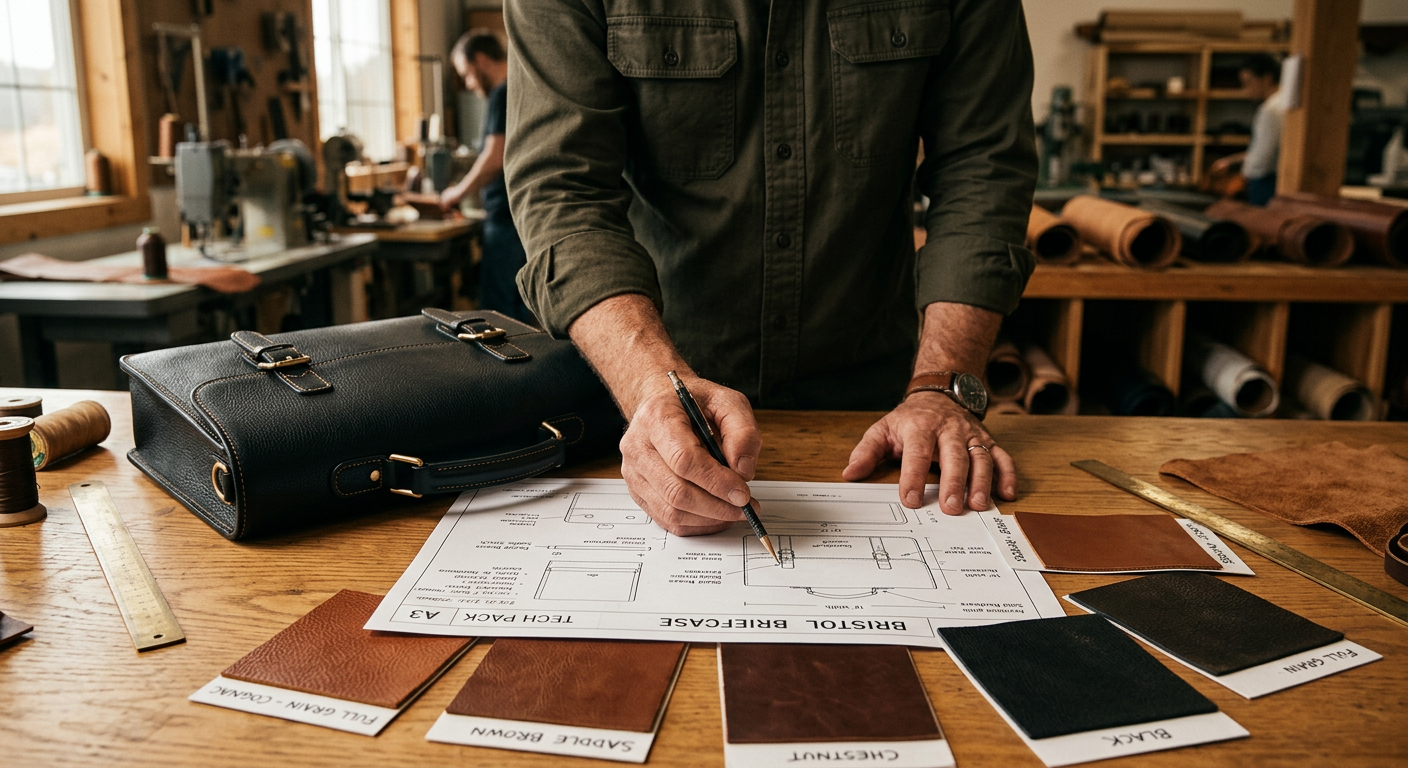
Navigating the B2B leather sourcing process is critical for brand success. This guide details our factory's entire journey, from tech pack review to final FOB shipment.
The buyer's problem
Choosing a manufacturing partner is one of the most consequential decisions a brand founder or buyer will make. The difference between a smooth, profitable production run and a series of costly, brand-damaging disasters often comes down to the factory's process and transparency. When communication is unclear, when samples don't match specifications, or when shipments are delayed without warning, your entire business is put at risk. This is why understanding the complete leather sourcing process from a factory's perspective is not just helpful—it is essential for mitigating risk and building a reliable supply chain.
For serious buyers, the goal is to find a partner who operates with predictable, documented procedures. You need to know what happens to your design once you send it, how materials are selected, what quality standards are enforced, and how your finished goods will make their way from the factory floor to your designated port. A trustworthy manufacturer demystifies this journey, providing clear checkpoints and accountability at every stage. This guide exists to do exactly that, outlining our end-to-end process so you can evaluate us and make an informed decision.
What the "leather sourcing process" actually means in a factory
To a buyer, the term leather sourcing process might simply mean finding the right hide for a product. In our factory, the term encompasses the entire production lifecycle, from interpreting your technical pack to the final boxed shipment. It is the master framework that translates your creative vision into a tangible, commercially viable product. It is a sequence of highly integrated steps that happen on the production floor, each one dependent on the last and benchmarked against your approved standards.
When we receive your tech pack, the leather sourcing process begins. It is not a search; it is a response. Your specifications for leather type (e.g., full-grain bovine, 1.4mm thickness, drum-dyed), hardware (e.g., YKK #5 zip in antique brass), and construction (e.g., 8 stitches per inch, rolled edges) trigger a series of precise actions. Our pattern makers create physical or digital templates. Our procurement team contacts our network of tanneries to secure hides that match your exact criteria. Our production managers schedule time on cutting, skiving, stitching, and finishing lines. Every detail on your spec sheet becomes a work order and a quality control checkpoint on the factory floor. This structured approach is what separates professional manufacturing from guesswork.
Materials, specs and standards
Precision in manufacturing begins with precision in specification. The quality of your final product is a direct result of the quality of the information you provide. A comprehensive tech pack is the single most important document in the entire production journey. It serves as the blueprint, the contract, and the ultimate quality reference. While we can certainly help fill in the gaps for newer brands, the more detail you can provide, the faster and more accurately we can quote and produce your samples.
We work with a wide range of materials, from vegetable-tanned and chrome-tanned leathers to specialised finishes like pull-up, Nappa, and Saffiano. We source from reputable tanneries and can provide swatches for your approval. The same goes for hardware, linings, and thread—every component is specified and agreed upon before a single hide is cut. To ensure we are aligned, we work to clear, measurable standards. The table below outlines some of the typical specifications we manage against. Providing your target values for these metrics is critical.
| Specification / Standard | Unit of Measure | Typical Range / Example | Why It Matters |
|---|---|---|---|
| Leather Thickness | Millimetres (mm) | 1.2 - 1.6 mm (Bags) | Affects the product's structure, weight, and durability. |
| Stitch Density | Stitches Per Inch (SPI) | 7 - 9 SPI | A key indicator of construction quality and aesthetic refinement. |
| Colour Consistency | Pantone (TCX) Code | Within Delta E < 2.0 | Ensures colour matches your brand standard across all units. |
| Dimensional Tolerance | Millimetres (mm) | +/- 3 mm | Defines the acceptable variation in the final product's size. |
| Edge Finish | Method | Painted, Burnished, Folded | Critical for aesthetics and preventing fraying; must be specified. |
| Hardware Plating | Description | Antique Brass, Polished Nickel | Determines the look, feel, and corrosion resistance of zips/buckles. |
| Defect Allowance (A-Surface) | Count per sq. foot | Max 1 minor defect | Manages natural hide variations to ensure a clean final product. |
| AQL Standard | Level (e.g., 2.5/4.0) | AQL 2.5 Major, 4.0 Minor | The statistical sampling plan for final quality inspection. |
Our process, step by step
To ensure transparency and consistent quality, we follow a rigorous 10-step process for every client, from start-up brands to established retailers. This structure is the backbone of our operation, detailed in our About TAT Manufacture profile.
Inquiry & Tech Pack Review: It starts when you request a quote. You send us your tech pack, sketches, or a physical reference sample. Our technical team immediately reviews it for manufacturing feasibility, flagging any potential construction issues or cost-saving opportunities.
Initial Quotation: Within 24-48 hours, we provide an initial quotation. This includes the estimated price per unit based on FOB (Free On Board) Chattogram terms, the specified materials, and the order quantity. We are clear about what drives the cost.
Material Sourcing & Swatching: Once you approve the initial quote, we begin sourcing the exact leather and hardware. We will send you physical leather swatches and hardware samples for your tangible approval. Nothing proceeds until you have signed off on the raw materials.
Prototyping & First Sample: Our master pattern-makers create the patterns, and a dedicated sampling team constructs the first prototype. This is a critical step in the leather sourcing process where we translate the 2D tech pack into a 3D product. This is where our custom / OEM programme truly shines.
Sample Feedback & Revisions: We ship the first sample to you for evaluation. You review it against the tech pack and provide feedback. We encourage specific, actionable comments (e.g., “move the pocket up by 1cm,” “use a thicker thread for the handle attachment”). If revisions are needed, we create a second sample incorporating your changes.
Pre-Production Sample (PPS) Approval: We produce a final, perfect sample—the Pre-Production Sample (PPS). This piece is made with the exact bulk materials and construction methods. Your formal approval of the PPS is our green light for mass production. It becomes the master standard against which every bulk unit is measured.
Bulk Production: Upon receiving your deposit and PPS approval, we begin production. This involves bulk leather cutting using dies for consistency, skiving to thin edges for clean seams, assembly-line stitching, and hardware attachment. Our production floor workflow is visible in our factory gallery.
Quality Control (QC): Quality is not just a final check. We have in-line QC supervisors who monitor production at every stage. Once production is complete, our dedicated QC team conducts a final inspection based on an AQL 2.5/4.0 standard, comparing each item to the approved PPS.
Packing & Documentation: Each item is cleaned, stuffed (if it's a bag), and packed in a polybag, then into master cartons as per your specifications. We prepare all necessary export documentation, including the commercial invoice, packing list, and bill of lading instructions.
Logistics & Final Shipment: Once the final QC report is approved and the final payment is received, we transport the goods to the Port of Chattogram and clear them through customs. Under FOB terms, your designated freight forwarder then takes over for shipment to your final destination.
Ready to move from research to samples? Send us your tech-pack or reference image and we'll come back within 24 hours with materials, MOQ and an FOB quote. Request a quote →
MOQs, lead times and pricing signals
Understanding the commercial realities of manufacturing is key to a successful partnership. We believe in being upfront about our operational parameters so you can plan effectively.
Minimum Order Quantity (MOQ): Our MOQ is 50 pieces per style, per colour. We have this minimum for several concrete reasons. Tanneries have minimum order requirements for custom-dyed hides. Creating cutting dies for a specific design has an upfront cost that is only economical when spread over a reasonable number of units. Finally, setting up a production line for a specific style involves labour and machine calibration that is inefficient for very small batches.
Lead Times: Time is a critical resource, and we manage our production schedule tightly.
- Sampling: 10-14 days from the confirmation of materials and tech pack details.
- Bulk Production: 25-45 days after your formal approval of the Pre-Production Sample (PPS) and receipt of the deposit. The exact time within this range depends on the complexity of the product and the total order volume. We provide a firm delivery date upon order confirmation.
Pricing Signals: Our pricing is quoted as FOB Port of Chattogram. This means the price includes the cost of the product, packing, and transport to the port. The buyer is responsible for the main sea/air freight, insurance, and any import duties or taxes at the destination country. The final price is a function of four main variables:
- Materials: A handbag made from Italian full-grain vegetable-tanned leather will be significantly more expensive than one made from standard corrected-grain cowhide.
- Complexity: A simple tote with one compartment is faster to produce than a multi-pocket leather backpack with complex construction.
- Hardware: Custom-branded, solid brass hardware costs more than generic zinc-alloy equivalents.
- Volume: Larger orders (e.g., 500+ units) may allow for slightly better unit pricing due to economies of scale in material purchasing and production efficiency.
Common mistakes buyers make
Over our 25 years in business, we have seen buyers succeed and struggle. The successful ones avoid a few common pitfalls. Here are some mistakes to watch out for in your own process:
Providing an Incomplete Tech Pack: A spec sheet with missing dimensions, material types, or hardware details leads to guesswork, delays, and incorrect samples.
- The Fix: Use a detailed tech pack template. If you don't have one, ask your potential manufacturer. Include clear drawings, all measurements, material specs, and Pantone codes.
Unrealistic Cost Expectations: Expecting a premium full-grain leather product at a synthetic leather price point. This misalignment wastes time in quoting and negotiation.
- The Fix: Be transparent about your target cost per unit. An experienced manufacturer can then suggest material or construction alternatives to help you meet your target without fatally compromising quality.
Rushing the Sampling Process: Authorising bulk production based on a 'good enough' sample with known flaws, assuming they will be fixed in bulk. This is a recipe for disaster.
- The Fix: Treat the Pre-Production Sample (PPS) as sacred. Do not approve it until it is perfect. Any flaw you accept in the PPS will be replicated across your entire order.
Giving Vague or Subjective Feedback: Comments like "make it look more premium" or "the quality feels off" are not actionable for a factory.
- The Fix: Provide precise, objective feedback. Instead of "make it better," say "increase stitch density to 8 SPI," "use a firmer interlining in the flap," or "the edge paint is too thin."
Forgetting About Logistics and Duties: Getting a great FOB price but failing to calculate the landed cost (including shipping, insurance, customs duties, and local transport).
- The Fix: Contact a freight forwarder early in the process. We provide the necessary HTS codes, carton weights, and dimensions so you can get an accurate landed cost estimate before you commit.
Misunderstanding Natural Material Tolerances: Expecting every full-grain leather item to be 100% identical. Natural hides have minor variations in grain and colour.
- The Fix: Work with your manufacturer to define an acceptable range of variation. Approve a range of swatches, not just a single perfect one, to set realistic expectations for production.
How to evaluate a supplier for this
When you are comparing potential manufacturers, you are not just comparing prices. You are evaluating a partner for their ability to execute the leather sourcing process reliably. Use this checklist to assess any factory you consider:
- Communication Clarity & Speed: Do they respond to your enquiry within 24-48 hours? Are their answers detailed and professional? Do they ask intelligent questions about your tech pack, or just give a price?
- Technical Understanding: Do they grasp the details of your design? Can they identify potential production challenges and suggest thoughtful improvements? A good partner improves your product.
- Process Transparency: Are they open about their step-by-step process? Do they clearly explain their MOQ, lead times, and pricing structure (e.g., FOB vs. EXW)?
- Sample Quality & Accuracy: When you receive a sample, is it a faithful execution of your tech pack? Is the craftsmanship clean? The quality of the first sample is a strong indicator of their capability.
- Proof of Experience: Can they show you examples of similar products they have made? Do they have a long history in the business? Our 25 years of experience is something we are proud of.
- Proactive Guidance: Do they guide you through the process, helping you with things like material selection or logistics planning? Or do they just passively wait for your instructions? A proactive partner is invaluable, especially for new brands.
Case snapshot
A start-up brand founder from Germany approached us to produce a new line of high-end, minimalist leather wallets and cardholders. Her background was in design, not production, and her initial tech packs were visually strong but technically sparse. The order was for 300 units across four styles (75 pieces each). The primary challenge was translating her aesthetic—which called for extremely thin profiles and clean, unpainted edges—into a durable product. Her initial material choice, a soft lambskin, was not suitable for the burnished edges she desired.
Our team worked with her through two rounds of sampling over three weeks. We explained that for a clean, burnished edge, a firmer, vegetable-tanned cowhide would be necessary. We sent her three different tannage options. We also prototyped a new internal construction method using skived layers to achieve the slim profile she wanted without sacrificing strength. The entire process, from first contact to the final goods being ready for shipment FOB Chattogram, took 10 weeks. This included the extended sampling phase. The outcome was a successful product launch that met her design vision and quality requirements, and she placed a reorder for double the quantity six months later.
Frequently asked questions
What determines the final price of a product?
The price is primarily determined by four factors: the cost of materials (leather, hardware, lining), the complexity of the design (which dictates the labour time), the order quantity (larger volumes have better economies of scale), and any special finishing or packaging requirements.
Why is your MOQ 50 pieces per style/colour?
Our 50-piece MOQ is set by the practical constraints of production. Tanneries have minimum purchase requirements for hides, especially for custom colours. Setting up machinery and cutting dies for a new design carries a fixed cost that becomes prohibitive on very small runs. This MOQ ensures we can operate efficiently and offer you a fair price.
Can I get a sample before placing a bulk order?
Absolutely. We insist on it. The sampling stage is mandatory to ensure we are perfectly aligned before mass production. We typically charge a sampling fee (e.g., 2-3x the estimated unit cost) to cover the cost of materials and our pattern makers' time. This fee is usually credited back to you when you place the bulk order.
How does shipping work?
We ship on FOB (Free On Board) Port of Chattogram terms. This means our price includes manufacturing the goods and delivering them to the port. You are responsible for arranging and paying for a freight forwarder to handle ocean or air freight, insurance, and customs clearance in your country. We provide all the necessary export documents and carton details (weight, volume, HTS codes) to make this process smooth for your forwarder. We have a detailed guide in our Buyer FAQ.
Can you create a completely custom design?
Yes, that is the core of our business. Around 95% of our production is for custom, private-label designs for brands. We work from your tech packs, sketches, or reference samples to bring your unique vision to life. This is the essence of our OEM/private label service.
How do you ensure quality control?
We employ a multi-stage QC process. First, all incoming raw materials are inspected. Second, we have supervisors who perform in-line checks at key stages of the assembly process. Finally, upon completion, a separate QC team performs a final inspection of a statistically significant portion of the order based on AQL 2.5/4.0 standards, checking every detail against the approved Pre-Production Sample.
Next step
Understanding the manufacturing journey is the first step towards building a successful product line. The next is to take action. If you are ready to move from planning to production, send us your design specifications.
Request a quote via our contact form and let's begin the process of building your next collection of leather bags together.
Ready to manufacture
Request a quote from TAT Manufacture
Full-grain leather, low MOQ from 50 pcs, OEM & private label. Get a detailed itemised quote within 24 hours.
25 years of leather manufacturing craftsmanship.
Services →OEM, private label, and custom leather production.