How to Protect Leather Products During International Shipping
Protect your investment. Learn the professional leather export packaging methods that prevent mould, crushing, and moisture damage during international shipping. We detail the materials, processes, and standards that ensure your leather goods arrive in pristine, retail-ready condition.
The buyer's problem
Finalising a production run is a significant milestone for any brand. Your designs have been perfected, samples approved, and manufacturing completed. The final, crucial step is getting those products from our factory floor to your warehouse or distribution centre, often halfway across the world. This is where many brands, especially those new to sourcing, underestimate the risks. Receiving a container of beautifully crafted leather goods damaged by mould, crushed out of shape, or stained by water is a catastrophic, and entirely preventable, scenario. It represents not just lost inventory and revenue, but also launch delays, broken promises to retailers, and long-term damage to your brand's reputation for quality.
Choosing a manufacturing partner must therefore go beyond assessing stitching quality and leather grading. You must have confidence in their logistical expertise, particularly their approach to leather export packaging. A factory that treats packaging as an afterthought is a factory that puts your entire investment at risk. The journey from Chattogram Port to Rotterdam, New York, or Sydney is fraught with humidity fluctuations, temperature extremes, rough handling, and container condensation. The right packaging is not an expense; it is insurance, ensuring the value we build into your products at the bench is the same value you unbox in your facility.
What "leather export packaging" actually means in a factory
In a professional manufacturing environment, leather export packaging is a formal, documented system, not just the final step of putting items in a box. It is a series of precise actions and material choices designed to create a protective micro-environment for each product, shielding it from the three primary enemies of international freight: moisture, compression, and abrasion.
At its core, the process involves creating multiple layers of defence. It begins long before a product sees a shipping carton. After passing final quality control, leather goods are moved to a designated, climate-controlled packing area. This is crucial for stabilising the moisture content of the leather itself before it is sealed. The process differs significantly from packaging for domestic sale. A product sold within Bangladesh might only require a simple dust bag and a retail box. An exported product, however, must be prepared to spend 30-45 days in a sealed steel container on the ocean, where temperatures can swing wildly, causing condensation (known as 'container rain') to form on the interior walls.
Our approach to leather export packaging addresses this with a multi-layered strategy:
- Moisture Control: The primary goal. We use desiccants like silica gel sachets placed inside items like leather bags and anti-mould chipsets (e.g., Micro-Pak®) inside the sealed outer polybag. This combination actively absorbs ambient moisture within the packaging, preventing the germination of mould spores.
- Shape & Structure Preservation: Handbags, backpacks, and jackets cannot be packed flat without risking permanent creasing or damage. We use specific acid-free paper stuffing, inflatable air pillows, or custom foam inserts to ensure the product maintains its intended silhouette from our factory to your customer's hands.
- Surface & Hardware Protection: High-quality leather is durable but can be scuffed. Polished metal hardware like buckles, zips, and logos are susceptible to scratching. Each item is first wrapped in a soft material, like a non-woven dust bag or soft tissue paper, and hardware is often covered with a removable protective film.
- Carton Integrity: The master shipping carton is the product's suit of armour. We use high-strength, multi-ply corrugated cartons (typically 5-ply or 7-ply) that resist crushing when stacked inside a container. The carton's design, flute direction, and burst strength are all specified to handle the rigours of transit and multiple handling points.
This systematic approach ensures that every piece arrives in factory-fresh, retail-ready condition, ready for immediate sale without the need for costly and time-consuming re-conditioning or repairs.
Materials, specs and standards
Specificity is paramount in professional packaging. Vague instructions lead to inconsistent results. Over our 25 years in business, we have refined a set of standard materials and specifications that provide a robust baseline for all international shipments. While we can easily accommodate a client's specific requirements (such as branded retail boxes or unique wrapping), our default protocol is designed for maximum protection. Buyers should be familiar with these terms and standards when preparing a tech pack or evaluating a supplier.
We work to clear, measurable standards. The table below outlines some of our typical specifications for leather export packaging materials. These are the details that make the difference between a successful shipment and a damaged one.
| Component | Specification / Standard | Purpose |
|---|---|---|
| Silica Gel Desiccant | 2-5g sachet per wallet; 10-50g sachet per bag | Absorbs ambient moisture inside the product and its immediate packaging. |
| Polybag | LDPE, 30-50 microns thick, with suffocation warning print | Creates a sealed barrier against external humidity, dust, and dirt. |
| Anti-Mould Chip/Sticker | 1-2 pieces per sealed polybag | Actively releases an anti-microbial agent to sanitise the air inside. |
| Stuffing Paper | Acid-free tissue or kraft paper, 28-40 GSM | Maintains product shape without transferring acids or colour to leather. |
| Master Carton | 5-ply or 7-ply corrugated board, min. 200 PSI burst strength | Prevents crushing and structural damage during stacking and transit. |
| Protective Hardware Film | Low-tack adhesive clear film | Protects polished metal buckles, logos, and zip pullers from scratches. |
| Carton Strapping | Polypropylene (PP), 12mm width | Reinforces carton integrity and provides secure handling points. |
| Humidity in Packing Area | Maintained below 60% Relative Humidity (RH) | Ensures products are packed in a dry state before being sealed. |
Understanding these material specifications allows for a more productive conversation with your manufacturer. When you request a quote for custom leather goods, being able to discuss whether you need 5-ply versus 7-ply cartons shows a level of professionalism that helps us tailor your quotation and production plan accurately from the very beginning.
Our process, step by step
To provide full transparency, here is the exact, step-by-step process each of your products follows from the final QC check to its departure from our factory.
Final Quality Control & Conditioning: Every single item undergoes a final inspection for craftsmanship, materials, and function. Once passed, it is moved to our dedicated, climate-controlled packing hall to acclimate for at least 12-24 hours. This stabilises the product's temperature and moisture content.
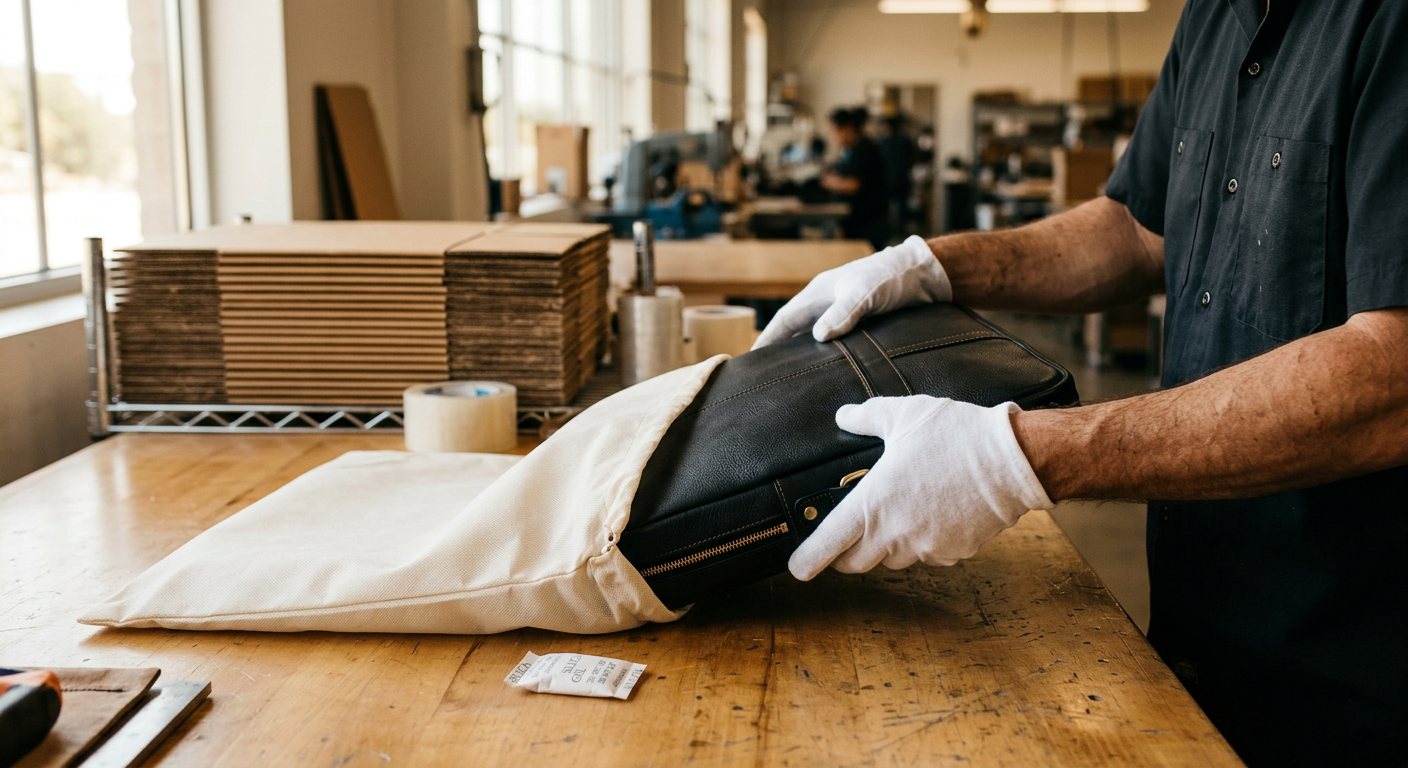
Hardware & Surface Protection: Our team, wearing cotton gloves to prevent fingerprints, applies low-tack protective film to all polished metal hardware. Delicate or embossed surfaces may be covered with a sheet of soft, acid-free tissue paper.
Stuffing for Shape Retention: For items like leather backpacks or tote bags, we carefully fill the main compartments with bundled acid-free paper or inflatable air pillows. This is done to preserve the design's intended structure and prevent deep creases from forming during transit.
Primary Wrapping & Desiccant Insertion: The product is placed into its non-woven dust bag. Just before closing, the correctly sized silica gel sachet is placed inside the product (e.g., in the main compartment of a bag or a billfold section of a leather wallet).
Sealing in Polybag: The dust-bagged product is then placed into a clear, appropriately sized low-density polyethylene (LDPE) polybag. An anti-mould sticker is placed inside, and the bag is securely sealed. This creates a contained, protected micro-climate.
Retail Boxing (If Applicable): If the order includes individual retail boxes, the sealed product is then placed into its box. We often add extra tissue paper to prevent movement within the box.
Master Carton Packing: We strategically arrange the items within the heavy-duty master shipping carton. Heavier items go to the bottom, and voids are filled with dunnage (filler material) to prevent shifting. We never over-pack, as this is a primary cause of crushing.
Carton Sealing, Strapping & Labelling: The master carton is sealed with high-tack packing tape, with all seams covered. For heavier cartons, we add two polypropylene straps in each direction for reinforcement. We then affix the shipping marks, which include consignee details, PO number, carton dimensions, weight, country of origin ('Made in Bangladesh'), and HTS code (e.g., 4202.21 for handbags).
Pre-Shipment Storage: The sealed, marked cartons are stored on pallets in a secure, dry area of our factory, elevated off the floor, awaiting collection for transport to Chattogram Port.
Container Loading Supervision: Whenever possible, a member of our logistics team supervises the loading of the cartons into the shipping container to ensure they are stacked correctly and the container is clean and dry before sealing.
MOQs, lead times and pricing signals
Understanding how packaging intersects with pricing and production timelines is key for effective planning. At TAT Manufacture, we aim for clarity in all our commercial dealings.
Our standard Minimum Order Quantity (MOQ) is 50 pieces per style, per colour. This accessible MOQ is designed to support both established brands testing new lines and emerging designers launching their first collection. The cost of our comprehensive, multi-layer export packaging, as detailed above, is included in the FOB (Free On Board) price we quote you.
Here are the typical timelines you can expect when working with us:
- Sampling: Once we have your tech pack and you've approved our initial quotation, producing a physical sample takes approximately 10-14 days.
- Mass Production: After you approve the pre-production sample and place your bulk order, manufacturing lead time is between 25 and 45 days. The exact duration depends on the complexity of the product (a simple leather belt is faster than a complex jacket), the size of the order, and the availability of any unique, custom-sourced materials.
Our pricing is quoted as FOB Chattogram Port, Bangladesh. This means our price includes manufacturing the product to your specification, packing it for export, and delivering it to the port, ready to be loaded onto the vessel you have booked. You, the buyer, are responsible for the ocean freight, insurance, and any import duties or taxes in the destination country. This is a standard and transparent Incoterm used globally.
While our standard packaging is robust, some brands have specific needs that can affect the price. For example:
- Custom-Printed Retail Boxes: If you require high-quality, full-colour printed retail boxes, we can source these for you. The cost will be quoted separately as an add-on to the FOB unit price.
- Upgraded Carton Specs: If your distribution network involves exceptionally rough handling and you require 7-ply cartons instead of our standard 5-ply, there would be a small surcharge per carton.
- Container-Lining Desiccants: For shipments to extremely humid destinations or during high-risk seasons, we can arrange for the entire container to be lined with large-format desiccant blankets. This is a service with an additional cost, passed on to you at-rate.
We always itemise and explain any costs beyond the standard FOB price, ensuring there are no surprises.
Common mistakes buyers make
Over the years, we have seen buyers make the same few preventable mistakes that compromise their shipment's safety. Here are the most common ones and how to avoid them.
Mistake: Leaving packaging details out of the tech pack.
- The Fix: Your tech pack should have a dedicated page or section for packaging. Specify the type of dust bag, polybag thickness, desiccant requirements, and any retail box specifications. If you don't have specs, simply state "Factory to use its standard export packaging for approval."
Mistake: Not requesting packaging photos before shipment.
- The Fix: As part of your quality control process, insist on receiving clear photos of your products being packed. Ask for pictures of the individual wrapping, the master carton being packed, and the final sealed carton with shipping marks. It's a simple step that verifies the process is being followed.
Mistake: Forgetting about product shape.
- The Fix: For structured products like bags and backpacks, explicitly specify the need for stuffing material (e.g., "Stuff with acid-free paper to maintain shape"). Without this instruction, a factory might pack items flat to save space, resulting in creased, unsellable goods.
Mistake: Approving a weak retail box design.
- The Fix: If we are sourcing retail boxes for you, ask for samples to be included with your product sample. Test it yourself. Can it withstand pressure? Does it protect the product? A flimsy retail box will be crushed inside the master carton.
Mistake: Using vague or incomplete shipping marks.
- The Fix: Provide your freight forwarder's recommended shipping mark format as a clear diagram. Incomplete or incorrect marks can lead to major delays at customs or even lost cartons at a busy port. We always send our proposed shipping mark layout for your final approval before printing.
Mistake: Trying to cut costs on cartons.
- The Fix: The master carton is not the place to save a few cents. A collapsed pallet of goods due to weak cartons will cost you thousands. Trust your manufacturer's recommendation on the appropriate carton strength (ply and burst rating) for your product's weight and journey.
How to evaluate a supplier for this
When you are comparing potential manufacturing partners, you need to assess their packaging and logistics capability with the same rigour you apply to their leatherwork. Here is a practical checklist to guide your evaluation:
Request their Standard Operating Procedure (SOP) for Packaging: A professional factory will have a documented process. Ask to see it. It should detail materials, steps, and QC checks.
Ask for Photographic Evidence: Request photos from a recent shipment of a product similar to yours. Look for consistency, cleanliness, and the use of protective materials as described.
Inspect the Packing Area: If you visit the factory (or take a virtual tour, which you can get a sense of from our factory gallery), pay close attention to the packing department. Is it clean, dry, and organised, or is it a chaotic afterthought in a damp corner?
Discuss Humidity Control: Ask direct questions. "How do you monitor and control humidity in your packing and pre-shipment storage areas?" Look for specific answers involving hygrometers (humidity meters) and climate control systems.
Provide Your Own Packaging for a Test-Pack: If you have existing retail packaging, send a few units to the factory along with your sample request. Ask them to pack the sample using your box and send it back to you. This is the ultimate test of how it will survive.
Inquire About Their Logistics Experience: Ask which countries they ship to most frequently. An experienced exporter will be familiar with the customs and import requirements for major markets like the EU, USA, and UK, and can often provide advice on HTS codes and documentation.
Clarify What's Included: During quotation, ask for a clear breakdown: "Does your FOB price include individual polybags, silica gel, and 5-ply master cartons?" A transparent partner will answer directly.
Ready to move from research to samples? Send us your tech-pack or reference image and we'll come back within 24 hours with materials, MOQ and an FOB quote. Request a quote →
Case snapshot
Client: A mid-sized German fashion brand. Order: 3,000 units of a complex, multi-pocket leather travel bag, split across three colours. Challenge: The order was scheduled to ship from Bangladesh in July and arrive in Hamburg in late August, a period with high heat and humidity at both origin and destination. The client was extremely concerned about the risk of mould, having faced issues with a previous supplier in another country. The bag's structure was also complex, with several external pockets that needed to retain their shape. Our Solution: We proposed a 'triple-lock' moisture defence system. First, a 50g silica gel sachet was placed inside the main compartment of each bag. Second, each bag was sealed in a 40-micron polybag containing two Micro-Pak® anti-mould stickers. Third, the master cartons themselves were lined with a large kraft paper sheet impregnated with a desiccant clay. To maintain the bag's shape, we created custom-cut foam inserts for the main compartment and used rolled acid-free paper for the external pockets. We provided the client with a detailed photo report of the packing process for the first 100 units before proceeding with the bulk. Timeline & Outcome: Production took 42 days. Sea freight from Chattogram to Hamburg took 34 days. The client's distribution centre conducted a 100% inspection upon arrival and reported zero instances of mould, moisture damage, or compression. The bags went straight into their inventory system and were launched online on schedule, resulting in a strong sell-through and a follow-up order for our client's next season.
Frequently asked questions
Is your export packaging included in the FOB price?
Yes, our standard, high-quality leather export packaging is fully included in the FOB Chattogram price we quote. This includes appropriate stuffing, a non-woven dust bag, a sealed polybag, silica gel desiccants, anti-mould chips, and a robust 5-ply or 7-ply master carton. The only time there are additional costs is if you require custom-printed retail packaging or non-standard materials, which we will always quote for you transparently upfront.
What is your minimum order quantity (MOQ)?
Our standard MOQ is 50 pieces per style and per colour. We have structured our production to accommodate this accessible quantity, allowing brands of all sizes to work with us. Whether you are launching a new product or replenishing a bestseller, this MOQ provides flexibility for your inventory management. For a more detailed discussion, please see our buyer FAQ page.
How do you prevent mould during sea freight?
We take mould prevention very seriously. It is a multi-step process. First, we ensure all leather products are conditioned in a climate-controlled environment before packing. Second, we use a calculated amount of silica gel inside each item. Third, we seal the item in a polybag with an anti-mould agent like a Micro-Pak® sticker. This creates a stable micro-climate. For high-risk routes or seasons, we can also advise on and arrange for container-level desiccants for maximum protection.
Can we use our own branded packaging?
Absolutely. We actively encourage brands to supply or specify their own branded retail boxes, dust bags, or tissue paper to create a cohesive customer experience. You can either free-issue the materials to our factory, or you can provide us with the detailed specifications and artwork, and we will source them on your behalf from our network of trusted local packaging suppliers. This is a core part of our custom / OEM private-label programme.
What information do you need for shipping marks?
To ensure your goods are handled correctly and clear customs smoothly, we require a standard set of information for the shipping marks on each master carton. This typically includes: Consignee (your company name/address), Destination Port, Purchase Order Number, Style Number, Carton Number (e.g., 'Carton 1 of 250'), Quantity per Carton, Gross Weight (GW), Net Weight (NW), Carton Dimensions (L x W x H), and Country of Origin ('Made in Bangladesh'). We will provide you with a template to fill in and approve before we print the marks.
How long does shipping take from Bangladesh?
Once your order is complete and loaded onto the vessel (the FOB point), sea freight transit times vary by destination. As a general guide from Chattogram Port (CGP): to major European ports like Rotterdam or Hamburg is approximately 30-40 days; to the US East Coast (e.g., New York/New Jersey) is about 35-45 days; and to the US West Coast (e.g., Long Beach) is around 30-40 days. Air freight is significantly faster at 5-10 days but is a far more expensive option, typically reserved for urgent samples or very high-value, low-volume orders.
Next step
Protecting your product during transit is a non-negotiable part of a successful global sourcing strategy. By partnering with a manufacturer who obsesses over these details, you ensure your investment arrives safely and your brand's quality promise is kept. If you are ready to discuss an upcoming project, send us your tech-pack or design ideas.
We will provide a detailed quotation, including a full breakdown of our process for getting your finished leather jackets or accessories to you in perfect condition. Request your free quote today →
Ready to manufacture
Request a quote from TAT Manufacture
Full-grain leather, low MOQ from 50 pcs, OEM & private label. Get a detailed itemised quote within 24 hours.
25 years of leather manufacturing craftsmanship.
Services →OEM, private label, and custom leather production.