Leather Manufacturing
How to Balance Cost, Quality, and Delivery in Leather Manufacturing
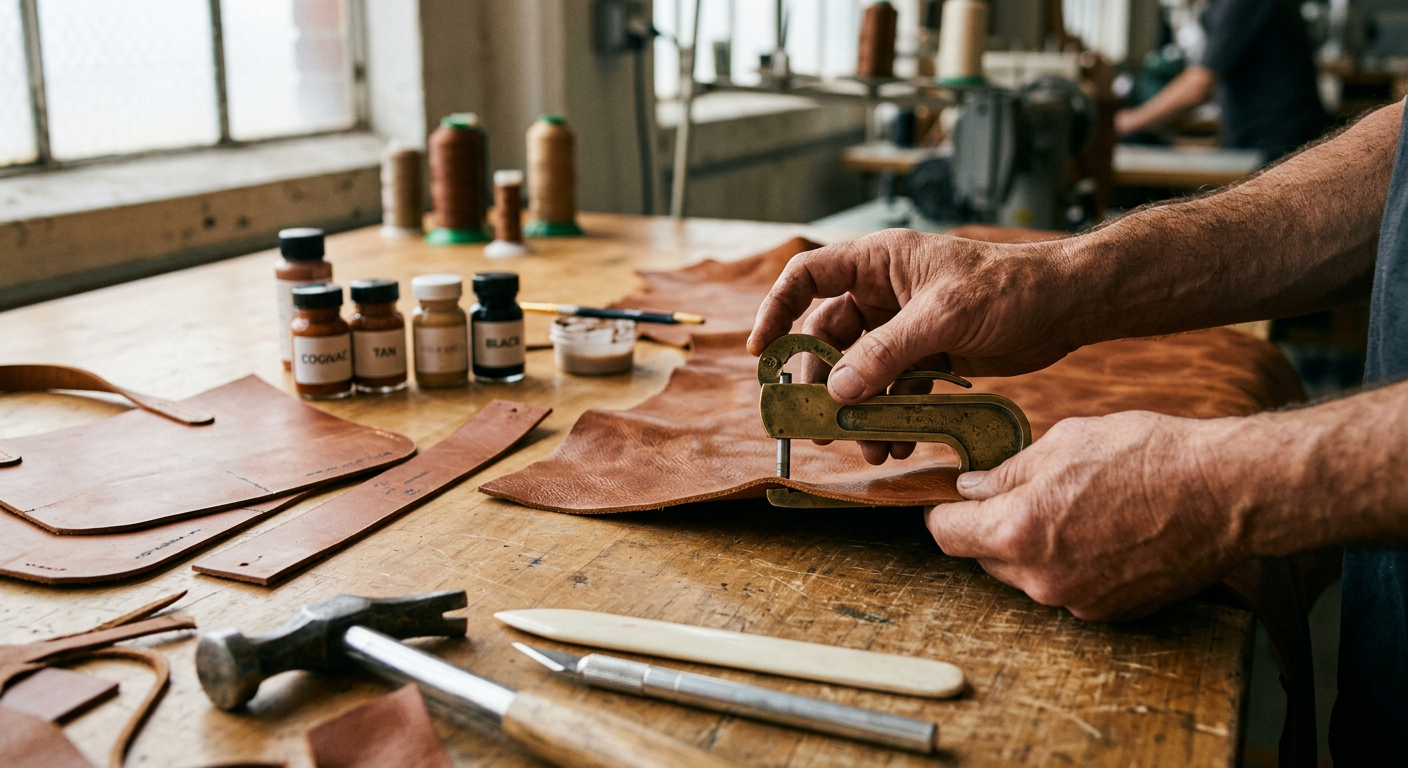
Learn how to balance unit cost, finished quality, and factory lead times on the production floor with actionable sourcing insights directly from an export manufacturer.
The buyer's problem
Every sourcing manager, brand founder, and procurement director faces the classic manufacturing trilemma: cost, quality, and delivery speed. In leather goods production, the pressure is particularly unforgiving. Leather is an organic, non-uniform raw material where yield variations can instantly undermine a landed-margin calculation, while an unexpected delivery delay can leave seasonal retail shelves empty during peak trading quarters.
Most buyers approach this challenge by attempting to negotiate aggressively on unit price alone, only to find that the factory quietly compensates by downgrading hide selection, skipping interlining steps, or rushing wet-edge finishing. Alternatively, buyers over-specify materials beyond their market's willingness to pay, burning through working capital and missing delivery windows due to protracted raw material procurement. Finding equilibrium requires an operational understanding of how a factory actually converts your tech-pack into a physical, boxed product. Developing a coherent leather manufacturing strategy is the only repeatable way to control landed costs without sacrificing standardisation or missing critical launch deadlines.
What "leather manufacturing strategy" actually means in a factory
A viable leather manufacturing strategy is not a slide deck or a theoretical purchasing philosophy. On our production floor, it is the deliberate synchronisation of raw hide selection, pattern nesting, component preparation, assembly line balancing, and freight scheduling to meet a clear commercial target. When you define your strategy early, every operational station in the factory knows how to treat your order.
Take raw material utilisation as a primary example. In genuine full-grain leather, hide surfaces feature natural variations, neck wrinkles, healed wire scratches, and insect bites. If your brand positioning demands pristine, unmarked panels across large pattern pieces—such as the front faces of leather bags—cutting yields can drop to 55% or 60%. That means 40% of the purchased leather becomes scrap or must be relegated to unseen interior reinforcements. Conversely, if your product architecture incorporates smaller cut panels, pieced construction, or can accommodate character marks in non-critical zones, yield climbs to 75% or 80%. That operational shift alone reduces square-footage consumption per unit by 20% to 25%, shaving substantial cost off the bill of materials without degrading the integrity of the finished article.
The strategy also dictates machine selection and labour allocation. A small run of complex leather backpacks requiring extensive hand-skiving and triple-pass edge painting will occupy our senior sample-room artisans, moving through dedicated workstation benches rather than high-speed progressive assembly lines. In contrast, standardised commercial runs of leather wallets or structural leather belts utilise hydraulic clicker presses, automated edge-staining carousels, and computer-controlled pattern sewing machines. A disciplined leather manufacturing strategy forces clarity on these trade-offs before a single knife cuts into leather: you choose whether your margins are driven by raw material prestige, pattern modularity, or assembly throughput.
Materials, specs and standards
Quality disputes between buyers and manufacturers almost always stem from vague specifications. A tech-pack that simply calls for "genuine brown cowhide" invites variance. To secure consistent production runs that arrive on time and within budget, specifications must be defined in measurable, testable engineering units.
The table below outlines the core parameters, physical tolerances, and testing protocols we monitor across our production lines:
| Component / Parameter | Specification Range | Testing Standard / Method | Floor Tolerance | Commercial Impact on Cost & Lead Time |
|---|---|---|---|---|
| Leather Subsidiarity & Tannage | Full-grain chrome-tanned / Semi-veg cowhide (1.2–1.4 mm) | ISO 2589 (Thickness measurement) | ±0.1 mm across hide belly to butt | Premium selection increases raw material cost by 18-25%; raw tannery lead time 14-20 days |
| Tensile & Tear Strength | Minimum 15 N/mm² tensile; 30 N tear strength | ISO 3376 / ISO 3377-2 | Min threshold; zero negative tolerance | Protects against structural seam blowouts; low impact on unit cost, critical for warranty claims |
| Finish Adhesion & Wet Rub | Fastness to cyclic rub: dry 500 cycles, wet 150 cycles | ISO 11640 (Veslic rub tester) | Grade 4 grey scale minimum | Inadequate finishing leads to colour crocking on apparel; correct cross-linking agents add 2% to finishing cost |
| Edge Finishing (Edge Paint) | Polyurethane-acrylic basecoat + 2 colour coats + topcoat | SATRA TM160 (Flex cracking at 20°C) | Total edge build: 0.3–0.5 mm; no air bubbles | High manual labour input; drying time adds 3-4 days to assembly flow unless forced-convection ovens are used |
| Stitching Thread | Continuous filament bonded nylon or polyester (Tex 70 to Tex 90) | ISO 2062 (Thread breaking force) | Metric ticket size 30–40; 6–8 stitches per inch (SPI) ±0.5 SPI | High-tenacity thread prevents machine down-time and thread snap during production; negligible unit cost impact |
| Metal Hardware Plating | Solid brass or zinc alloy (Zamak 3) with PVD / electroplating | ASTM B117 (Neutral salt spray testing) | Minimum 48-hour salt spray without red or white corrosion | Zinc alloy reduces hardware costs by 40% vs solid brass; custom tooling dies require 15 days lead time |
| Lining Material | 100% twill cotton (220–280 gsm) or ripstop polyester | ISO 13934-1 (Fabric tensile properties) | ±5% weight; colour fastness to water Grade 4 | Poor lining selection tears at pocket mouth seams; low-cost upgrade that prevents costly retail returns |
| Bonded Reinforcements | Non-woven microfibre boards (0.4–0.8 mm) / Salpa reconstituted leather | Internal peel-adhesion bond test (ASTM D903) | 100% glue transfer coverage on skived margins | Controls structural shape retention; essential for maintaining silhouettes in bags and wallets over time |
Our process, step by step
To keep unit economics predictable and shipping dates uncompromised, we process client orders through a closed-loop eight-stage system. This sequence prevents unvetted engineering decisions from reaching mass production.
Technical pack audit and bill-of-materials cost analysis Upon receiving your design files, our engineering team assesses your pattern geometries, required hide specifications, hardware blueprints, and finishing details. We calculate net leather yields and highlight potential manufacturing bottlenecks—such as excessively tight corner radiuses or unsupported load points—proposing material alternatives to protect your target margin.
Tannery formulation and hardware procurement We source raw hides directly from audited tanneries. Tannages are calibrated to your required temper, thickness (measured in millimetres with dial callipers), and target pantone reference. Concurrently, casting dies or custom stamping moulds for your zinc alloy or brass hardware are assigned to our metalworking partners.
Prototyping and counter-sampling Our dedicated sample masters build the first prototype. This stage reveals real-world material behaviour: how the leather folds along skived edges, how interlinings bond under pressure, and how reinforcement boards support structure. We verify internal pocket clearances, stitch balances, and zipper smooth-glide action. This sample is dispatched to you alongside swatch cuttings for physical review.
Sample sign-off and golden seal lock Once revisions are completed, we manufacture two final identical samples. One is couriered to your technical team; the second is tagged as the factory "Golden Seal". This unit stays suspended in our production control room as the visual and physical benchmark against which all end-of-line quality control inspectors measure the mass production run.
Clicking and preparation Depending on run volume and material characteristics, leather is cut using steel rule dies on hydraulic swing-arm clicking presses or precision automated CNC oscillating blade cutting tables. In the prep line, pieces undergo edge-skiving (splitting leather margins down to feather-thicknesses of 0.4 mm for turning), edge-creasing, thermal logo stamping, and base-layer reinforcement bonding.
Sub-assembly and main line stitching Production proceeds through modular sub-assemblies: pocket lines, strap and handle construction, and lining prep. These converge at the main assembly tables where heavy-duty cylinder-arm and walking-foot industrial sewing machines assemble the primary structural 3D shell. High-wear stress points receive bar-tack stitches or reinforced internal box-x joins.
Edge paint finishing and dry-cycle curation Edges are smoothed, hand-sanded with fine abrasive papers, primed with clear basecoat, and finished with layered Italian water-based polyurethane edge paints. Each layer must dry fully in temperature-controlled curing chambers before subsequent coats are applied, preventing cracking, peeling, or tackiness during ocean transit.
Full inline QC, packaging, and export staging Every unit is subjected to functional inspection: zipper cycle test, hardware latch clearance, structural alignment, loose thread elimination, and surface cleaning. Goods are packed with acid-free tissue stuffing to maintain form, sealed in individual polybags or cotton dust covers, crated into export-grade five-ply corrugated master cartons, and staged for container loading.
MOQs, lead times and pricing signals
Transparency around minimums, calendars, and price structures allows sourcing directors to build realistic merchandise financial plans. We reject the practice of quoting unrealistically low prices or hyper-compressed timelines simply to capture a deposit, only to alter terms halfway through production.
Our baseline minimum order quantity across standard collections is 50 pcs per style and colourway. This volume is intentionally accessible: it allows independent brands to launch balanced collections without tying up cash in dead inventory, while permitting us to order dedicated hide batches from our partner tanneries without incurring split-lot surcharges. For multi-component or custom-moulded designs, our custom manufacturing programme works with brands to stagger production runs efficiently.
Lead times follow a clear, two-phase calendar:
- Sampling phase: 10–14 working days from technical pack confirmation and receipt of sampling materials.
- Mass production phase: 25–45 working days following sample approval and purchase order deposit, scaling based on order volume and hardware customisation requirements.
All pricing is calculated on an FOB Chattogram (Chittagong), Bangladesh basis. Sourcing from our vertical regional footprint allows buyers to bypass the elevated baseline labour overheads seen in southern China or southern Europe, while still accessing premium grade leather. Shipping out of Chattogram port provides direct feeder access to primary transshipment hubs in Singapore, Colombo, and Port Klang, connecting with major ocean container lines servicing Rotterdam, Hamburg, Felixstowe, New York, and Los Angeles.
When evaluating pricing signals, understand that the bill of materials accounts for 50% to 65% of the ex-factory unit price on leather goods. If an offshore factory offers a quote that is 30% below prevailing international market rates, they have not discovered a production secret. They are inevitably substituting split leather with heavy polyurethane coatings for full-grain stock, switching to corrosive low-grade iron hardware (HTS code 8308), omitting reinforcement layers, or running unbonded threads that disintegrate under UV exposure.
Common mistakes buyers make
Failing to specify edge paint application standards and drying cycles
Buyers frequently specify edge paint colour while ignoring formulation and application passes. Low-grade edge paint applied in a single thick coat directly over unsealed raw edges will split and peel within three months of consumer use.
The fix: Mandate a minimum 3-pass application (one primer/filler basecoat, two colour coats, one protective topcoat) with mechanical light sanding between coats, verified to pass SATRA TM160 cold-flex benchmarks.Over-specifying leather temper for structured silhouettes
Selecting a very soft, oil-tanned leather for an architecturally rigid tote bag forces the factory to pack the interior with heavy, synthetic, non-breathable paperboards, which compromises the tactile hand-feel and adds shipping weight.
The fix: Select a firmer veg-retan cowhide with an intrinsic 3.5–4.5 oz temper for structural patterns, reducing reliance on synthetic stiffeners.Treating hardware as an afterthought late in sampling
Waiting until patterns are finalised to source buckles, snap hooks, and swivel clasps leads to significant delays. Custom zinc alloy hardware requires tooling moulds that take 12 to 18 days to mill, test, and plate.
The fix: Approve your hardware specifications, base metals, and plating finishes (such as electro-plated brushed nickel or antique brass) simultaneously with your initial pattern submission.Ignoring leather yield loss when calculating target prices
Buyers often take the square footage of flat pattern cutouts, multiply it by the square-foot leather cost, and assume that equals raw material cost. They fail to factor in natural hide geometry, perimeter wastage, and surface defect clearance.
The fix: Always factor a 25% to 40% cutting loss into unit material budgets for top-tier full-grain leather, or adjust pattern panels so smaller offcuts can be integrated into interior pockets, card slots, or items like leather accessories.Neglecting customs classification and regional compliance early
Classifying finished goods incorrectly can result in unexpected tariff liabilities at import ports. For example, a bag with an outer surface of composition leather carries different customs duty rates (often under HTS 4202.21 versus 4202.22) compared to pure bovine top-grain leather.
The fix: Request preliminary HS/HTS commodity classifications and country-of-origin documentation from our export team prior to final commercial invoicing.Over-compressing sampling rounds to meet retail drop dates
Attempting to compress a 12-day sampling window into 4 days forces factories to skip wear-testing and glue-curing verification. Defects remain unnoticed until thousands of finished pieces arrive at your distribution centre.
The fix: Build an 8-week buffer into your launch roadmap for new silhouettes, ensuring thorough counter-sample testing before releasing mass production cutting orders.
How to evaluate a supplier for this
When vetting an offshore leather goods factory, standard marketing claims like "uncompromising quality" provide zero insight into operational capability. Sourcing managers must interrogate how the facility manages quality assurance, resource planning, and material sourcing on the shop floor.
Use this evaluation framework during supplier audits:
- Assess raw material incoming inspection protocols: Ask the supplier how incoming leather lots are inspected. Do they check batch thickness across butt, belly, and shoulder sections with standardized thickness gauges? Do they inspect color consistency across hides under a D65 standardized light booth? A competent factory will show you physical incoming raw material inspection logs.
- Review cutting floor technology and nesting practices: Determine whether the factory cuts leather exclusively by hand with cardboard templates or employs steel clicking dies and CNC oscillating cutters. Die cutting ensures absolute piece-to-piece pattern repeatability; manual knife cutting on large production orders inevitably introduces assembly variance across seam margins.
- Examine machine maintenance standards: Walk the sewing lines (or review high-resolution production video). Look at needle-feed and walking-foot equipment. Are machines clear of accumulated thread lint? Are bobbin tensions routinely calibrated using tension gauges, or left to guess-work? Consistent tension prevents loose underside loops and thread bunching.
- Verify worker skill allocation and specialization: Leather manufacture relies heavily on manual skill. Inquire about the average tenure of assembly craftspeople, particularly those handling critical stations like skiving, corner folding, and edge-painting. You can learn more about our factory lineage, bench artisans, and operational heritage across 25 years of continuous production by visiting our about us overview.
- Check export documentation fluency: Ensure the factory provides clear bills of lading, verified gross mass (VGM) declarations, certificates of origin, and transparent packing lists broken down by gross weight, net weight, and cubic measurement (CBM). Inspect how goods are packed to prevent mould accumulation during tropical sea transits.
--- INSERT MID-POST CTA BLOCK HERE (verbatim, on its own line) ---
Ready to move from research to samples? Send us your tech-pack or reference image and we'll come back within 24 hours with materials, MOQ and an FOB quote. Request a quote →
Case snapshot
A mid-tier lifestyle brand based in Melbourne, Australia, approached us to manufacture their core range of commuter leather backpacks. Their previous domestic and regional suppliers had left them caught between unsustainably high unit costs (which choked their wholesale margins) and erratic delivery schedules that caused stockouts during the fourth-quarter holiday trading period.
We audited their technical drawings and identified that their previous design utilised large single-panel leather cuts across hidden base and back-lining panels, generating an excessive cutting waste rate of 38%. We re-engineered the back-panel construction, introducing an ergonomically quilted mesh-and-leather combination that preserved full-grain aesthetics on all visible panels while dropping hide consumption per unit by 22%. Furthermore, we transitioned their custom buckle hardware from low-volume CNC-machined brass to high-precision zinc-die-cast Zamak with antique brushed plating.
We initiated production at 150 units across two colourways. Physical counter-samples were approved within 11 days. The primary production run of 300 units completed across 34 working days, packed into five-ply moisture-barrier export cartons, and shipped FOB Chattogram to Melbourne. Landed unit costs dropped by 27% compared to their prior manufacturing partner, while zero seam-stress failures or edge-paint fractures were recorded across their entire seasonal retail run.
Frequently asked questions
What are your minimum order quantities (MOQs)?
Our standard production minimum is 50 pieces per style and colourway. We maintain this low barrier specifically to allow growing brands, boutique fashion labels, and commercial retailers to launch targeted collections, test new colourways, and manage cash flow without absorbing overstock risk. For complex bespoke hardware requiring custom tooling dies, the metal components may carry separate foundry minimums (typically 300–500 pieces), but we can hold excess hardware stock in our secure warehouse for your future production cycles.
How long does the sampling process take?
Standard physical counter-samples require 10 to 14 working days from the moment your tech-pack details, leather selections, and hardware dimensions are approved. If your design requires fully bespoke cast hardware with fresh tooling moulds, add 10 to 14 days for casting die fabrication. Once completed, samples are shipped via express international courier (DHL, FedEx, or UPS) with an average transit time of 3 to 5 business days to Europe, North America, or Australasia.
How do you control unit pricing against raw material inflation?
Leather is a commodity influenced by global raw hide availability, chemical processing costs, and energy inputs. We hedge these risks for our clients by securing fixed-price quarterly agreements with our core tannery partners for standard-line cowhide and goat leather. Furthermore, by locking in your bill of materials (BOM) during final prototype sign-off, our quoted FOB Chattogram unit price remains fixed for the duration of the contracted purchase order, protecting your operating retail margins from sudden mid-cycle price adjustments.
What shipping terms and export ports do you work with?
Our standard export baseline is FOB (Free on Board) Chattogram Port, Bangladesh. Under these terms, our factory handles all internal transport, customs documentation, export clearings, and port loading fees. You, or your nominated freight forwarder, assume responsibility from the moment the vessel receives the container, giving you total control over ocean freight routing, marine insurance, and customs clearance at your destination port. For smaller air-freight consignments or urgent drop-ship orders, we also accommodate EXW (Ex Works) or FCA terms dispatched via Dhaka International Airport (DAC).
How does your factory handle customisation and private labelling?
Our manufacturing infrastructure is built entirely for private-label and OEM/ODM production. We provide blind debossing, foil stamping (gold, silver, matte, gunmetal), laser engraving, woven label insertion, and custom interior jacquard linings. We also handle custom packaging fabrication, including custom-printed rigid boxes, natural cotton twill dust bags with silk-screened logos, and barcode/hangtag application, ensuring your goods arrive shelf-ready for your distribution centre.
What quality control inspections take place before shipment?
We employ a strict four-stage QC system on the factory floor: incoming material inspection (leather gauge, tensile strength, colour fastness), in-line cutting check (clearing scars, pattern direction, skiving accuracy), sub-assembly inspection (stitching consistency, edge coat adhesion, reinforcement alignment), and final 100% finished-goods inspection. Before packing, every single item is visually checked, cleaned, functional-tested (zips, snaps, clasps), and verified against the agreed Golden Seal benchmark under standard retail lighting.
Next step
To bridge the gap between creative design and a predictable, profitable manufacturing run, your brand needs a factory partner that treats production as an exact discipline. Explore our comprehensive collection of contract-ready leather wallets to assess our detailing and craftsmanship, or connect directly with our production planning team. Request a quote → with your tech-pack or concept specifications today, and we will return a comprehensive BOM review and clear cost projections within 24 hours.
Ready to manufacture
Request a quote from TAT Manufacture
Full-grain leather, low MOQ from 50 pcs, OEM & private label. Get a detailed itemised quote within 24 hours.
25 years of leather manufacturing craftsmanship.
Services →OEM, private label, and custom leather production.