Buying Guide
How to Approve Leather Colors Before Mass Production Begins
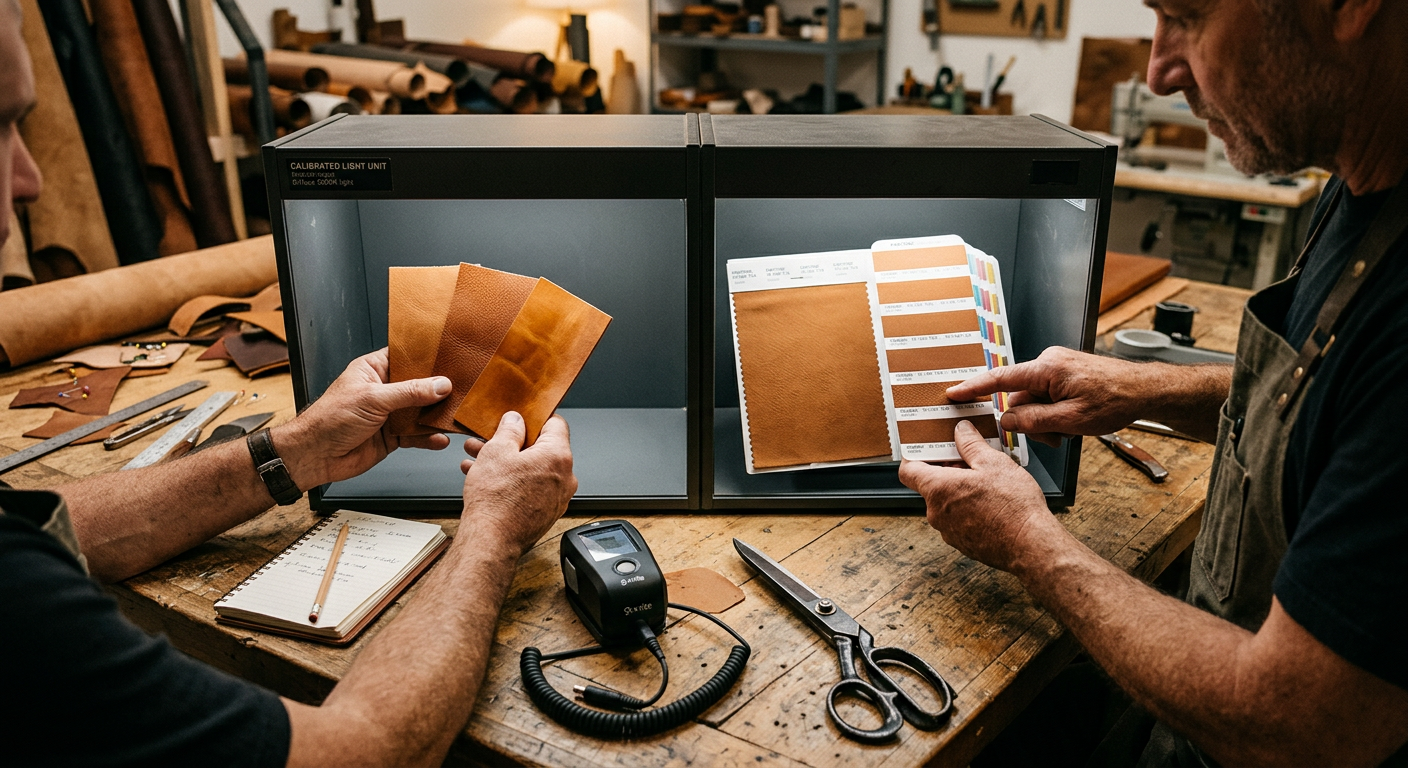
Master the leather color approval process before mass production. Learn technical strike-off standards, spectrophotometer tolerances, and lighting checks to avoid costly batch rejections.
The buyer's problem
Few things erode brand margin and delay release schedules faster than a full container of leather goods arriving in the wrong shade. For product developers, sourcing heads, and brand founders, achieving formal leather color approval before bulk cutting begins is the single most critical quality gate in the manufacturing cycle. Leather is an organic, non-uniform substrate; unlike synthetic textiles woven from synthetic polymer filament, bovine hides vary in density, grain pore structure, and natural fat content across every single square foot.
When brands approve a colour from a digital CAD rendering or a small fabric swatch, they frequently assume the tannery can spray or immerse-dye animal hides to an identical finish without deviation. When bulk goods dock and the tan tote bags lean orange under shop lights, disputes over who pays for dead inventory or remakes escalate quickly. Understanding the industrial realities of colour development protects your purchase orders, controls landed costs, and ensures your factory produces consistent commercial lots season after season.
What leather color approval actually means in a factory
On the factory floor, approving leather colour is not a subjective appraisal of whether a swatch "looks handsome." It is an exact chemical, mechanical, and visual verification protocol that bridges your design specification with drum-dyeing formulation. When you submit a colour target—whether a Pantone TCX reference, a physical master swatch, or an archived cut from a previous run—our tannery partners formulate an initial wet-end dye recipe.
Raw, un-dyed wet blue (chrome-tanned) or wet white (chrome-free) crust absorbs dyestuff according to hide porosity. Aniline leathers rely solely on transparent acid dyes that penetrate deep into the corium fibers, meaning the underlying natural skin tone directly dictates the final optical depth. Semi-aniline and pigmented leathers receive an additional micro-pigment coat and protective polyurethane or nitrocellulose topcoat, which provides more uniform coverage but introduces gloss, refraction, and hand-feel variables.
When we ask you for final approval on a strike-off, we are establishing the central commercial standard against which every cutting panel for your leather bags or leather wallets will be measured. Once signed off, this reference sample governs drum loading weight, dye auxiliary ratios, milling durations, and drying temperature profiles on the processing line. If you approve without checking metameric properties or mechanical rub fastness, you commit hundreds of square metres of raw material to cutting with zero recourse.
Materials, specs and standards
Setting measurable technical parameters eliminates ambiguity between your buying office and our production floor. We measure colour variance, crocking resistance, and finish adhesion against internationally recognised testing methods before cutting a single pattern.
| Parameter / Specification | Standard Reference | Industry Tolerance | High-End Retail Target | Factory Quality Check Point |
|---|---|---|---|---|
| Colour Difference (Delta E) | ISO 105-J03 / ASTM D2244 | ΔE CMC ≤ 1.50 | ΔE CMC ≤ 0.80 to 1.00 | Spectrophotometer D65/10° |
| Dry Veslic Rub Fastness | ISO 11640 | 500 cycles ≥ Grade 4 | 1,000 cycles Grade 4-5 | Dry felt pad mechanical test |
| Wet Veslic Rub Fastness | ISO 11640 | 150 cycles ≥ Grade 3 | 300 cycles ≥ Grade 4 | Wet felt with deionised water |
| Colour Fastness to Light | ISO 105-B02 (Xenon Arc) | Blue Wool Grade 3-4 | Blue Wool Grade 5+ | Exposure chamber 72 hours |
| Finish Adhesion to Leather | ISO 11644 | ≥ 2.0 N/cm | ≥ 3.5 N/cm | Tensile adhesive peel test |
| Water Spot Fastness | ISO 15700 | Grade 3-4 (no ring mark) | Grade 4-5 after 16h dry | 0.5 ml distilled water drop |
| Perspiration Resistance | ISO 11641 | Grade 3 (staining) | Grade 4 on Greyscale | Alkaline artificial sweat soak |
In our laboratory assessments, visual checks are paired with a spectrophotometer set to the CIE Lab* colour space. The L* axis defines lightness (0 = pure black, 100 = pure white), a* denotes the green-to-red axis (-a = green, +a = red), and b* defines blue-to-yellow (-b = blue, +b = yellow). While a commercial fashion standard permits a total colour difference (ΔE) up to 1.50, our factory targets ΔE ≤ 1.00 for luxury programs. This boundary prevents visible panel-to-panel shade divergence when cut parts are assembled into three-dimensional products.
Our process, step by step
Achieving exact consistency across production batches requires an unyielding sequence. At our production facility, colour development proceeds through eight disciplined checkpoints before cutting begins:
- Standard Ingestion & Analysis: You provide an internationally recognised target, ideally a physical Pantone Fashion, Home + Interiors (FHI) Cotton TCX swatch or an approved master leather swatch. We log the target under standardised light conditions and take baseline spectrophotometric spectral curves.
- Crust Selection: We select raw material lots based on natural grain clarity, fat-wrinkle density, and intended temper. For structural goods, full-grain steer hides from audited suppliers are conditioned; for softer items, light-weight calf or sheep skins are isolated.
- Lab-Dip Dye Kitchen Formulation: The master colourist produces three 15 cm x 15 cm test strike-offs in laboratory mini-drums. We balance dyestuffs (acid dyes, direct dyes, or basic dyes) to formulate matching tones across target shades while maintaining the required chemical saturation.
- Topcoat & Grain Texture Simulation: A strike-off cannot be evaluated bare. We apply the specified topcoat—matte, satin, semi-gloss, or high-gloss—and mechanical plating (such as subtle haircell or pebbled embossing) because texture scattering changes human colour perception dramatically.
- Light Box Visual Evaluation: We examine lab dips inside a calibrated multi-source light booth under CIE Standard Illuminant D65 (average noon daylight), TL84/Store Light (fluorescent retail), and Illuminant A (incandescent domestic warm light). This step eliminates metamerism—where two swatches match under daylight but clash completely under department store track lights.
- Physical Sample Courier: We cut each approved lab dip into three identical labelled sections. Two swatches are dispatched to your development team via air courier along with Delta E spectro-readings. We retain the third under dark, climate-controlled storage at the factory as the physical master.
- Sign-Off & Golden Sample Production: Upon receipt, your team signs and dates one swatch, returning physical confirmation or digital acceptance against the unique lot number. We then build the initial pre-production sample using leather milled from an intermediate 500-sq-ft drum run under our custom OEM manufacturing programme.
- Bulk Drum Dyeing & Master Swatch Pull: When bulk raw production begins, our technicians take three cuttings from the neck, belly, and butt of hides in the first, middle, and final drum batches. These cuttings are checked against your retained Golden Sample; mass production cutting starts only when ΔE tolerances clear inspection.
MOQs, lead times and pricing signals
Tanneries operate on chemical drum weights. A production drum requires a baseline volume of hides to spin, wet out, and take up dyestuff evenly. If a drum is under-loaded, the mechanical action violently beats the skins, causing looseness in the grain; if over-loaded, dye distribution is uneven, resulting in mottled or patchy hides.
Our minimum order quantity (MOQ) is 50 pcs per style/colourway for manufactured goods. To support emerging luxury brands and focused seasonal launches, our tannery maintains a running stock inventory of standard crusts that we dye in small 300-sq-ft drum batches. For fully custom, bespoke drum formulations outside our core palette, the tannery-level raw material requirement is typically 1,000 to 1,500 square feet of finished leather (roughly 25 to 35 hides), which easily converts into 200–300 handbags or 600–800 small leather goods.
Lead times run on concrete intervals. Laboratory strike-offs require 10–14 working days from receipt of your target swatch or Pantone code. Once you provide formal approval on colour swatches, complete pre-production prototypes take 14 days. Full mass production of goods requires 25–45 days depending on the SKU architecture and hardware tooling complexity.
All pricing is calculated FOB Chattogram (Sea Port, BDCHG) or FCA Hazrat Shahjalal International Airport, Dhaka (DAC) for rapid air dispatches. Custom dye runs carry minor initial lab-dip development costs (typically credited against bulk production POs). Sourcing managers should note trade classifications: leather handbags generally clear under HTS code 4202.21, pocket wallets under HTS 4202.31, and leather belts under HTS 4203.30. Factoring raw hide yield formulas (typically 65% usable area on full grain hides due to edge discard) avoids unexpected unit price revisions later in your costing phase.
Common mistakes buyers make
Even experienced brand buyers fall into operational traps that introduce avoidable factory disputes. Here are six mistakes we routinely catch and correct before production starts:
- Approving colours via smartphone screens or emailed photographs: Digital displays utilise RGB backlighting with varied colour profiles (sRGB, DCI-P3). An image viewed on a smartphone looks vastly different from the physical hide on a factory bench. The Fix: Never issue a production cutting release based on photos. Inspect only physical cuttings viewed under standard illumination.
- Failing to test under retail and incandescent light sources (Metamerism): A dye formulation that matches your Pantone perfectly under natural daylight can shift drastically toward green or purple under commercial 3000K or 4000K store lighting. The Fix: Require your team and the factory to evaluate lab dips under both D65 daylight and TL84/U30 store lighting inside a closed viewing booth.
- Treating pull-up and veg-tan leathers like uniform synthetics: Vegetable-tanned and wax/oil pull-up leathers alter their surface tone when stretched over curves, folded, or ironed during edge-finishing and assembly. The Fix: Expect natural variations of ±1.5 ΔE on pull-up leathers, and judge tone on a fully assembled, edge-painted sample rather than a loose, flat swatch.
- Approving body leather while forgetting edge paint, thread, and zipper tape: A leather body colour that looks flawless can be ruined by mismatched edge finishes or contrasting stitching that makes the hide appear slightly muddy or off-shade. The Fix: Request a comprehensive trims and finishes board containing the leather cutting, matched edge enamel, high-tenacity nylon bonded thread, and dyed-to-match zipper tapes simultaneously.
- Skipping the dry and wet rub crocking test on deep shades: Rich navy, crimson, and black leathers hold excess un-bonded surface dyestuff if washed improperly at the tannery. In production, this bleeds onto light garments. The Fix: Specify minimum Veslic rub standards (ISO 11640) on your tech packs, mandating Grade 4 or higher for dark dyed leathers prior to bulk release.
- Holding only one physical approved master swatch at brand headquarters: If your office holds the sole physical cutting and the factory relies on a digital copy, cutting managers have no baseline to compare against emerging drums. The Fix: Issue master swatches in triplicate: one for your design archive, one for the factory quality manager's bench, and one for the lead tannery technician.
How to evaluate a supplier for this
When vetting an overseas manufacturer for fine leather goods, asking broad questions like "Can you match my colour?" yields meaningless reassurances. You need to inspect their operational infrastructure and quality control methodology. Use this practical verification checklist during factory audits or onboarding calls:
- Do they own a calibrated light cabinet? The factory must maintain a multi-source light booth (e.g., VeriVide or X-Rite Judge QC) containing D65, TL84, Incandescent A, and UV tubes. Ask them for a video demonstrating their light cabinet inspection procedure.
- Do they possess bench-top or portable spectrophotometers? An experienced factory does not rely on eyeball assessments alone. They should be able to produce a printed or digital CIE Lab* reading showing ΔE variance against your master target.
- How do they archive approved lots? Tour their sample room or ask to see their lot retention library. Swatches must be filed away from UV light, high humidity, and direct heat to prevent degradation while bulk materials are sourced.
- What is their tannery integration? A high-reliability production facility operates with direct tannery integration or maintains closely audited contract tanneries with internal chemistry laboratories. You can review our facility's production capabilities and history on our about TAT Manufacture page.
- Do they inspect incoming leather hide-by-hide? In mass production, shade sorting is non-negotiable. Every delivered hide must be inspected under uniform lighting and graded into Tone A, Tone B, and Tone C bins. Cutting dies must only cut individual bag panels from the same tone bin to eliminate cross-panel shading on the finished product.
Ready to move from research to samples? Send us your tech-pack or reference image and we'll come back within 24 hours with materials, MOQ and an FOB quote. Request a quote →
Case snapshot
A mid-sized contemporary menswear label based in Munich, Germany, approached us to manufacture a line of vegetable-tanned business briefcases and small cardholders (HTS 4202.11 / 4202.31). Their collection required an exact, moody "espresso brown" with warm red undertones across 1,200 total units. Their previous supplier had delivered bulk runs that appeared charcoal grey in outdoor daylight and olive brown under showroom retail spotlights—a severe metameric failure that prompted wholesale buyer pushback.
Upon onboarding, our technicians evaluated their physical target swatch with an X-Rite spectrophotometer, discovering that the previous dye balance used cheap black pigment to darken an unstable brown base. Our tannery reformulated the dye kitchen recipe using high-grade metal-complex acid dyes in our experimental drum. Within 12 working days, we air-couriered two strike-offs showing ΔE CMC of 0.72 under D65 daylight and 0.68 under TL84 store lighting.
Once the customer approved the master swatch, we completed pre-production samples in 14 days and ran bulk hides across three matched drums. Our team segregated all hide cuttings into strict shade lots before cutting. The production run shipped FOB Chattogram on time; customer inspections reported zero batch rejections, and the client expanded their order run by 40% for the following seasonal cycle.
Frequently asked questions
How does the Pantone TCX system translate to genuine leather?
Pantone TCX (Textile Cotton Edition) references are dyed on cotton sheeting, which exhibits distinct light absorbance and surface reflectivity compared to tanned animal hide. When we formulate a leather dye match against a TCX reference, we replicate the visual spectral curve while matching the hand-feel, oil content, and surface grain of real hide. Because cotton has no natural fat, grain pore texture, or variable protein density, we advise matching under a controlled light booth to achieve a precise visual and instrumental balance within ΔE ≤ 1.00.
What happens if a bulk leather drum dye comes out off-shade?
If a production drum drifts beyond the agreed commercial tolerance (ΔE > 1.20 or visible Greyscale variation under Grade 4), the hides must not be cut into product panels. Depending on whether the batch is too light or off-cast, our tannery technicians can wash back, re-mill, or apply micro-pigmented top spray adjustments in our finishing line to bring the tone back within tolerance. If an aniline drum comes out darker than the approved standard, those hides are set aside for deeper colour runs, and a completely fresh batch of crust is drummed to preserve quality control.
Why does the cut panel look different from the flat swatch once assembled?
When flat leather is skived along edges, wrapped around reinforcement boards (such as salpa, microfibre, or EVA foam), or pulled tight over corners during bag assembly, grain pores open and close under tension. This mechanical stress alters surface light refraction. For oily pull-up leathers or deep vegetable-tanned hides, stretching disperses the internal oils, causing highlights on corners. This is why we insist on verifying an assembled pre-production sample—not just a flat 10x10 cm swatch—before bulk cutting begins.
Can we approve leather colors via high-resolution photos or video?
We strongly advise against approving colour solely through digital photography or video streaming. Camera sensors, compression algorithms, and display screens alter colour temperatures significantly. Even minor shifts in ambient room lighting when taking the photograph can skew a warm tan into an olive tone. To avoid costly manufacturing disputes and unsellable bulk stock, always base your formal sign-off on a physical leather cutting examined under standardized light sources.
How do edge paint and leather body color matching work together?
Edge paint utilizes an aqueous acrylic polymer compound with dense synthetic pigmentation, whereas leather relies on drum dyes and light micro-topcoats. The chemical compositions react differently to ambient light. During sampling, our finishing department matches edge paints manually against the dry, conditioned leather master. We apply minimum three coats of edge paint with intermediate sanding and drying to verify that the edge hue harmonises with the grain face before sending the sample for your sign-off.
Does leather thickness and temper affect dye penetration and tone?
Yes. Heavier steer hides (2.0 mm to 2.4 mm) used for unlined tote bags and belts require significantly longer drum-dye cycles and higher auxiliary penetrant levels to achieve complete cross-section through-dyeing than thin lambskin or calf leather (0.7 mm to 1.1 mm). The extended processing time can deepen colour saturation and alter the temper (firmness). During development, we calibrate drum times specifically for the target thickness to maintain both hand-feel and precise chromatic saturation.
Next step
Achieving uncompromising colour accuracy requires a direct, disciplined partnership between your development team and the factory floor. Review our factory floor capabilities and craft standards in our factory & product gallery, explore our construction detailing for leather bags, and request a quote with your design tech packs to initiate your bespoke strike-off programme within 24 hours.
Ready to manufacture
Request a quote from TAT Manufacture
Full-grain leather, low MOQ from 50 pcs, OEM & private label. Get a detailed itemised quote within 24 hours.
25 years of leather manufacturing craftsmanship.
Services →OEM, private label, and custom leather production.