Leather Manufacturing
How Quality Control Works at Every Stage of Leather Production
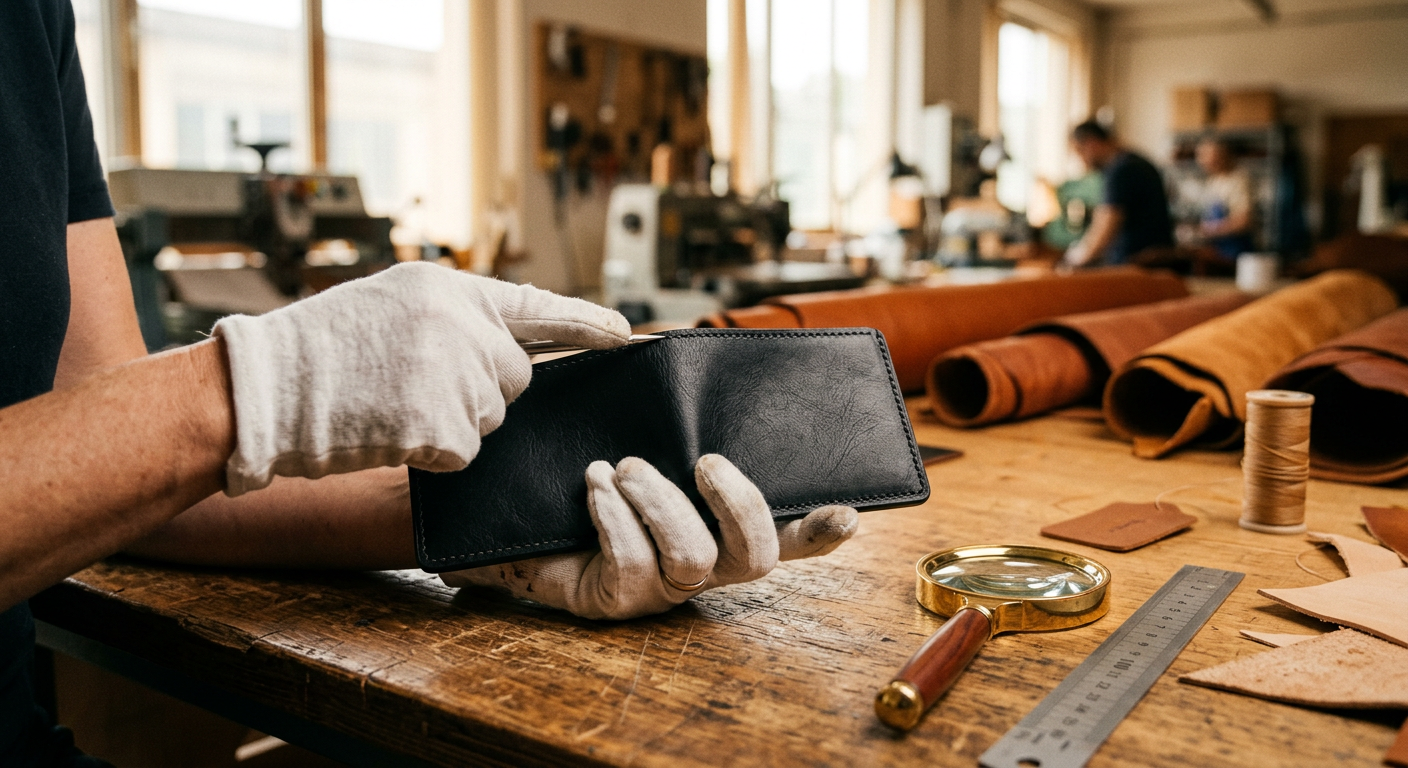
Effective quality control isn't just a final check. We show you how our in-process inspections prevent defects, save time, and ensure your final order meets every specification.
The buyer's problem
For any brand founder or sourcing manager, the single greatest risk in offshore manufacturing is quality fade. The samples look perfect, the price is agreed, and production begins. Weeks later, a container arrives at port, only for you to discover that 15% of the units have misaligned seams, faulty hardware, or inconsistent colour. The cost is catastrophic: not just the money lost on unsellable goods, but the cost of shipping, import duties, reputational damage from angry customers, and the crippling delay in getting your collection to market. This scenario is the direct result of a supplier who treats quality control as a final, superficial check rather than a core part of the entire manufacturing process.
Choosing a factory partner must therefore go beyond comparing price lists. The critical question is, how does a potential supplier manage leather production quality control from the moment your tech pack arrives to the moment the container is sealed? A trustworthy manufacturer can not only answer this question but can demonstrate a systematic, documented process that builds quality into every single step. This is the only effective way to protect your investment, your brand, and your customers from the costly fallout of poor production.
What "leather production quality control" actually means in a factory
In many factories, 'quality control' is a small team that inspects finished goods before they are packed. This is a fundamentally flawed approach. It is reactive, inefficient, and expensive, as it only catches defects after the time and materials have already been spent making the faulty product. At TAT Manufacture, we operate on a principle of Quality Assurance (QA), which is proactive, combined with Quality Control (QC), which is reactive. The goal of our system is to prevent defects from occurring in the first place.
This integrated approach to leather production quality control transforms the factory floor. It means we have dedicated QC inspectors, separate from the production supervisors, stationed at critical points along the assembly line. These inspectors have the authority to halt production on a specific line if they detect a recurring issue. It's not about blaming workers; it's about identifying the root cause—be it a miscalibrated machine, a flawed pattern, or an ambiguous instruction—and fixing it immediately before hundreds of units are affected.
This system relies on three pillars:
- Clear, Documented Standards: Every product has a 'master specification sheet' derived from your approved pre-production sample (PPS). This document, complete with photos, measurements, and tolerances, is the bible for both production and QC teams.
- In-Process Checkpoints (IPQC): Instead of one final inspection, we have multiple. We check components after cutting, after skiving, after preliminary stitching, and after hardware attachment. This modular approach ensures that a mistake made at an early stage is never carried through to the end.
- Traceability and Accountability: Every batch of materials and every production run is logged. If a defect is found, we can trace it back to the specific roll of leather, the machine operator, or the time it was produced, allowing for precise corrective action.
Materials, specs and standards
The foundation of a high-quality leather product is high-quality raw materials. Our quality process begins long before the first piece of leather is cut. Every delivery of leather, lining, hardware, thread, and even packaging is subject to Incoming Quality Control (IQC). Hides are unrolled and inspected on large, well-lit tables for unacceptable scarring, insect bites, colour inconsistencies, and thickness variations beyond the agreed tolerance. Hardware is checked for plating consistency, durability, and function.
We work with clients to establish a clear Approved Materials List and a Specification Sheet that codifies these standards. Tolerances are not arbitrary; they are practical standards that ensure aesthetic consistency and product longevity. For customs clearance, we ensure all products are correctly classified with Harmonised Tariff Schedule (HTS) codes, such as 4202.21 for handbags with an outer surface of leather or 4203.10 for leather apparel like leather jackets.
Here is a sample of the parameters we define and inspect against:
| Parameter | Standard / Specification | Tolerance | Inspection Point |
|---|---|---|---|
| Leather Thickness | 1.2 mm (as per tech pack) | +/- 0.1 mm | Incoming Quality Control (IQC) |
| Stitching Density | 8 stitches per inch (SPI) | +/- 0.5 SPI | In-Process (IPQC) & Final (FQC) |
| Edge Paint Application | 3 layers, smooth, no cracking | No visible bubbles or overflow | Post-Assembly & Final (FQC) |
| Colour Consistency | Approved swatch, Delta E < 1.5 | N/A | IQC (materials) & FQC (final product) |
| Hardware Function | Zipper slides smoothly, locks engage | 100% pass/fail | IQC (hardware) & FQC |
| Component Alignment | Pockets, straps, logos centred | +/- 1.0 mm | IPQC & FQC |
| Dimensions (Overall) | 30cm x 20cm x 10cm | +/- 3.0 mm | Final Quality Control (FQC) |
| Packaging Markings | Carton labels match packing list | 100% accuracy | Packing Inspection |
Our process, step by step
To give you a transparent view of how your project moves through our factory, here is our end-to-end process, with quality checkpoints built into every stage:
Enquiry & Technical Review: You send us your tech pack, sketches, or reference samples. Our team reviews them not just for price, but for manufacturability. We identify potential production challenges upfront and may suggest modifications to improve quality or durability. A preliminary quote is provided within 24-48 hours.
Sourcing & Pre-Production Sample (PPS) Creation: Once the quote is approved, we source the exact materials for your product. We create a single PPS, which serves as the 'master' standard for the entire production run. This is a critical step in our custom OEM programme.
Sample Approval & Standard Finalisation: We ship the PPS to you for approval. Any feedback or required adjustments are documented. Once you approve the sample, its specifications are codified into our internal QC documents, which are distributed to the production floor.
Incoming Quality Control (IQC): Upon arrival of the bulk materials for your order, our IQC team inspects them against the approved standards. Any non-conforming leather hides, hardware, or fabric are rejected and returned to the supplier before they ever enter production. You can see our inspection tables in the factory gallery.
Cutting & Component Inspection: Patterns are laid out on the hides to maximise yield while avoiding natural defects. After cutting, a QC inspector checks a statistical sample of the cut components against the master patterns to ensure dimensional accuracy before they move to the assembly lines.
In-Process Quality Control (IPQC): This is the core of our leather production quality control system. QC inspectors are stationed at key assembly stages (e.g., after stitching main panels, after attaching handles, after inserting lining). They perform rolling checks to catch any systemic errors like incorrect stitch tension or crooked seams early.
Post-Assembly Cleaning & Inspection: Once a product is fully assembled, it moves to a dedicated cleaning and finishing station. Here, another QC check is performed to review the overall construction, wipe away any production marks, and check the function of all hardware (zips, clasps, buckles).
Final Quality Control (FQC): After cleaning, 100% of the units are moved to the final inspection area. Our FQC team inspects each item based on an AQL (Acceptable Quality Limit) standard, typically AQL 2.5, or a custom standard you define. They check for aesthetics, measurements, function, and any other client-specific requirements. This is also the stage where we welcome third-party inspectors if you choose to use one.
Packing & Carton Inspection: Products that pass FQC are packed according to your specifications (e.g., polybag type, stuffing material, hangtag placement). A final inspector verifies that carton contents match the packing list and that shipping marks are correct to prevent logistical errors.
Shipment & Documentation: We manage the logistics to get your order onto the vessel. As our standard term is FOB Chattogram Port, we handle all processes up to that point. We provide you with all necessary shipping documents, including the Bill of Lading, Commercial Invoice, and Packing List, for smooth customs clearance on your end.
MOQs, lead times and pricing signals
Understanding the commercial framework is as important as understanding the production process. We believe in being transparent about these figures so you can plan effectively.
- Minimum Order Quantity (MOQ): Our standard MOQ is 50 pieces per style, per colour. For example, an order for a tote bag in black and tan would be 50 black units and 50 tan units. This minimum allows us to operate efficiently, covering the costs of machine setup, pattern creation, and meeting the MOQs of our own material suppliers.
- Lead Times: Time is a critical factor in fashion. Our typical lead times are:
- Sampling: 10-14 days from confirmation of details and receipt of funds.
- Mass Production: 25-45 days, depending on the complexity of the product, the size of the order, and material availability. This clock starts from the date of your formal PPS approval and deposit payment.
- Pricing Signals: Our pricing is a direct reflection of the materials, labour complexity, and quality assurance measures involved in producing your goods. We operate on an FOB (Free On Board) Chattogram Port basis. This means our price includes manufacturing the goods to your specification, packing them, and delivering them to the port, ready for shipping. All subsequent shipping, insurance, and import costs are managed by you, the buyer. The fastest way to get an accurate quote is to provide a detailed technical pack. If you have questions about what to include, our Buyer FAQ page has helpful guidance.
Common mistakes buyers make
Over our 25 years in business, we've seen buyers make the same handful of costly mistakes. By avoiding these, you can ensure a much smoother production experience.
- Providing Vague Specifications: Submitting a single photo with a request for a quote will inevitably lead to an inaccurate price and a sample that doesn't meet your vision. The fix: Invest time in creating a detailed tech pack with dimensions, material types, hardware specifics, and stitching details.
- Choosing a Supplier on Price Alone: The lowest FOB price is often a red flag. It can signal a factory that cuts corners on materials, pays unfair wages, or, most commonly, has a non-existent QC process. The fix: Vet a factory's quality process as thoroughly as you vet their pricing. Ask the hard questions we've outlined here.
- Skipping Paid Samples: Some buyers try to save a few hundred pounds by avoiding paid samples. This is false economy. The fix: View the Pre-Production Sample as your single most important insurance policy. It is the only way to physically validate a factory's ability to execute your design.
- Approving a "Good Enough" Sample: If a sample has minor flaws that you assume will be fixed in bulk production, you are taking a huge risk. The fix: Be meticulous. The approved PPS becomes the master standard. Any flaw you approve on the sample is a flaw you have authorised for the entire production run.
- Ignoring Packaging and Logistics: A perfect product can be damaged by poor packaging, or an entire shipment can be delayed by incorrect carton markings. The fix: Specify your packaging requirements in your tech pack—from the thickness of the polybag to the labelling on the master carton.
Ready to move from research to samples? Send us your tech-pack or reference image and we'll come back within 24 hours with materials, MOQ and an FOB quote. Request a quote →
How to evaluate a supplier for this
When you are comparing potential factory partners, use this checklist to assess the seriousness of their leather production quality control.
- Request their QC Process Documentation: Ask for a flowchart or a written manual that explains their QC system. A serious factory will have this readily available. A vague answer is a major warning sign.
- Ask for a Virtual or Physical Tour: Go beyond the showroom. Ask to see the QC stations on the production line, the incoming materials inspection area, and the final FQC department. If you can't visit, ask for a live video walkthrough. More information about our facility can be found on the about us page.
- Speak to a QC Manager: Don't just talk to the sales representative. Insist on a brief conversation with the person who actually manages the quality team. Ask them how they train their inspectors and what happens when a batch fails an in-process check.
- Test Their System with a Detailed Tech Pack: Send your most detailed tech pack to the factories you are vetting. A good factory will review it and ask intelligent questions. A poor factory will just give you a price.
- Order a Paid Sample: This is the ultimate test. Pay for a sample and evaluate it with a critical eye. Does it match your spec exactly? Is the craftsmanship consistent? The quality of this single sample is a direct indicator of the quality you can expect from a bulk order.
- Discuss AQL and Third-Party Inspections: Bring up AQL standards in your initial conversations. Ask about their policy on allowing third-party inspection services like SGS, Intertek, or QIMA. A confident factory will always welcome external validation.
Case snapshot
An emerging accessories brand from the UK approached us in a difficult position. Their first production run for a new line of leather backpacks, sourced from a different supplier, had arrived with a staggering 20% defect rate. The primary issues were inconsistent dye lots, resulting in bags that were visibly different shades of navy, and weak stitching on the shoulder straps. They had an urgent launch date for a trade show and could not afford a repeat of this disaster. Their initial order with us was for 250 backpacks across two styles (125 units each). Our first action was to hold a video conference to review their tech pack and the defective samples. We identified the critical control points: leather hide batching for colour control and reinforcement stitching on all load-bearing points. During production, we provided the client with daily photo updates from our IPQC station, specifically showing the colour matching of cut panels and close-ups of the bar-tack stitching on the straps. Before shipment, we provided them with our internal AQL 2.5 final inspection report, which they reviewed and approved. The production took 35 days, and the goods were air-freighted to London. The shipment arrived with zero defects related to colour or strap construction, enabling the brand to launch successfully at the trade show. They have since become a regular client, adding leather belts to their range.
Frequently asked questions
What is your standard AQL for final inspection?
We typically work to an AQL 2.5 (for major defects) and 4.0 (for minor defects) standard, which is common for consumer goods. However, we are flexible. If your brand requires a stricter standard, such as AQL 1.5, we can absolutely accommodate that. We will discuss and agree upon the AQL standard with you before production begins.
How do you ensure colour consistency across a batch?
This is a critical part of our IQC and IPQC process. For leather, we work with the tannery to get 'cutting for approval' (CFA) swatches from the specific dye lot that will be used for your order. We get your approval on this swatch. On arrival, we inspect the bulk hides against that approved swatch. During cutting, we carefully manage the hides to ensure components for a single bag come from the same area of a hide to minimise variation.
Can I use a third-party inspection service like SGS or Intertek?
Yes, absolutely. We welcome and encourage third-party inspections. You can arrange for an inspector to visit our factory to conduct a pre-shipment inspection (PSI). We will coordinate with them to ensure they have access to the finished goods and a suitable space to conduct their work. Transparency is key to building trust.
What happens if defects are found during production?
Our in-process quality control (IPQC) system is designed to catch defects early. When an inspector finds a non-conforming item, it is immediately segregated from the production line. Our production supervisor and QC manager then analyse the defect to find the root cause. If it's a worker error, retraining is provided. If it's a machine issue, it's recalibrated. The goal is always to fix the process, not just the product, to prevent it from happening again.
How does your leather production quality control process impact pricing?
Our robust QA/QC process is not an optional extra; it's integrated into our entire operational structure and is a component of our FOB price. While this might mean we are not the absolute cheapest quote you will find, it represents a far greater total value. The cost of our integrated quality system is marginal compared to the catastrophic cost of a rejected shipment, air-freighting replacement goods, or losing customer trust due to faulty products.
Next step
Understanding a factory's quality control process is the most important step you can take in protecting your brand and ensuring the success of your product line. If our systematic approach to quality aligns with your brand's standards, the next step is to see it in action. Send us your technical pack for a detailed, no-obligation quote and let's discuss building your products to a standard you can trust. You can explore our full range of capabilities, from leather bags to small accessories, and then request a quote to begin the conversation.
Ready to manufacture
Request a quote from TAT Manufacture
Full-grain leather, low MOQ from 50 pcs, OEM & private label. Get a detailed itemised quote within 24 hours.
25 years of leather manufacturing craftsmanship.
Services →OEM, private label, and custom leather production.