Leather Manufacturing
From Sketch to Shipment: How Custom Leather Products Are Manufactured
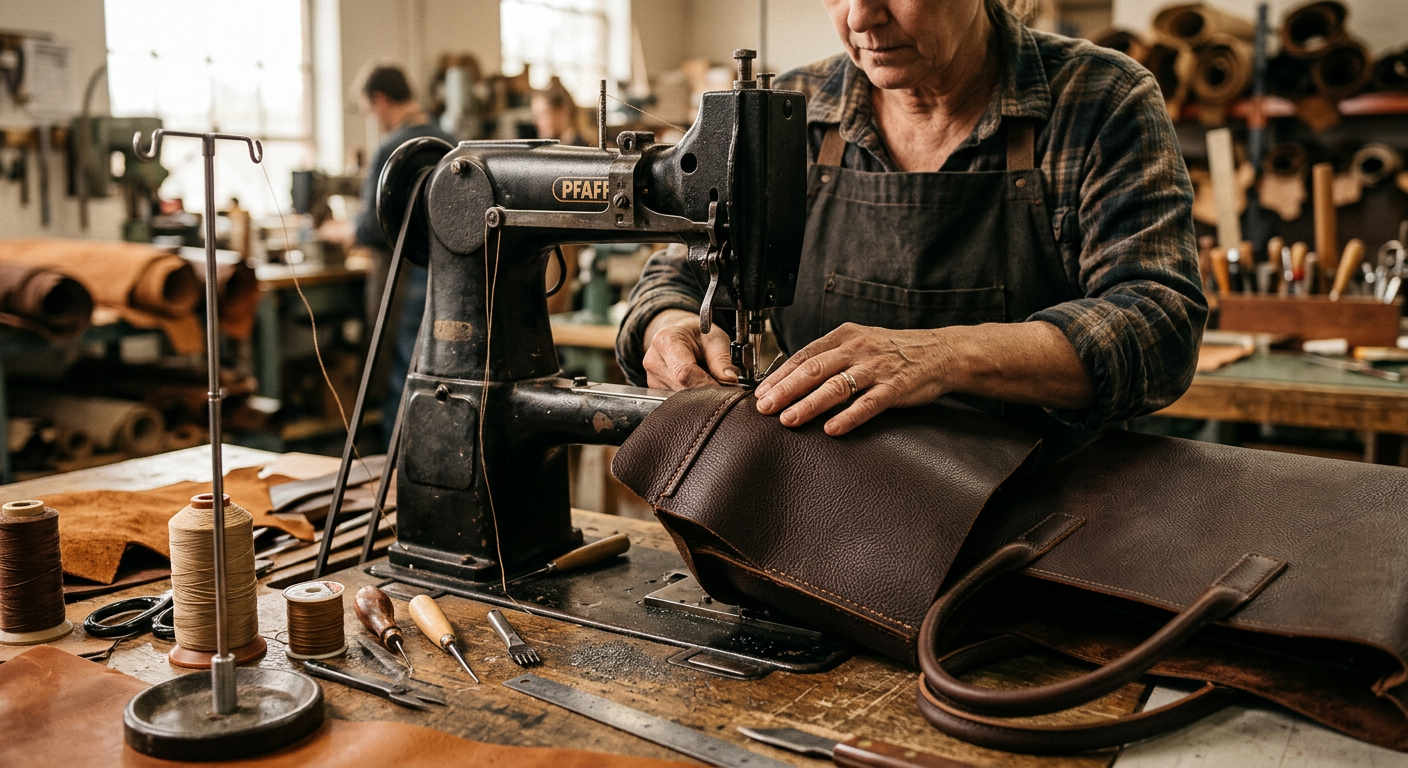
We detail our entire process for turning a design into a finished product. For brands and buyers, understanding the steps in custom leather product manufacturing is key to a successful partnership.
The buyer's problem
For a brand founder or sourcing manager, moving from a design concept to a container of finished goods can feel opaque and fraught with risk. You have a vision for your product, but turning it into a physical item that meets your quality, cost, and timeline targets requires a factory partner you can trust. The wrong choice can lead to costly delays, inconsistent quality, and materials that do not match your specifications. The difference between a successful collection launch and a failed one often comes down to the capability and transparency of your chosen manufacturer.
This is why understanding the mechanics of custom leather product manufacturing is so critical. It is not merely about placing an order; it is about engaging in a detailed, collaborative process. When you understand how a factory like ours moves from technical specification to finished product, you are better equipped to provide the correct inputs, ask the right questions, and accurately assess a potential supplier's competence. This knowledge demystifies the production journey and empowers you to manage your supply chain effectively, ensuring the final product delivered matches the one you designed.
What "custom leather product manufacturing" actually means in a factory
In our industry, the term custom leather product manufacturing—often used interchangeably with Original Equipment Manufacturing (OEM) or private label production—refers to a specific service model. Unlike buying from a wholesaler's existing catalogue, this is a process where we build your unique product from the ground up, based entirely on your designs and specifications. It is the core of our business and what allows brands to create truly proprietary collections. You are not just putting your logo on our pre-designed bag; you are commissioning us to be the manufacturing arm of your design team. Our /products/custom programme is built entirely around this principle.
On the factory floor, this means we are not running continuous lines of the same item. Instead, production is organised around your specific project. This starts with dedicated pattern making, where our technicians translate your technical drawings ('tech packs') into physical templates for cutting the leather. New cutting dies may need to be created. Jigs and guides for stitching complex patterns are constructed. Our teams conduct sourcing specifically for your required leather, hardware, and lining. Essentially, a unique production workflow is established just for your product, from the first hide inspection to the final packaged unit. This is a far more involved process than mass production of a single, repeating design, and it requires a higher degree of skill, project management, and quality control at every stage.
Materials, specs and standards
Quality is not accidental; it is engineered. The final character of a leather product is determined by the raw materials chosen and the precise standards to which they are assembled. We source a wide range of leathers—including full-grain, top-grain, and crazy horse from tanneries in both Bangladesh and abroad—and components to match any design brief and price point. Our standard hardware is solid brass and stainless steel, with YKK, SAB or other specified brand zippers, but we can source any custom hardware you require.
Adherence to technical specifications is non-negotiable in custom leather product manufacturing. Vague instructions lead to inconsistent results. We work from detailed tech packs and agree on all standards before a single piece of leather is cut for the bulk order. Below is a table outlining some of the key specifications and our typical factory tolerances. Clarity on these points from the outset prevents misunderstandings later.
| Specification Parameter | Industry Standard / Our Tolerance |
|---|---|
| Leather Thickness | +/- 0.2mm of specified thickness (e.g., 1.4mm - 1.6mm) |
| Stitch Per Inch (SPI) | 8-10 SPI for bags; 10-12 SPI for wallets. +/- 1 SPI tolerance. |
| Colour Matching (Leather/Thread) | Matched to Pantone (TCX/TPG) or physical swatch with Delta E < 2.0 tolerance. |
| Edge Paint Application | 3-5 layers, hand-sanded between layers, for a smooth, non-cracking finish. |
| Hardware Placement | +/- 1.5mm tolerance from specified pattern location. |
| Dimensional Tolerance | +/- 3mm for overall bag dimensions; +/- 1.5mm for wallets and small goods. |
| Reinforcement | Critical stress points (strap anchors, corners) reinforced with bonded nylon or non-woven material. |
| Skiving (Edge Thinning) | Consistent skiving to 0.6mm - 0.8mm for clean, non-bulky seams. |
Our process, step by step
Transparency is a cornerstone of our relationship with clients. To that end, here is the exact step-by-step journey your product takes when you partner with TAT Manufacture, from initial enquiry to final shipment.
Enquiry & Tech Pack Review. It begins when you contact us with your design. You will send us a technical pack (tech pack), which is the blueprint for your product. This document should include detailed drawings, dimensions, material specifications (leather type, thickness, colour), hardware requirements, and branding details (logo placement, type). Our technical team reviews your pack for feasibility, clarity, and potential production challenges. We may come back with questions or suggestions to optimise the design for manufacturing.
Quotation & Material Confirmation. Based on the reviewed tech pack, we provide a detailed quotation. This will outline the per-unit price at different volume tiers, the cost for pre-production samples, and an estimated lead time. The price is typically quoted as FOB Chattogram (CGP). We also confirm the availability of your specified materials or propose suitable alternatives from our network of trusted tanneries and hardware suppliers.
Pattern Making & Prototyping (Sampling). Once the quotation is approved and the sampling fee is paid, we move to the physical creation phase. Our master pattern maker creates a full set of paper or card patterns from your tech pack. These patterns are then used to cut the leather for your first sample. This 'pre-production' or 'counter' sample is a complete, finished version of your product. This is a critical validation step in the custom leather product manufacturing process.
Sample Approval & Feedback. We ship the sample to you for evaluation. This is your opportunity to hold the product, test its function, and check the quality of materials and workmanship. We expect detailed feedback. It is best to provide this in a consolidated document with images and annotations pointing out any required adjustments, whether it is moving a pocket by 5mm, changing the thread colour, or adjusting the strap length. If changes are significant, a second revised sample may be necessary.
Bulk Material Procurement & Inspection. Upon your final approval of the sample and placement of a bulk order (typically with a 50% advance payment), we begin procuring all the materials for the entire production run. This includes ordering the specific batch of leather, all hardware, linings, threads, and packaging. When these materials arrive at our factory, they undergo a rigorous incoming quality inspection. We check leather hides for excessive defects, verify hardware finishes, and ensure all materials match the approved sample.
Cutting, Skiving & Component Preparation. With approved materials, the production line is set up. The leather hides are carefully laid out to maximise yield and avoid natural imperfections. Our cutters use the master patterns to cut each component, either by hand with a knife or using steel-rule dies on a hydraulic press for high-volume precision. Edges that will be stitched together are 'skived'—thinned by a special machine—to reduce bulk and create clean, flat seams.
Assembly & Stitching. The cut components move to our stitching lines. This is where the product takes shape. Skilled operators assemble the pieces in a precise order, using industrial sewing machines calibrated for the specific thread and leather thickness. This stage may involve multiple steps, from attaching zippers and pockets to constructing the main body of a bag or wallet. In-line quality checkers inspect the work at key assembly points to catch any errors early.
Finishing, Edge Painting & Cleaning. After stitching, the products go to the finishing department. This is a highly skilled, manual process. It includes trimming excess threads, applying edge paint layer by layer to raw edges, installing final hardware like magnetic snaps or buckles, and giving the product a final clean and conditioning to remove any marks from production.
Final Quality Control (QC). Every single finished unit undergoes a final, thorough quality inspection. Our QC team follows a detailed checklist based on the approved sample and your tech pack. They check for stitching quality, hardware function, correct dimensions, material consistency, and overall cleanliness. We typically inspect to an AQL (Accepted Quality Limit) 2.5 standard, but can accommodate client-specific requirements.
Packaging & Shipment. Once a unit passes final QC, it is packaged according to your specifications. This usually involves stuffing (for bags), wrapping in protective paper or cloth, adding silica gel packets, and placing it inside a polybag. The units are then packed into export-grade cartons, correctly labelled with SKU, quantity, and dimension information. We manage the logistics to deliver the shipment to Chattogram Port, clear export customs, and hand it over to your nominated freight forwarder. At this point, we provide you with the Bill of Lading and other shipping documents, completing the FOB transaction.
Ready to move from research to samples? Send us your tech-pack or reference image and we'll come back within 24 hours with materials, MOQ and an FOB quote. Request a quote →
MOQs, lead times and pricing signals
Understanding the commercial parameters is essential for planning. We have structured our operations to support both emerging brands and established retailers. Our Minimum Order Quantity (MOQ) is 50 pieces per style, per colour. This is the minimum we can run through a production line efficiently while maintaining quality and material consistency. It also aligns with the minimums imposed by many of our tanneries and hardware suppliers.
Regarding timelines, you can expect the following:
- Sampling: 10-14 days from receipt of tech pack and payment for the sample.
- Bulk Production: 25-45 days from approval of the pre-production sample and receipt of the advance payment. This window depends on the complexity of the product and the order volume.
Pricing is directly influenced by three main factors: materials, complexity, and quantity. A full-grain leather tote will cost more than a top-grain one. A bag with 50 components, multiple pockets, and complex stitching will be more expensive than a simple wallet. Higher order volumes (e.g., 500 pieces vs. 50) allow for better efficiencies in cutting and assembly, which can be reflected in a lower per-unit price. All our formal quotations are provided on an FOB Chattogram Port (CGP) basis. This Incoterm means we are responsible for the goods and costs until they are loaded onto the vessel nominated by you at the port. You are responsible for the ocean freight, insurance, and import duties in your country.
Common mistakes buyers make
Over our 25 years in business, we have seen buyers make the same avoidable mistakes. Avoiding them will make the production process smoother for everyone involved.
- Submitting an Incomplete Tech Pack. A drawing with a few dimensions is not enough. The fix: A detailed tech pack is your most important tool. It must specify materials, hardware, dimensions, stitching details, and branding. The more detail you provide, the more accurate your sample and quote will be.
- Unrealistic Price Expectations. Expecting a full-grain leather bag for the price of a PU or canvas one is a common issue. The fix: Research raw material costs. A quality leather hide is a significant part of the final product's cost. Good manufacturing costs more than corner-cutting.
- Underestimating the Importance of Sampling. Some buyers want to skip sampling to save time or money. The fix: Never skip the sample approval step. This is your only chance to physically validate the design, materials, and workmanship before committing to a bulk order of hundreds or thousands of units.
- Providing Vague Feedback. Comments like "this doesn't feel right" are not actionable for our production team. The fix: Be specific and objective. Use photos, mark up PDFs, and provide clear measurements. For example, say "move the logo 10mm to the left" instead of "the logo is in the wrong place."
- Misunderstanding Incoterms. A buyer might be surprised by shipping and import costs if they do not understand what FOB means. The fix: Clarify the Incoterm (we work on FOB Chattogram) from the start and consult a freight forwarder in your country to get a full landed cost estimate, including shipping, insurance, customs, and taxes.
- Not Planning for a Production Buffer. Assuming a 30-day production lead time means goods will be in your warehouse in 30 days. The fix: Factor in time for sea freight (3-5 weeks), customs clearance (several days), and inland transport. Plan your launch dates accordingly.
How to evaluate a supplier for this
Choosing the right partner for custom leather product manufacturing is paramount. Here is a practical checklist we recommend any brand use when evaluating a potential factory, including us.
- Assess Communication. How quickly, clearly, and professionally do they respond? Do they ask intelligent questions about your tech pack? Good communication is a proxy for good project management.
- Scrutinise Their QC Process. Do not just accept that they "do QC." Ask for specifics. What is their inspection procedure? Do they perform incoming material checks, in-line inspections, and final inspections? What AQL standard do they use?
- Always Order a Sample. There is no substitute for a physical sample. It tells you everything about their material quality, stitching skill, and ability to follow instructions. Seeing the real thing is better than any factory tour or photo gallery. Our own factory gallery is helpful, but the sample is the proof.
- Enquire About Material Sourcing. Ask where they source their leather and hardware. Do they have established relationships with tanneries? Can they source certified materials if required? A factory with a poor sourcing network will be a constant source of problems.
- Verify Their Specialisation. Ensure they have experience making your type of product. A factory that specialises in leather bags may not be the best choice for intricate leather gloves, and vice versa. Ask for examples of past work similar to your design.
- Confirm They Are a Genuine Manufacturer. Many online sourcing portals are populated by trading companies or agents masquerading as factories. Ask direct questions: "Are you a factory or a trading company?" A real factory will be able to talk in detail about their machinery, production capacity, and team. Our /about page details our 25-year history as a direct manufacturer.
Case snapshot
A German startup brand approached us to produce their inaugural collection of high-end minimalist accessories. Their focus was on a slim bifold wallet and a matching cardholder, designed with a unique single-seam construction. Their initial enquiry included a highly detailed tech pack, which allowed us to provide an accurate quote within 24 hours. The order was for 150 units of each style (300 units total), split across two colours of full-grain cowhide leather they specified from a particular Italian tannery we have a relationship with. Our MOQ of 50 pieces per style/colour made this feasible for them. We created the first samples within 12 days. After receiving the samples, the client requested a minor change to the debossed logo's depth, which we adjusted. Upon approval and receipt of the 50% advance, production began. The entire production run of 300 leather wallets and cardholders was completed in 28 days. The goods were inspected, packed, and delivered FOB Chattogram, arriving at the client's distribution centre in Hamburg 4 weeks later, well in time for their planned online store launch. They reported excellent sell-through and have since placed a reorder three times the size of the initial run.
Frequently asked questions
What is your pricing for a custom leather bag?
Pricing is entirely dependent on your specific design. The cost is calculated based on the quantity of leather used, the type and grade of that leather, the complexity of the design (e.g., number of panels, pockets, hardware pieces), the type of hardware, and the total order quantity. To get a precise price, please send us your complete tech pack.
Can you work with an MOQ lower than 50 pieces per style?
Our standard MOQ of 50 pieces is set to ensure production efficiency and consistent quality. Setting up a production line, training operators on a new style, and meeting material purchasing minimums from our suppliers make smaller runs commercially unviable and prone to higher defect rates. For established clients with ongoing orders, we can sometimes offer more flexibility.
How much do samples cost and is the fee refundable?
Pre-production samples are typically priced at 2x to 3x the projected bulk unit price, plus shipping costs. This covers the cost of our pattern maker's time, the low-quantity material sourcing, and the dedicated attention required to create a single unit. For bulk orders over 500 units, we typically credit the sample fee (excluding shipping) back against your bulk order invoice.
How does shipping work from your factory in Bangladesh?
We ship on FOB (Free On Board) Chattogram Port (CGP) terms. This means we handle all production, packaging, and transportation to the port, as well as clearing the goods for export. You, the buyer, are responsible for contracting a freight forwarder to manage the ocean or air freight, insuring the goods, and handling customs clearance and duties in your destination country. We can recommend reliable freight forwarders we have worked with.
Can I provide my own custom-branded hardware or lining?
Yes, absolutely. We can work in two ways. We can source custom hardware or printed linings on your behalf based on your specifications, though this may have its own MOQs and lead times. Alternatively, you can have your suppliers ship the components directly to our factory. We will need the full specifications and delivery schedule to coordinate this into the production timeline. For more queries like this, see our main FAQ page.
Next step
Understanding the manufacturing process is the first step toward building a resilient supply chain and a successful brand. We operate with the transparency and expertise that serious buyers expect from a long-term manufacturing partner. When you are ready to turn your designs into exceptionally crafted products, we are ready to assist.
For a detailed quote, please send your technical pack via our contact form. If you are still exploring product ideas, we invite you to browse our core capabilities in product categories like leather jackets.
Ready to manufacture
Request a quote from TAT Manufacture
Full-grain leather, low MOQ from 50 pcs, OEM & private label. Get a detailed itemised quote within 24 hours.
25 years of leather manufacturing craftsmanship.
Services →OEM, private label, and custom leather production.