Common Design Mistakes That Increase Leather Manufacturing Costs
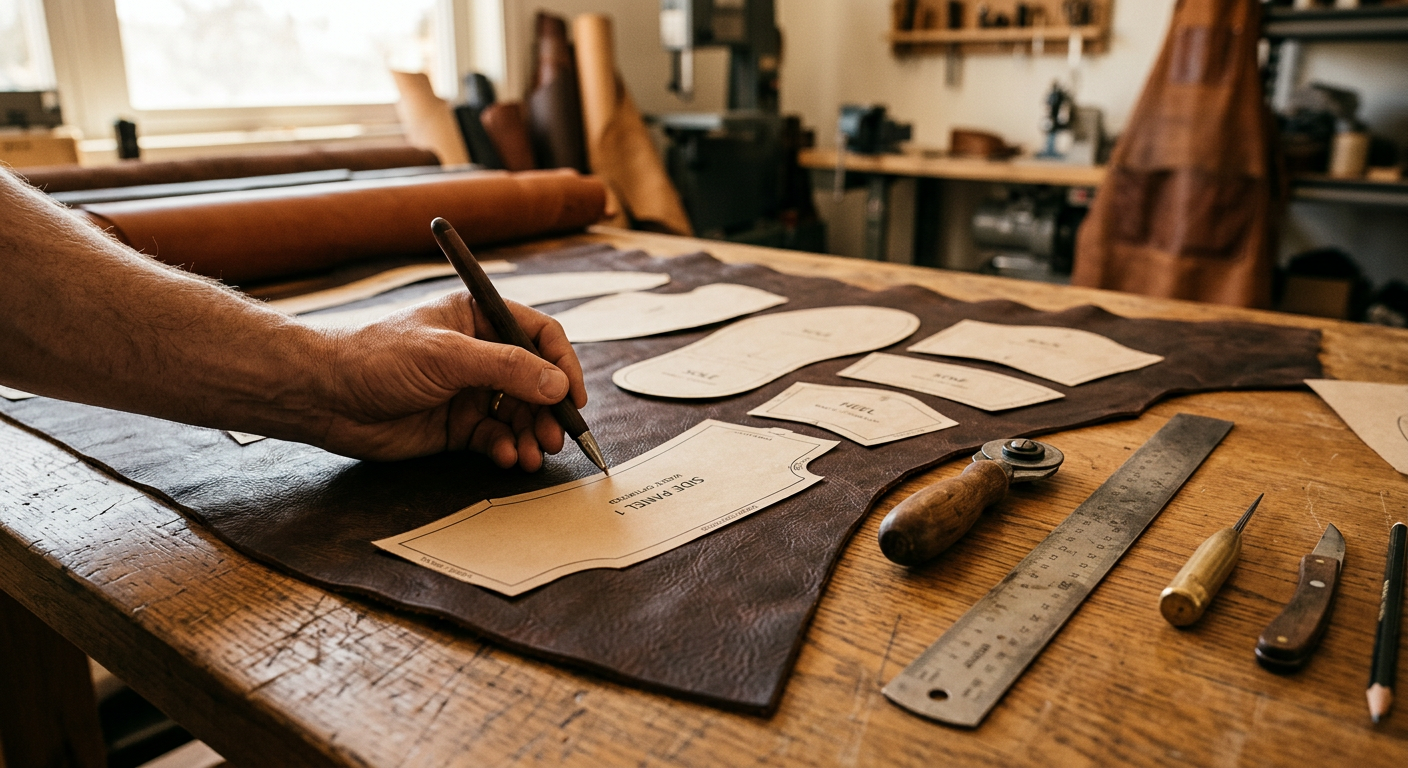
Discover how seemingly small design choices can inflate your manufacturing costs. We break down common leather product design mistakes and offer practical fixes to optimize your products for production, saving you time and money.
The buyer's problem
As a brand founder or sourcing manager, your goal is to bring a product to market that is both desirable to your customers and profitable for your business. You have a vision, a design, and a target cost price. The challenge arises when that initial design, which looks perfect on paper, results in a manufacturing quote that far exceeds your budget. This disconnect between design intent and production reality is a common hurdle that can delay launches, shrink margins, and even render a product line unviable.
Choosing the right manufacturing partner is not just about finding the lowest price; it's about finding a partner who can translate your design into a physical product efficiently and cost-effectively. Missteps in the early design phase are the single biggest contributor to budget overruns. Understanding these potential pitfalls before you even request a quote is crucial for a smooth production run. This is where a factory's experience becomes your greatest asset, helping you navigate the technical nuances that separate a good design from a producible, profitable one.
What "leather product design mistakes" actually means in a factory
On the factory floor, the term leather product design mistakes doesn't refer to poor aesthetics or a lack of creativity. It refers to design choices that are inefficient to produce at scale. These are features that dramatically increase material consumption, labour hours, or the need for specialised, time-consuming processes. What might be a simple detail on a CAD drawing can translate to hundreds of extra hours and significant material waste over a production run of several hundred units.
For example, a bag designed with numerous small, external panels might look distinctive, but it creates significant problems for our cutting department. It drastically reduces 'yield'—the usable amount of leather from a single hide—as cutters must work around the natural imperfections of the skin to find flawless sections for each small piece. This increases waste and the total amount of leather required. Similarly, designs with extremely tight curves on thick, 4mm bridle leather are difficult to stitch cleanly and consistently, leading to a higher rejection rate and slower production speeds. Every extra seam, every complex corner, and every non-standard hardware attachment adds seconds, and therefore cost, to each unit produced.
Materials, specs and standards
Your technical specifications (tech pack) are the blueprint for your product, and the choices within it directly dictate the final cost. The type of leather is the most obvious factor. A full-grain aniline-dyed cowhide will be more expensive and show more natural character (and potential 'unusable' areas) than a corrected-grain, pigmented split leather. But the impact goes deeper, into construction standards and tolerances.
At TAT Manufacture, we work to precise standards, but these can be adjusted based on your design and price point. A design that demands unnecessarily tight tolerances can increase the quality control burden and rejection rate. For instance, insisting on a stitch count of 10 stitches-per-inch (SPI) on a thick, oily pull-up leather might be counterproductive, whereas 6-7 SPI would be stronger and more appropriate for the material. Understanding these trade-offs is key. We pride ourselves on the depth of our experience, as detailed in our 25-year history about us, and we use that knowledge to guide our partners. Below is a table outlining some typical standards and how they can be adapted.
| Specification | Standard Range | Cost Impact of Higher Spec | Factory Note |
|---|---|---|---|
| Stitch Per Inch (SPI) | 6-10 | High | Higher SPI requires more time and can weaken certain leathers. |
| Panel Dimension Tolerance | +/- 1.5mm | Medium | Tighter tolerances require more precise cutting and QC checks. |
| Edge Paint Layers | 3-5 | High | Each layer requires application, drying, and sanding time, increasing labour. |
| Material Yield Target | 75-85% | N/A | Designs with large, simple panels achieve higher yield and lower material cost. |
| Hardware Finish | Standard (Nickel, Brass) | High (for custom) | Custom plating or moulding requires significant tooling costs and higher MOQs. |
| Reinforcement Materials | Texon, Bontex | Medium | Adding reinforcements increases durability but adds cutting and lamination steps. |
| HTS Code Example | 4202.21 (Handbags) | N/A | Correct classification is vital for customs; complexity can affect this. |
Our process, step by step
Transparency is essential for building trust. We want you to understand exactly how we take your design from a concept to a shipment leaving the port. Our process is structured to catch potential issues early, particularly the leather product design mistakes that add cost, ensuring the final product meets your quality and budget expectations.
- Enquiry & Tech Pack Review: You send us your technical pack or detailed reference images. Our team reviews every detail, looking for potential production challenges or cost-saving opportunities.
- Initial Quotation: Within 24-48 hours, we provide an initial FOB quote based on the design, specified materials, and order quantity. We will highlight any design features we believe are driving up the cost.
- Sample Development: Upon agreement, we move to sampling. This critical stage takes 10-14 days. We create a physical sample for your approval, allowing you to assess the quality, feel the materials, and test the functionality.
- Buyer Feedback & Revisions: You review the sample. This is the moment to make adjustments. We provide our feedback on how any requested changes will affect the unit price and lead time.
- Order Confirmation & Deposit: Once the sample is approved, you confirm the bulk order and wire the deposit (typically 50%). This allows us to procure all the necessary raw materials in bulk.
- Bulk Production: Our production lines begin their work: clicking (cutting), skiving, splitting, stitching, and assembling your products. This phase typically takes between 25 and 45 days, depending on complexity and quantity.
- In-Line Quality Control: We don't wait until the end to check for quality. Our supervisors perform checks at every stage of production—after cutting, post-stitching, and before final assembly—to ensure consistency and catch any errors immediately.
- Finishing & Final QC: Products undergo final finishing, which includes edge painting, polishing, hardware checking, and cleaning. A final, rigorous quality control inspection is performed on a percentage of the run based on AQL standards.
- Packing & Boxing: Each item is individually packed according to your specifications (e.g., poly bags, dust bags, barcodes) and then placed into export-grade cartons.
- Final Payment & Shipment: We provide you with a packing list and final invoice. Upon receipt of the balance payment, we manage the logistics to deliver the shipment to the port for departure, under FOB Chattogram terms.
MOQs, lead times and pricing signals
Understanding the key operational numbers of a factory is vital for planning your inventory and cash flow. Our Minimum Order Quantity (MOQ) is 50 pieces per style/colour. This number isn't arbitrary; it represents the minimum batch size required to make a production run efficient. Setting up cutting dies, calibrating stitching machines, and dedicating a production team to a specific style involves fixed setup costs. Spreading that cost over 50 units allows us to offer a competitive price. For orders below this, the per-unit cost would become prohibitively high.
Our lead times are predictable:
- Sampling: 10-14 days
- Bulk Production: 25-45 days after sample approval and deposit receipt.
The 25-45 day production window depends almost entirely on design complexity. A simple, die-cut leather wallet with minimal stitching will be closer to 25 days. A complex leather jacket with a quilted lining, multiple pockets, and custom hardware may take the full 45 days. This is a direct consequence of the labour hours required for each unit.
When you submit a design, we look for key pricing signals. These are the elements that have the largest impact on the final FOB Chattogram price. The most significant are:
- Material Choice: The cost difference between lambskin and vegetable-tanned cowhide is substantial.
- Component Count: More individual pieces mean more cutting time, more stitching, and lower material yield.
- Stitching Complexity: Are there decorative stitches, tight curves, or internal seams that are difficult to access?
- Hardware: Stock zippers, rivets, and buckles are affordable. Custom-moulded hardware with a brand logo carries tooling charges and higher MOQs from the hardware supplier.
Being aware of these signals allows you to make informed trade-offs during the design phase.
Common mistakes buyers make
Over our 25 years in business, we've seen brilliant designs that were simply not viable for production without modification. Here are some of the most frequent leather product design mistakes we encounter, along with our recommended solutions.
- Mistake: Over-complicating for the sake of it. Adding non-functional straps, excessive panels, or decorative-only hardware that requires extra assembly steps. Every step adds labour cost.
- Fix: Scrutinise every element of your design and ask, "Does this serve a functional or critical aesthetic purpose?" Often, simplifying a pattern can reduce cost without compromising the core design.
- Mistake: Not considering material yield. Designing a large tote bag where the main body panels are just slightly wider than half the width of a standard hide. This can mean only one main panel can be cut per hide, creating massive waste.
- Fix: Ask us for the standard dimensions of the hides you wish to use. Designing your largest pattern pieces to fit efficiently within these dimensions can reduce material costs by 10-20%.
- Mistake: Specifying non-standard hardware late in the process. A buyer approves a sample with our stock buckle but then requests a custom-branded buckle for the bulk run, not realizing this requires a 6-week tooling and production process from a third-party supplier, delaying the entire project.
- Fix: Finalise all hardware choices during the initial design and quotation phase. We can source from our extensive supplier network or use our in-stock options, but custom parts must be factored into the timeline from day one.
- Mistake: Ignoring the properties of the chosen leather. Designing a very structured, rigid bag using soft, pliable lambskin, which will not hold its shape without extensive and expensive internal reinforcements.
- Fix: Design for the material. Or, let the material inform the design. We can advise on which leathers are best suited for structured, soft, or rugged applications, like those seen in our custom projects.
- Mistake: Providing an incomplete or ambiguous tech pack. Tech packs that miss key dimensions, lack stitching details, or use vague terms like "high-quality zipper" leave too much to interpretation, leading to incorrect samples and delays.
- Fix: Create a comprehensive tech pack. Specify everything: dimensions, material type and thickness, SPI, edge finishing, hardware models and finishes. The more detail you provide, the faster and more accurately we can quote and sample. Our buyer FAQ has more on this.
Ready to move from research to samples? Send us your tech-pack or reference image and we'll come back within 24 hours with materials, MOQ and an FOB quote. Request a quote →
How to evaluate a supplier for this
When you are comparing potential factories, you need to assess not just their price, but their ability to be a true production partner. A good manufacturer will actively help you avoid costly design mistakes. As you vet suppliers, use this checklist:
- Do they ask clarifying questions? A good sign is a factory that comes back with questions about your tech pack. It shows they are scrutinising the design for production feasibility, not just calculating a price based on assumptions.
- Do they proactively suggest optimisations? A great partner will say, "We can make it exactly as specified, but if you are open to rounding this corner slightly or consolidating these two panels, we can reduce the unit cost by X." This demonstrates a collaborative, problem-solving mindset.
- Are they transparent about their capabilities? Ask about their machinery. Do they have splitting and skiving machines? What kind of sewing machines do they use (e.g., post-bed, cylinder-arm)? A factory that is proud of its equipment, as seen in our gallery, is likely well-equipped to handle complex work.
- Is their sampling process collaborative? The sampling phase should be a dialogue. They should provide feedback on the physical sample and explain why certain things are difficult or expensive to achieve.
- Do they provide a detailed quotation? A quote should break down the major costs where possible (or at least be based on a clear understanding of materials, labour, and hardware) rather than just being a single number. This shows they have done their homework.
- Can they explain why your design costs what it does? They should be able to point to the specific features—the high component count, the complex stitching, the expensive hardware—that are driving the cost. This empowers you to make informed revisions.
Case snapshot
A German retail brand approached us to manufacture a new style of leather backpack for their SS22 collection. Their initial design was ambitious, featuring an intricate woven front panel, 12 separate zippered compartments, and custom-cast zinc alloy hardware. Our initial FOB quote, while accurate for the labour involved, was 30% above their target cost. Instead of simply declining the project, we initiated a design consultation. We proposed replacing the hand-woven panel with an embossed pattern that mimicked the look at a fraction of the labour cost. We also worked with them to consolidate several internal pockets, reducing the design from 45 total pattern pieces to 32. Finally, we sourced a stock hardware set from a premium supplier that matched their aesthetic without requiring a custom mould. These changes, made before the first physical sample, brought the unit cost down by 22%, right into their target range. The brand placed an initial order for 300 units. We completed sampling in 12 days and shipped the full order from Chattogram 40 days after approval, enabling a successful and profitable product launch for the client.
Frequently asked questions
How much does my choice of leather affect the final price?
It is one of the biggest factors. A product made from Italian full-grain vegetable-tanned leather can be 2-3 times more expensive than the same product made from a standard Indian or Pakistani chrome-tanned corrected-grain leather. This is due to the raw material cost, the yield (less wastage from higher quality hides), and the tanning process itself. We can source a wide range of leathers to fit your target price point.
Can you help me source custom-branded hardware?
Yes, absolutely. We have relationships with numerous hardware suppliers. However, be aware that custom hardware (e.g., buckles, zipper pulls with your logo) involves a one-time mould fee (typically $300-$800 USD) and has its own MOQ, often 1,000 pieces or more. The lead time for producing custom hardware is also around 4-6 weeks, which needs to be factored into your overall project timeline.
What is the cost of a sample and is it refundable?
A sample is typically priced at 2x to 3x the projected bulk unit price, plus shipping. This covers the higher cost of labour for a single piece and the sourcing of small quantities of material. For most orders over our MOQ, we will credit the sample cost (excluding shipping) back against your bulk order deposit. This is our way of investing in a long-term partnership.
How do you handle Quality Control (QC) during production?
We have a multi-stage QC process. First, all raw materials are inspected upon arrival. Second, we have dedicated in-line QC personnel who check products at critical stages: after cutting, after main body assembly, and before final hardware is attached. Finally, a separate team performs a final inspection based on AQL 2.5 standards before packing. You are also welcome to hire a third-party inspection service to audit the goods before shipment.
What are your standard payment terms?
Our standard terms are a 50% deposit to confirm the order and begin material procurement, with the 50% balance due upon completion of production and prior to shipment. We will send you a final packing list and images of the finished goods when the balance payment is requested.
What do you need from me for an FOB shipment?
As we ship FOB (Free On Board) Chattogram, our responsibility ends once the goods are loaded onto the vessel. To facilitate this, we need your complete consignee (recipient) details, your freight forwarder's contact information in Bangladesh, and your desired port of destination. Our logistics team will coordinate with your forwarder to ensure a smooth handover.
Next step
Avoiding common leather product design mistakes is the most direct path to a profitable product and a healthy, long-term relationship with your manufacturer. By considering material yield, hardware choices, and construction complexity from the very beginning, you can ensure your vision is realised on time and on budget. When you're ready to move from theory to practice, our team is ready to review your design with a manufacturer's eye.
Send us your project details for a comprehensive quote or explore our catalogue of leather bags to see examples of production-optimised designs we have crafted for our global partners.
Ready to manufacture
Request a quote from TAT Manufacture
Full-grain leather, low MOQ from 50 pcs, OEM & private label. Get a detailed itemised quote within 24 hours.
25 years of leather manufacturing craftsmanship.
Services →OEM, private label, and custom leather production.