Sustainability
Common Communication Mistakes Between Brands and Manufacturers
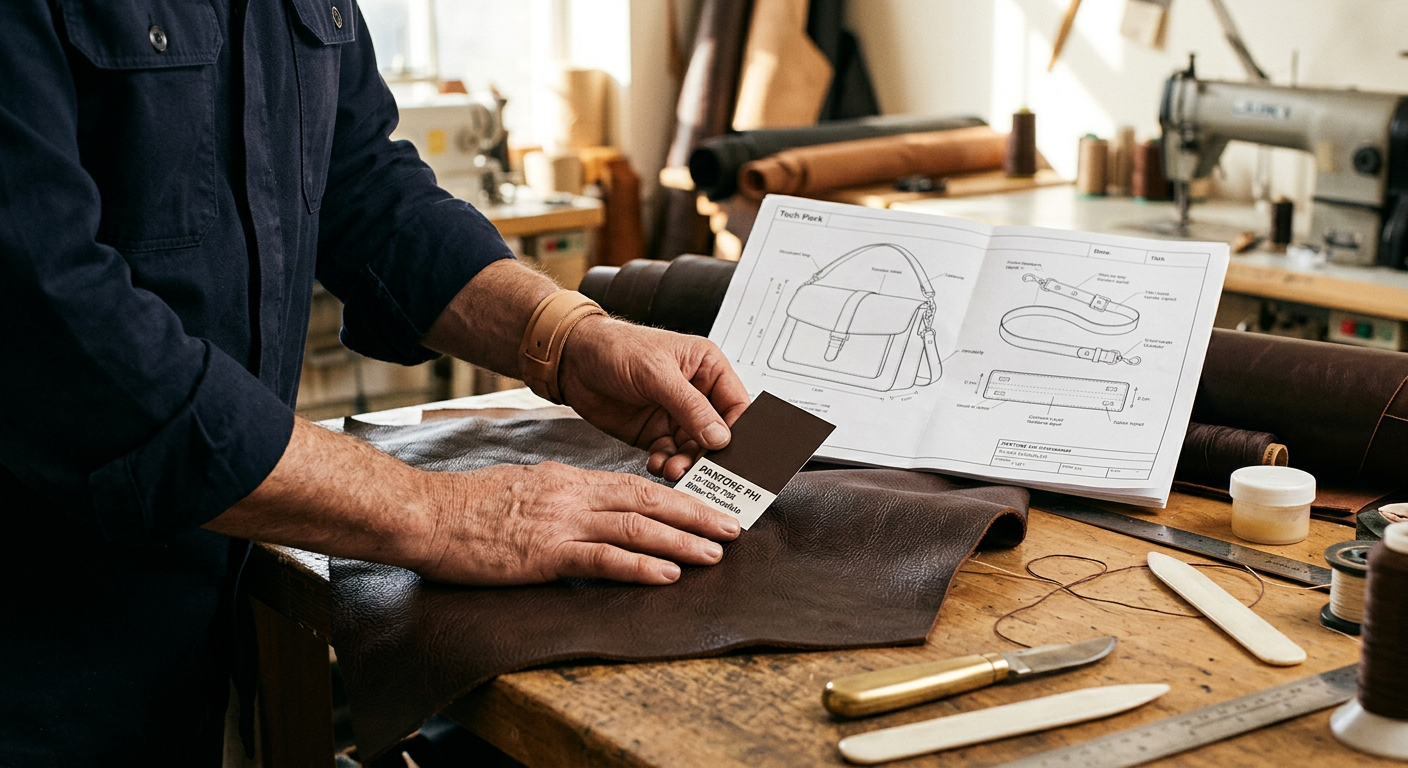
Poor factory communication leads to costly mistakes and delays. Learn how a detailed tech pack, clear specifications, and a structured sampling process prevent errors in your leather goods production.
The buyer's problem
For over 25 years, we have seen promising brands falter not because of poor design, but because of poor execution rooted in communication breakdowns. A simple misunderstanding between a brand and its manufacturer can cascade into costly delays, incorrect inventory, and ultimately, a damaged reputation with your customers. The financial risk is significant; capital is tied up in goods that cannot be sold, and the cost of remanufacturing or air-freighting replacements can erase your entire margin. These are the direct consequences of what we call manufacturer communication mistakes.
Choosing a manufacturing partner is therefore one of the most critical decisions a brand founder or sourcing manager will make. It extends far beyond a simple price comparison. The real value lies in a partner's ability to listen, interpret technical details accurately, and translate your vision into a physical product flawlessly, time and again. A robust communication framework is not a 'nice-to-have'; it is the central pillar of a successful, long-term manufacturing relationship that allows your brand to scale predictably and profitably.
What "manufacturer communication mistakes" actually means in a factory
On the factory floor, abstract terms in an email become concrete, expensive problems. When a buyer's instruction is ambiguous, our team has to either make an assumption—which is always a risk—or halt progress to ask for clarification, causing delays. The term manufacturer communication mistakes isn't about politeness; it's about the precision of technical instruction required to mobilise a production line of skilled artisans and machinery.
Consider this real-world example: A purchase order specifies "a large tote bag in dark brown leather with a gold logo." For our production manager, this raises immediate questions. How large? What are the exact dimensions? What kind of "dark brown"? Is it a pull-up leather, a corrected grain, a nubuck? We stock dozens of 'dark brown' leathers. Is the logo to be foil-stamped or a metal badge? If stamped, what size and placement? "Gold" hardware could mean polished brass, antique brass, or a specific plated finish. Each of these choices affects cost, lead time, and the final look of the product.
Without a detailed technical specification, or 'tech pack', a factory is forced to guess. A guess on the leather type could mean hundreds of square feet of the wrong material being cut. A guess on the logo placement could result in an entire batch of leather bags being embossed incorrectly, rendering the front panels useless. These aren't minor issues. They create waste, require re-ordering materials, and push back delivery dates. This is why our process is built around eliminating ambiguity before the first piece of leather is ever cut.
Materials, specs and standards
Precision begins with the tech pack. This document is the blueprint for your product and the single most important tool for avoiding communication errors. It should leave no room for interpretation. It details everything from the Harmonized System (HTS) code for customs (e.g., 4202.21 for handbags with an outer surface of leather) to the number of stitches per inch. Vague specifications are the primary source of production errors. A well-defined standard, conversely, is the primary source of quality and consistency.
At our factory, we work with brands to refine their specifications to a production-ready standard. We translate design intent into measurable factory-floor instructions. For example, instead of "strong thread," we would specify a thread size and material, such as Coats 'Astra' 75 TKT spun polyester. Instead of "nice lining," we would specify the material (e.g., 150D polyester or cotton twill), weight, and a Pantone colour code. This level of detail is essential. The table below illustrates how to transform ambiguous requests into clear, actionable specifications that prevent common manufacturer communication mistakes.
| Parameter | Vague Spec (The Mistake) | Clear Spec (The Solution) |
|---|---|---|
| Stitching Density | "Tight stitching" | "9-10 Stitches Per Inch (SPI)" |
| Leather Thickness | "Standard bag leather" | "Full-grain cowhide, drum-dyed, 1.4-1.6mm thickness" |
| Edge Finish | "Neat edges" | "Hand-painted with 3 coats of Fenice edge paint, sanded between coats, matte finish" |
| Logo Application | "Debossed logo on front" | "Heat deboss, 0.6mm depth, centred 4.5cm from top edge, 6cm wide" |
| Colour Matching | "As per the brown wallet" | "Match to Pantone 19-1111 TCX, lab dips required for approval" |
| Hardware Finish | "Gold-coloured metal" | "Antique Brass finish, must pass 48-hour salt spray test for corrosion" |
| Reinforcement | "Make the straps strong" | "Reinforce strap anchor points with 20x20mm non-woven textile insert" |
| Zipper Spec | "Good quality zip" | "YKK #5 metal zipper, antique brass finish, with custom logo puller as per drawing" |
Our process, step by step
Our production methodology is designed to systematically eliminate ambiguity and ensure the final product is exactly what you envisioned. We have honed this process over two decades of manufacturing for discerning global brands. It serves as a structured communication path from initial idea to final shipment.
- Enquiry and Quoting: You send us your enquiry, ideally with a tech pack or at least detailed drawings and reference images. Our merchandising team reviews the details and provides a comprehensive FOB quote within 24-48 hours. This quote will clearly state the assumed materials and construction.
- Tech Pack Analysis: Our technical team performs a deep dive into your specifications. We identify potential production issues, cost-saving opportunities, or durability enhancements. We might suggest a different construction for a strap or a more suitable lining material, explaining our reasoning. This is a collaborative dialogue, not just a transaction.
- Material Sourcing and Confirmation: Based on the tech pack, we source the exact leather, hardware, and other materials. We then courier physical swatches to you for touch-and-feel approval. Digital photos are insufficient for confirming colour and texture; physical approval is mandatory to proceed.
- Pre-Production Sample (PPS) Creation: Once materials are approved, we create a single, perfect sample. This PPS is the 'master' product and the physical contract for what we will produce in bulk. This typically takes 10-14 days. It is a crucial step in our Custom / OEM / private-label programme.
- Sample Review and Finalisation: You receive and inspect the PPS. You can provide feedback for revisions. We will not proceed to bulk production until you have signed off on the PPS in writing. Any requested changes are documented and confirmed, sometimes requiring a second revised sample.
- Order Confirmation and Deposit: With the PPS approved, you place your bulk purchase order and we issue a pro-forma invoice. Production is scheduled upon receipt of a 50% advance deposit.
- Mass Production and In-Line QC: The approved PPS and tech pack are handed to our production manager, who briefs the line supervisors. We conduct quality control checks at multiple stages: we inspect all leather hides before cutting, check component parts before assembly, and have supervisors monitor the stitching lines. This 'in-line' QC catches any deviations early.
- Final Quality Control: Every single finished item undergoes a final, rigorous inspection based on a detailed checklist derived from your tech pack and the approved PPS. We check stitching, dimensions, hardware function, cleanliness, and overall construction.
- Packing and Logistics: Products are packed according to your specifications (e.g., individual polybags, stuffing, carton size and markings). We prepare all necessary export documentation for shipment FOB Chattogram Port, Bangladesh.
- Final Payment and Dispatch: We share a final packing list and inspection report. Upon receipt of the remaining 50% balance payment, we transport the container to the port and hand it over to your designated freight forwarder.
MOQs, lead times and pricing signals
Transparency on commercial terms is as important as technical clarity. Unclear expectations around pricing and timelines are a common source of friction. Here are our standard terms, which provide a reliable baseline for your planning.
Our Minimum Order Quantity (MOQ) is 50 pieces per style, per colour. This is a competitive MOQ that allows emerging brands and established retailers alike to test new designs like leather jackets or accessories without committing to thousands of units. For some products like leather belts, we can sometimes offer flexibility on splitting the MOQ across different sizes, but not typically across different leather colours due to the minimum hide purchases required from our tanneries.
Lead times are a critical factor for your seasonal planning:
- Sampling: 10-14 days from the moment all materials are confirmed and in our factory.
- Mass Production: 25-45 days, commencing from the date of your PPS approval and deposit payment. The exact time depends on the complexity of the product, the order quantity, and our production schedule at the time of order.
Our pricing is quoted as FOB Chattogram (Chittagong), Bangladesh. 'Free On Board' means our price includes manufacturing the product to your specification, packing it, and delivering it to the vessel at Chattogram Port. From that point forward, the buyer is responsible for arranging and paying for ocean/air freight, insurance, and any import duties or taxes in the destination country. We provide accurate carton dimensions and weights as soon as production is complete, enabling you to get precise quotes from your freight forwarder and calculate your final landed cost.
Common mistakes buyers make
Over the years, we've observed recurring patterns in communication that lead to problems. By being aware of these, you can proactively ensure a smoother production process with any manufacturer. The most damaging manufacturer communication mistakes are often the simplest to avoid.
Providing Only Reference Photos: A photo shows intent but not instruction. It doesn't specify dimensions, material thickness, internal pocket configuration, or stitch type.
- The Fix: Always provide a technical pack (tech pack). If you don't have one, invest in getting one made or work with a factory like us that can help you develop one based on your design. It is the single best investment you can make in your product.
Using Ambiguous Language: Terms like "premium feel," "darker shade," or "make it stronger" are subjective and unhelpful on a factory floor.
- The Fix: Quantify everything. Use Pantone TCX codes for colours. Specify dimensions in centimetres or inches. Define strength by requesting specific reinforcements or material weights. Reference the table in the 'Materials' section above.
Changing Specifications Mid-Production: Requesting changes after a production run has started is one of the most disruptive and costly mistakes. It can force a complete halt, require re-sourcing materials, and lead to extensive rework.
- The Fix: Treat the Pre-Production Sample (PPS) as the final word. Scrutinise it thoroughly. This is your last, best chance to make changes. Once you approve it, consider the design locked.
Ignoring Shipping and Duties: Many first-time buyers are surprised by the final landed cost because they only focused on the FOB unit price.
- The Fix: Contact a freight forwarder early in the process. Provide them with our estimated carton dimensions and weight to get a quote for shipping, insurance, and customs clearance fees. This gives you a true picture of your cost per unit.
Assuming 'Common Knowledge': Do not assume a factory knows your specific market's quality expectations or a 'standard' way of doing something.
- The Fix: Be explicit about your quality standards. What is an acceptable blemish? What is not? Provide a 'boundary sample' or a 'gold standard' product from another brand to illustrate the finish and quality level you expect to achieve.
Not Asking Questions: A good manufacturer welcomes questions. A lack of questions often indicates a lack of engagement from the buyer, which can be risky.
- The Fix: Ask why a certain construction is recommended. Ask about material limitations. Ask for progress updates. An engaged buyer helps create a better product. Our detailed FAQ page answers many preliminary questions.
How to evaluate a supplier for this
When you are comparing potential manufacturing partners, you are not just buying a product; you are buying a process. You need to evaluate their communication protocol as much as their price or perceived quality. A supplier who communicates well is a partner who will protect your investment.
Use this checklist during your vetting process:
- Response to your Initial Enquiry: Do they just send a price, or do they ask clarifying questions about your design? A good partner will immediately begin to probe for the missing details. Their questions reveal their experience.
- Sample Process: Do they have a formal, multi-step sampling process that requires your sign-off? Ask them to walk you through it. A factory without a rigid sampling protocol is a major red flag.
- Technical Capability: Ask them if they can help develop or refine a tech pack. A vertically integrated partner who can assist with the technical design phase is invaluable. You can learn more about our capabilities on our About page.
- Communication Point of Contact: Who will you be speaking with? Is it a salesperson with limited technical knowledge or a dedicated merchandiser or account manager who understands production and can communicate directly with the factory floor?
- Proactive Updates: Ask them how they communicate during production. Do they provide weekly progress reports? Will they send photos from the production line? Predictable updates prevent nervous follow-ups.
- Quality Control Documentation: Ask to see a blank copy of their final QC checklist. What specific points do they inspect on a product similar to yours? This demonstrates how they translate your standards into an actionable inspection process.
Ready to move from research to samples? Send us your tech-pack or reference image and we'll come back within 24 hours with materials, MOQ and an FOB quote. Request a quote →
Case snapshot
A promising start-up from the United Kingdom approached us after a disastrous first production run with another supplier. They had ordered 500 units of a custom leather backpack, but due to poor communication, the entire shipment arrived with the shoulder strap anchor points set too low, compromising the bag's ergonomics and appearance. The lining was also a different shade of navy than specified. They had lost significant capital and six months of market time. Their trust was broken. When they contacted us, their primary concern was reliability, not just price. We addressed this by first creating detailed technical counter-drawings of their backpack, explicitly marking the strap placement with precise measurements for their sign-off. We then sent physical swatches of three different navy cotton linings so they could approve the exact colour and feel. The pre-production sample was approved without changes. The final order for 500 backpacks was produced in 38 days and shipped FOB Chattogram. The client reported that the bulk production was 'pixel perfect' against the approved sample, restoring their confidence in offshore manufacturing. They have since become a regular client, adding a line of leather wallets to their collection.
Frequently asked questions
How does pricing work for custom orders?
Pricing for any custom product is a direct calculation based on four key factors: the cost of the leather and other raw materials, the amount of skilled labour required (complexity of construction), the cost of hardware and branding elements, and the order volume. This is why a detailed tech pack is so important. It allows us to calculate these costs accurately and provide a firm, reliable FOB quote. A vague enquiry will only ever receive a vague and unreliable price estimate.
What is your MOQ and can it be split?
Our standard MOQ is 50 pieces per style and per colour. This is the minimum we can efficiently run on a production line and the minimum order for which we can procure custom-dyed leather from our tannery partners. For products like belts, we can often split this 50-piece MOQ across a range of sizes (e.g., S, M, L, XL), but we generally cannot split the MOQ for a single style across multiple leather colours or major design variations.
How much do samples cost?
Pre-production samples are typically charged at 2x to 3x the projected bulk unit price. This is not a profit centre for us; it reflects the much higher cost of making a single item. It involves our senior pattern maker's time, sourcing small quantities of specific materials, and allocating a specialised sample artisan. For established clients or large orders, this sample fee is often waived or credited back against the deposit for the bulk production order.
What are the shipping terms and what's my total landed cost?
We ship on FOB Chattogram Port, Bangladesh terms. Our quoted price covers all costs to get your finished, packed goods onto the ship at our local port. You (the buyer) are then responsible for the subsequent costs: ocean or air freight, cargo insurance, import duties, VAT/GST, and local delivery in your country. To calculate your true 'landed cost' per unit, you must add these costs to our FOB price. We will always provide the total carton count, dimensions, and gross weight of your shipment so your freight forwarder can give you an accurate quote.
Can I customise every aspect of a product?
Yes, absolutely. This is the foundation of our business as an OEM/private label manufacturer. Through our custom programme, you have control over every detail: the type and grade of leather, the lining fabric and colour, the hardware material and finish, the thread colour, all dimensions, the pocket layout, and all branding applications (debossing, foil stamping, woven labels, metal plates). We exist to build your product to your exact specification.
How do you ensure consistent quality across a 500-piece order?
Consistency is achieved through a system, not by chance. It starts with the approved Pre-Production Sample (PPS), which becomes the physical benchmark for the entire order. Our quality assurance process involves three key stages: 1) Raw Material Inspection (checking all leather and hardware upon arrival), 2) In-Line QC (supervisors check products at key assembly stages, comparing them against the PPS), and 3) 100% Final Inspection (every single finished item is individually checked against a detailed list of quality criteria before being packed).
Next step
Effective, precise communication is the bedrock of a successful and profitable manufacturing partnership. It mitigates risk, ensures quality, and allows your brand to grow with confidence. If our structured, transparent approach to production aligns with your needs, the next step is to start a direct conversation about your product.
Let us review your design and demonstrate how our process can bring it to life. Request a quote to send us your tech pack, or explore our extensive catalogue of customisable leather goods to see the calibre of our craftsmanship.
Ready to manufacture
Request a quote from TAT Manufacture
Full-grain leather, low MOQ from 50 pcs, OEM & private label. Get a detailed itemised quote within 24 hours.
25 years of leather manufacturing craftsmanship.
Services →OEM, private label, and custom leather production.